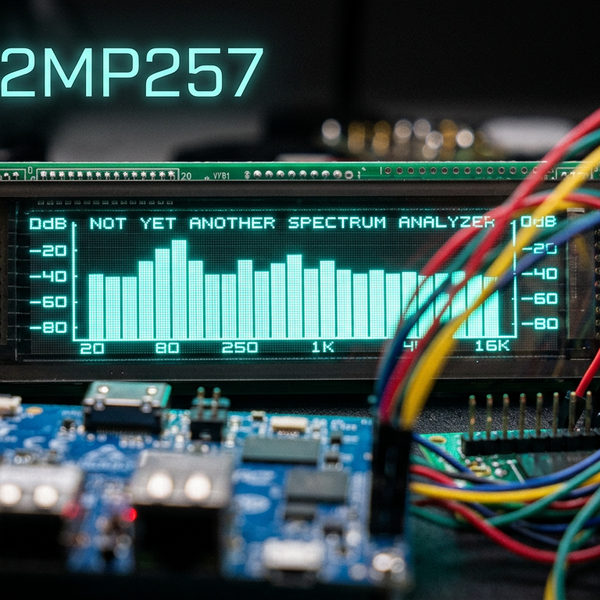
An audio spectrum analyzer using an STM32MP257 running Linux for audio capture and 8192-point FFT processing, paired with a bare-metal Cortex-M33 core driving a Noritake VFD via a parallel interface.
We stock the boards, sensors and modules this project needs. A full parts list is coming soon — for now, browse our DIY Kits & components or search for Analog / Discrete parts.
This project is sourced from another site, not written by us — this list is our best match of their components against what we stock, not a verified bill of materials. Always check the original blog (linked above) for the actual parts list before buying.
This audio spectrum analyzer splits heavy computational workloads across the heterogeneous architecture of the STM32MP257 development board. The microprocessor's Linux-based core handles system-level tasks, audio capture, and a high-resolution 8192-point Fast Fourier Transform (FFT) algorithm written in C++ to mathematically decompose incoming audio signals into discrete frequency bins. Meanwhile, OpenAMP and RPMsg drivers facilitate inter-processor communication, passing the processed frequency data securely from the Linux environment to the microcontroller core. On the receiving end, a bare-metal firmware running on the Cortex-M33 coprocessor takes over real-time peripheral control. It drives the Noritake GU256X64D-3900B Vacuum Fluorescent Display (VFD) via a high-speed parallel interface, translating the frequency spectrum values into a glowing, retro-styled visual representation across the 256x64 pixel grid.
Why Build This
Integrate heterogeneous multi-core processing by coordinating a Linux-running application processor with a bare-metal real-time coprocessor.
Implement high-resolution digital signal processing algorithms like an 8192-point FFT on embedded hardware.
Interface complex vintage-style display hardware like a high-resolution parallel VFD with modern microcontrollers.
Real-World Application
Retro-styled audio visualization for home stereos, custom audio equipment, and music gear.
Skills You'll Learn
Heterogeneous multiprocessing
Inter-processor communication
Linux OpenAMP and RPMsg drivers
Fast Fourier Transform implementation
Bare-metal firmware development
Parallel display interfacing
C++ embedded software design
Safety Precautions
No specific precautions noted for this build — always follow general electronics safety practices.
Technology Tags
STM32MP257
VFD
AUDIO SPECTRUM ANALYZER
FFT
DSP
LINUX
CORTEX-A35
CORTEX-M33
RPMSG
OPENAMP
C++
BARE-METAL
Frequently Asked Questions
Splitting the tasks allows the Linux side to handle heavy floating-point math and data acquisition, while the dedicated Cortex-M33 core ensures deterministic, low-latency timing required to drive the parallel VFD interface without visual flicker.
OpenAMP and RPMsg provide the standardized messaging framework that allows the Linux application running on the main processor to safely and efficiently pass processed audio spectrum data to the bare-metal M33 coprocessor.
Direct substitution is not trivial because the system architecture and bare-metal firmware are specifically written to target the exact parallel interface and timing constraints of the 256x64 Noritake display.
Gallery
This page is part of Kitkraft's Project Hub — a curated collection of electronics & robotics projects gathered from the maker community to help students and hobbyists discover and learn to build. Kitkraft does not claim authorship of the original project, and makes no representation as to the accuracy, completeness or safety of third-party source material. The summary and "How It Works" explanation above are AI-generated, rewritten with reference to the original tutorial — not a reproduction of it. Full credit and a direct link to the original source are provided above. If you're the original creator and have a concern about how your work is represented here, please contact us and we'll address it promptly.
Kitkraft Project Hub — curated from the maker community, credited at the source.