This project is sourced from another site, not written by us — this list is our best match of their components against what we stock, not a verified bill of materials. Always check the original blog (linked above) for the actual parts list before buying.
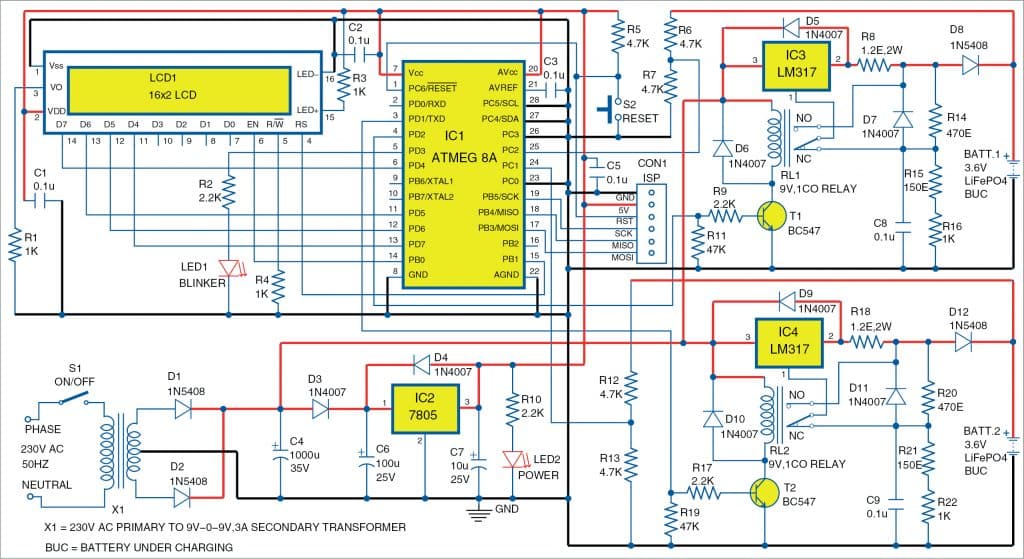
The Automatic LiFePO4 Cell Charger is an intelligent power management system designed to safely and efficiently charge lithium iron phosphate battery cells using a multi-stage charging profile. At the heart of the circuit is an ATmega8A microcontroller, which continuously monitors charging parameters and orchestrates the charging states. The system steps down AC mains voltage using a transformer, after which the power is regulated and conditioned. A 7805 voltage regulator provides a stable 5V DC supply for the ATmega8A microcontroller and the 16x2 LCD display, ensuring reliable digital logic and real-time visual feedback of system status and voltage levels. Meanwhile, two LM317 adjustable voltage regulators are utilized to precisely control the charging current and voltage delivered to the battery. The microcontroller interfaces with two single-changeover relays to automatically switch between constant-current and constant-voltage charging phases, or disconnect the battery when fully charged. LEDs provide immediate visual indicators for operational states, while various passive components such as resistors and capacitors ensure signal integrity, filter power supply noise, and set stabilization feedback loops around the active regulators. Developed using AVR Studio 4, the firmware governs the automated decision-making process, ensuring the LiFePO4 cell is charged safely within its strict electrochemical thresholds without risk of overcharging.
Why Build This
Design and implement advanced analog power regulation topologies using LM317 regulators controlled by digital microcontrollers.
Develop embedded C firmware in AVR Studio 4 to manage real-time feedback loops, sensor monitoring, and display logic for battery management systems.
Fabricate practical power electronics hardware suitable for solar energy storage, portable electronics, and electric vehicle prototyping.
Real-World Application
Charging LiFePO4 battery cells safely for portable electronics, solar setups, and electric vehicle battery packs.
Skills You'll Learn
Linear voltage regulation
relay switching control
analog-to-digital monitoring
microcontroller firmware development
power supply filtering design
LCD interface integration
Safety Precautions
Exercise caution when working with AC mains voltage connected to the transformer primary and ensure proper battery polarity during connection.
Technology Tags
ATMEGA8A
LM317
LIFEPO4
BATTERY CHARGER
MICROCONTROLLER
C PROGRAMMING
AVR STUDIO
Frequently Asked Questions
One LM317 is typically configured to regulate the constant current phase, while the second can be configured or assisted to manage the constant voltage phase required for safe LiFePO4 multi-stage charging.
While the LM317 circuits handle the heavy lifting of power regulation, the ATmega8A acts as the brain that monitors voltage levels, updates the 16x2 LCD, and triggers the relays to transition between charging modes or shut off upon completion.
No, LiFePO4 cells have a different nominal voltage (3.2V) and charge termination threshold compared to standard Li-Ion (3.6V/3.7V) cells, so the firmware and voltage thresholds would need substantial recalibration.
Gallery
This page is part of Kitkraft's Project Hub — a curated collection of electronics & robotics projects gathered from the maker community to help students and hobbyists discover and learn to build. Kitkraft does not claim authorship of the original project, and makes no representation as to the accuracy, completeness or safety of third-party source material. The summary and "How It Works" explanation above are AI-generated, rewritten with reference to the original tutorial — not a reproduction of it. Full credit and a direct link to the original source are provided above. If you're the original creator and have a concern about how your work is represented here, please contact us and we'll address it promptly.
 5V 1 Channel Relay Module
Rs. 87.00
 10pcs 5mm RED Diffused Light Emitting Diodes - LEDs Set
Rs. 39.00
 400 Points Mini Solderless Prototype PCB Breadboard High Quality
Rs. 89.00
 MB102 Adjustable Breadboard Power Supply Module (3.3V & 5V) for Arduino & Raspberry Pi
Rs. 139.00
 Jumper Wire 10 Pin Male To Male 20cm
Rs. 45.00
 Jumper Wire 10 Pin Male To Female 20cm
Rs. 45.00


