Batteryless E-Paper Displays and Energy Harvesting Methods
Project Hub
/Security Surveillance & Defense/RFID / NFC Access Systems/Batteryless E-Paper Displays and Energy Harvesting Methods
Advanced
OTHER CONTROLLER
Project Specific
6 – 12 Hours
Partial Kit
Batteryless E-Paper Displays and Energy Harvesting Methods
Explore how to create batteryless E-paper displays using energy harvesting methods like NFC, eliminating the need for traditional batteries by only requiring power during screen updates.
This project is sourced from another site, not written by us — this list is our best match of their components against what we stock, not a verified bill of materials. Always check the original blog (linked above) for the actual parts list before buying.
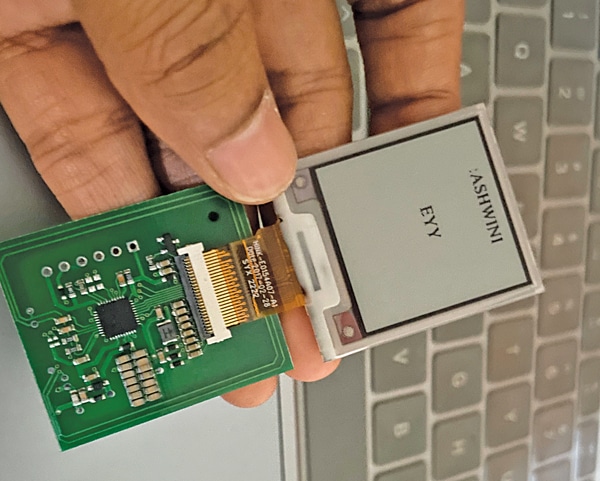
This advanced undergraduate-level engineering project demonstrates how to build a completely batteryless display system by combining NFC energy harvesting with an ultra-low-power electronic paper screen. At the heart of the hardware setup is the DENFC-M0 energy harvesting board, which captures radio frequency energy from a nearby NFC-enabled smartphone or dedicated NFC display writer device. When the smartphone or writer is brought into close proximity, the harvesting module intercepts the RF field and converts it into a localized electrical supply. This harvested energy temporarily powers the system controller and the connected GDEY0213B74 e-ink display. Firmware developed using the Keil IDE is deployed to the controller via an ST link emulator connector module, managing the initialization and screen data transmission over an SPI interface. The GDEY0213B74 display features a 250x122 resolution, an SSD1680Z driver IC, and supports a 1.5-second refresh rate along with 4-grayscale imaging. Because electronic paper (e-ink) is bistable—meaning it only consumes electrical power when the physical ink particles are actively being rearranged—the display retains its visual content indefinitely without drawing any standby current once the update cycle completes. This clever pairing of near-field power scavenging and reflective display technology completely removes the need for physical batteries, bulky wiring, or external power supplies, proving how passive electronics can drive sophisticated visual indicators entirely via inductive coupling during data updates.
Why Build This
Design zero-maintenance, battery-free smart business cards and digital ID badges that update instantly via an ordinary smartphone.
Prototype sustainable retail electronic shelf labels and market stall pricing tags that operate perpetually without battery replacements.
Explore cutting-edge RF energy harvesting techniques applicable to batteryless IoT sensor nodes and wearable electronics.
Real-World Application
Batteryless sensor nodes, low-power wearable devices, retail price tags in clothing stores and market stalls, marketing display screens, smart business cards, and digital ID cards.
Skills You'll Learn
NFC energy harvesting design
SPI communication protocol
e-ink display driver integration
low-power embedded firmware development in Keil
FPC connector handling
Safety Precautions
No specific precautions noted for this build — always follow general electronics safety practices.
Technology Tags
E-PAPER
E-INK
NFC
ENERGY HARVESTING
WIRELESS POWER
DISPLAY DRIVER
IOT
MICROCONTROLLER
PCB
SMT
Frequently Asked Questions
No, the entire point of the system is batteryless operation. The e-ink display is bistable, meaning it retains its visual state indefinitely without power after an update is completed.
Power is harvested wirelessly via the DENFC-M0 module when an NFC-enabled smartphone or NFC writer device is held close to the antenna field, generating just enough temporary voltage to update the screen.
You will need the Keil firmware development environment to write, compile, and flash the code to the system via the ST link emulator connector module.
Gallery
This page is part of Kitkraft's Project Hub — a curated collection of electronics & robotics projects gathered from the maker community to help students and hobbyists discover and learn to build. Kitkraft does not claim authorship of the original project, and makes no representation as to the accuracy, completeness or safety of third-party source material. The summary and "How It Works" explanation above are AI-generated, rewritten with reference to the original tutorial — not a reproduction of it. Full credit and a direct link to the original source are provided above. If you're the original creator and have a concern about how your work is represented here, please contact us and we'll address it promptly.
Kitkraft Project Hub — curated from the maker community, credited at the source.
 RFID Reader/Writer RC522 SPI S50 with RFID Card and Tag
Rs. 190.00
 400 Points Mini Solderless Prototype PCB Breadboard High Quality
Rs. 89.00
 MB102 Adjustable Breadboard Power Supply Module (3.3V & 5V) for Arduino & Raspberry Pi
Rs. 139.00
 Jumper Wire 10 Pin Male To Male 20cm
Rs. 45.00
 Jumper Wire 10 Pin Male To Female 20cm
Rs. 45.00


