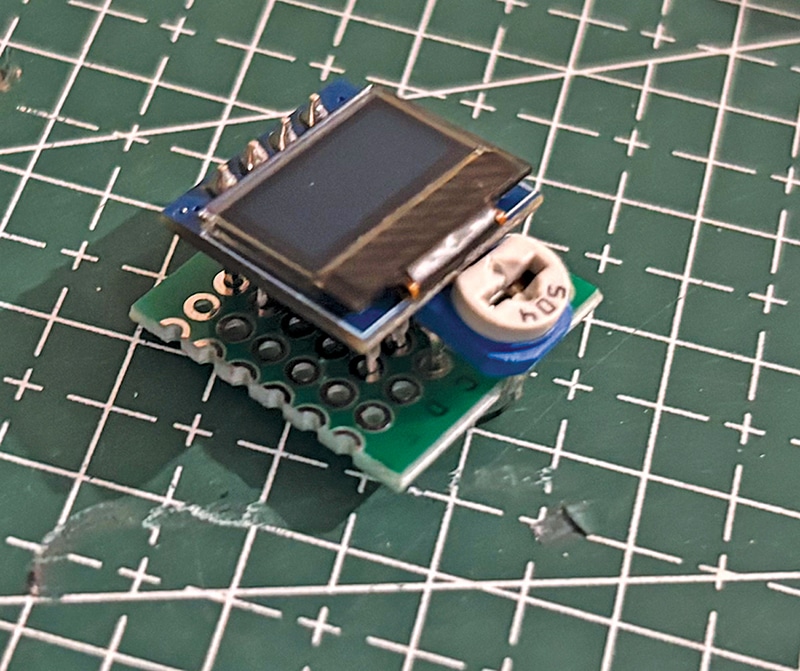
An ultra-compact, batteryless micro Game Boy built with an ATtiny85 and OLED display, powered entirely by energy harvested from a small solar cell and supercapacitor.
This project is sourced from another site, not written by us — this list is our best match of their components against what we stock, not a verified bill of materials. Always check the original blog (linked above) for the actual parts list before buying.
The Batteryless Gaming Console operates entirely on harvested light energy without relying on traditional chemical batteries. At the heart of the system is a small solar cell that generates electrical current when exposed to ambient light. This harvested energy passes through a 1N5817-TP Schottky diode, which prevents current from flowing backward from the storage element into the solar cell when light levels drop. The energy is then stored in a 2F, 2.7V supercapacitor, acting as an ultra-compact reservoir that smooths out power delivery. An ATtiny85 microcontroller draws its operating voltage from this supercapacitor to run the compiled game logic. User input is handled via a 10k potentiometer, allowing the player to interact with the software. Visual feedback is rendered on a tiny 0.49-inch SSD1315 OLED display connected to the microcontroller, displaying the game graphics in real time. Because the entire system relies strictly on transient solar power and capacitive storage, runtime depends directly on the balance between ambient light harvesting and the instantaneous power draw of the OLED screen and microcontroller.
Why Build This
Explore green electronics by building a functional gaming device that runs entirely on harvested light energy without traditional batteries.
Learn fundamental power management concepts by combining solar cells, Schottky diodes, and supercapacitors for energy storage.
Gain hands-on experience programming tiny microcontrollers like the ATtiny85 to drive compact I2C OLED displays.
Real-World Application
Portable pocket gaming devices, wearable tech, and ultra-low-power energy harvesting educational demonstrators.
Skills You'll Learn
Microcontroller programming
I2C display communication
energy harvesting circuit design
analog input reading with potentiometers
low-power system optimization
Safety Precautions
Flagged during content review — not in the original source
Supercapacitors can discharge very high currents rapidly if shorted; ensure proper polarity when handling the supercapacitor and solar cell to prevent component damage or minor thermal events.
Technology Tags
ATTINY85
SUPERCAPACITOR
SOLAR CELL
OLED DISPLAY
MICROCONTROLLER
RETRO GAMING
ENERGY HARVESTING
ULTRA-MINIATURISATION
Frequently Asked Questions
No, this circuit is specifically engineered for a 2.7V supercapacitor paired with a solar cell for direct energy harvesting and does not include proper lithium charging protection circuitry.
Because it relies on a 2F supercapacitor rather than a heavy battery, runtime in total darkness is usually quite short and depends heavily on the current drawn by the OLED screen and ATtiny85.
You will need an external AVR programmer or another Arduino board acting as an ISP programmer to transfer compiled code from the Arduino IDE directly to the ATtiny85 pins.
Gallery
This page is part of Kitkraft's Project Hub — a curated collection of electronics & robotics projects gathered from the maker community to help students and hobbyists discover and learn to build. Kitkraft does not claim authorship of the original project, and makes no representation as to the accuracy, completeness or safety of third-party source material. The summary and "How It Works" explanation above are AI-generated, rewritten with reference to the original tutorial — not a reproduction of it. Full credit and a direct link to the original source are provided above. If you're the original creator and have a concern about how your work is represented here, please contact us and we'll address it promptly.
Kitkraft Project Hub — curated from the maker community, credited at the source.
 0.96 Inch I2C/IIC 4pin OLED Display Module White
Rs. 349.00
 400 Points Mini Solderless Prototype PCB Breadboard High Quality
Rs. 89.00
 MB102 Adjustable Breadboard Power Supply Module (3.3V & 5V) for Arduino & Raspberry Pi
Rs. 139.00
 Jumper Wire 10 Pin Male To Male 20cm
Rs. 45.00
 Jumper Wire 10 Pin Male To Female 20cm
Rs. 45.00


