An article explaining and demonstrating batteryless and ultra-low-power energy harvesting systems designed to power wearables, IoT devices, and sensors using ambient energy.
We stock the boards, sensors and modules this project needs. A full parts list is coming soon — for now, browse our DIY Kits & components or search for Analog / Discrete parts.
This project is sourced from another site, not written by us — this list is our best match of their components against what we stock, not a verified bill of materials. Always check the original blog (linked above) for the actual parts list before buying.
We don't carry yet: Battery (generic / unspecified)
Capacitors
Header Pins / Terminals / Connectors
Supercap / UPS / Power Bank Module
Microcontroller IC (DIP) / Chip
LTC3588 module
Piezoelectric
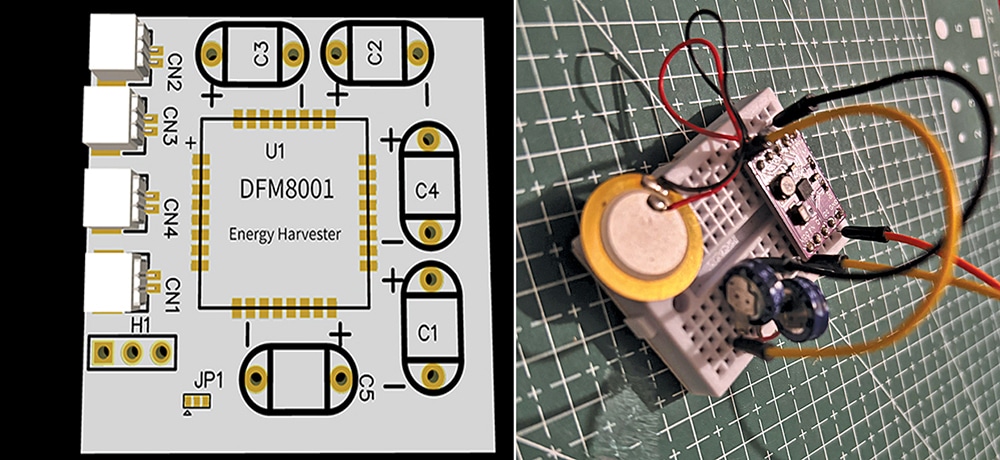
The Batteryless IoT Device is an energy-harvesting system designed to generate, regulate, and store electrical energy from ambient sources without relying on conventional disposable batteries. At the front end, a solar cell (PV1) and multiple piezoelectric elements (PZ1, PZ2, PZ3) capture light and mechanical vibrations from the environment, converting them into electrical signals. These transducers interface with the circuit via HC-1.0-2PWT connectors (CN1, CN2, CN3, CN4) and a 3-pin header (VGT H1). The harvested energy is then managed by specialized integrated circuits, namely the DFM8001 (U1) and the LTC3588 module (U2), which regulate the fluctuating input voltages and optimize power delivery. To maintain stable operation during intermittent energy harvesting, the system utilizes an extensive network of energy storage components. This includes a variety of supercapacitors—such as the HV0810-2R7105-R units (SC1, SC2, SC3), 10µF capacitors (C1, C2, C3), 1µF capacitors (C4, C5), and 5.5V 47µF capacitors (C6, C7, C8, C9)—which smooth out voltage ripples and store surplus charge. An optional 3.3V battery (BAT1) may also be integrated for supplementary backup power. Together, these analog and discrete components create a self-sustaining power architecture capable of driving low-power IoT electronics using only ambient environmental energy.
Why Build This
Design maintenance-free wearables, environmental sensors, and smart switches that operate indefinitely without battery replacements.
Gain hands-on engineering experience in harvesting ambient solar and mechanical energy using advanced power management ICs.
Master the integration of high-capacity supercapacitors and discrete analog circuits for stable ultra-low-power energy storage.
Real-World Application
Powering wearables, IoT devices, smart switches, remote controls, medical patches, and environmental sensors without relying on conventional disposable batteries.
Skills You'll Learn
Energy harvesting circuit design
power management IC integration
supercapacitor energy storage configuration
ambient solar and piezoelectric transducer interfacing
ultra-low-power system design
Safety Precautions
Flagged during content review — not in the original source
Ensure proper polarity when connecting supercapacitors (such as C6-C9 and SC1-SC3) and the 3.3V battery (BAT1) to prevent component damage, electrolyte leakage, or sudden thermal discharge.
Technology Tags
ENERGY HARVESTING
IOT
POWER MANAGEMENT
DFM8001
LTC3588
SUPERCAPACITORS
SOLAR CELLS
PIEZOELECTRIC
Frequently Asked Questions
Yes, the system is fundamentally designed as a batteryless energy-harvesting device that relies on ambient light, mechanical vibrations, and supercapacitor storage to function.
The various capacitance values (ranging from 1µF to 47µF, plus the HV0810-2R7105-R units) serve different roles in filtering high-frequency noise, decoupling power rails, and bulk energy storage to handle fluctuating power inputs from the solar cell and piezo elements.
They interface with the main board using the specified HC-1.0-2PWT connectors and the 3-pin header (VGT H1), routing the harvested signals directly into the power management integrated circuits (U1 and U2).
Gallery
This page is part of Kitkraft's Project Hub — a curated collection of electronics & robotics projects gathered from the maker community to help students and hobbyists discover and learn to build. Kitkraft does not claim authorship of the original project, and makes no representation as to the accuracy, completeness or safety of third-party source material. The summary and "How It Works" explanation above are AI-generated, rewritten with reference to the original tutorial — not a reproduction of it. Full credit and a direct link to the original source are provided above. If you're the original creator and have a concern about how your work is represented here, please contact us and we'll address it promptly.
Kitkraft Project Hub — curated from the maker community, credited at the source.