Project Hub/Healthcare Biomedical & Assistive/Bio-signal Acquisition (ECG/EMG/EEG)/BCI-Based Mind Controlled Computer Using Raspberry Pi
Advanced
RASPBERRY PI
Project Specific
6 – 12 Hours
BCI-Based Mind Controlled Computer Using Raspberry Pi
Create a Brain-Computer Interface (BCI) system using a Raspberry Pi to control computer mouse movements and clicks using brain waves and eye blinks.
Originally published by Ashwini Sinha on ElectronicsForU
View original tutorial
How It Works
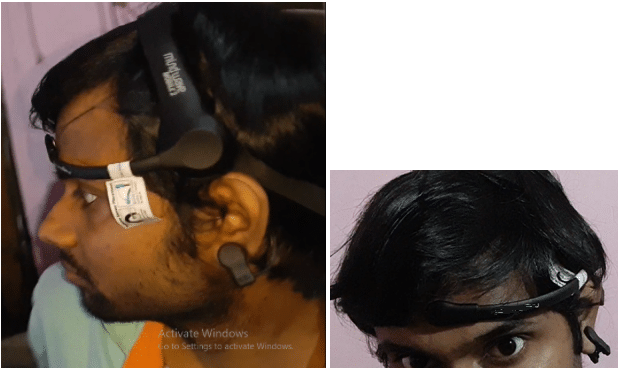
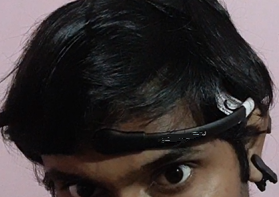
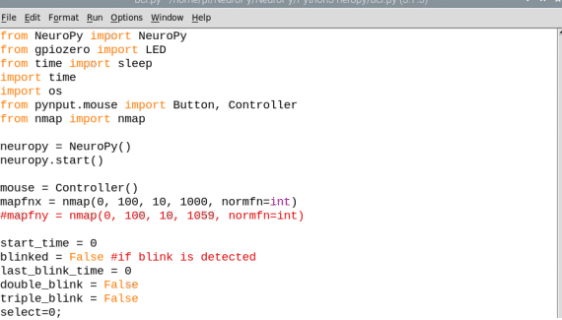
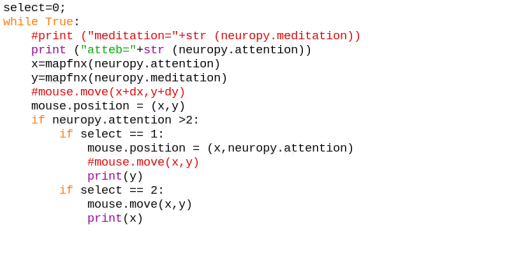
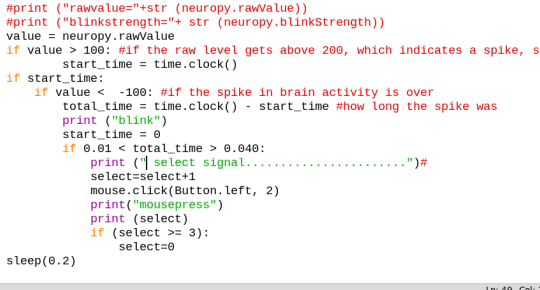
The BCI-Based Mind Controlled Computer project establishes a wireless link between a human-worn electroencephalography (EEG) headset and a Raspberry Pi 5 running Raspbian OS. The EEG sensor measures low-voltage electrical signals generated by brain activity and eye movements from the user's scalp. These bio-signals are transmitted via Bluetooth, utilizing the BlueZ protocol stack on the Raspberry Pi to manage the wireless connection. Once received, custom Python scripts handle the data stream: the nmap module can be utilized for network management if streaming over a local connection, while PySerial handles serial communications if wired diagnostic modes are needed. The NeuroPy library parses the raw data packets from the headset to extract specific attention, meditation, and blink values. Finally, the Pynput library translates these processed mental metrics and blink events into programmatic computer commands, allowing the Raspberry Pi to dynamically control mouse movements and generate click events without relying on standard physical input peripherals like a traditional keyboard or mouse.
Why Build This
Design and implement assistive technology interfaces tailored for paralyzed or mobility-impaired individuals.
Gain hands-on experience integrating wireless Bluetooth bio-sensors with single-board computers.
Develop custom Python software pipelines for real-time bio-signal processing and peripheral emulation.
Real-World Application
Assisted technology for paralyzed or differently-abled individuals to communicate, navigate computers, and play digital games without traditional input devices.
Skills You'll Learn
Bluetooth communication protocols
bio-signal data parsing
virtual input device emulation
Python scripting
Linux OS configuration
Safety Precautions
No specific precautions noted for this build — always follow general electronics safety practices.
Technology Tags
BCI
BRAIN-COMPUTER INTERFACE
PYTHON
BLUEZ
PYSERIAL
NEUROPY
PYNPUT
EEG
BLUETOOTH
Ready to build this?
We stock the boards, sensors and modules this project needs. A full parts list is coming soon — for now, browse our DIY Kits & components or search for Raspberry Pi parts.
Frequently Asked Questions
Can any Bluetooth-enabled EEG headset be used with this project?
The system specifically requires a headset that is compatible with the NeuroPy library and outputs standard serial or Bluetooth packet structures recognized by the software.
Does this project require soldering or custom circuit building?
No, this is a software- and integration-focused project utilizing off-the-shelf hardware components communicating via Bluetooth and USB connections.
How does the Raspberry Pi translate brain waves into mouse clicks?
The NeuroPy library interprets raw EEG data into measurable metrics like attention and blink detection, which the Pynput library then translates into standard operating system mouse events.
Gallery


Kitkraft Project Hub — curated from the maker community, credited at the source.
PRJ-00499