Project Hub
/Basic Analog & Power Electronics/Power Supplies & Voltage Regulators/BeanDeck
Advanced
ANALOG / DISCRETE
Project Specific
3 – 6 Hours
Partial Kit
BeanDeck
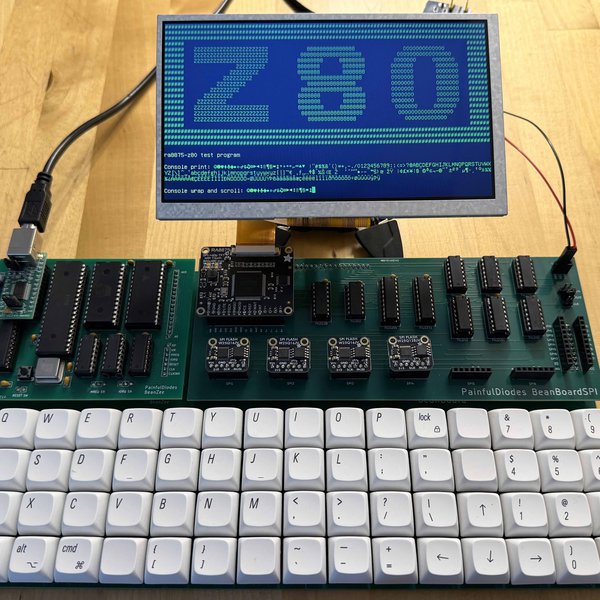
BeanDeck is a portable, self-contained Z80 computer combining a mechanical keyboard, 800x480 graphic color display, and removable flash cartridge storage.
This project is sourced from another site, not written by us — this list is our best match of their components against what we stock, not a verified bill of materials. Always check the original blog (linked above) for the actual parts list before buying.
BeanDeck is a completely self-contained, portable retro-computing workstation built around a BeanZee Z80 single board computer core. The system integrates multiple specialized subsystems into a custom enclosure powered by an independent battery power supply. User input is handled by the BeanBoard QWERkY keyboard, which interfaces directly with the Z80 system to provide both typing capabilities and general-purpose input/output (GPIO) routing. Visual output is driven by an 800x480 TFT display panel managed by an RA8875 controller chip, allowing the system to render crisp graphical user interfaces and text without heavily taxing the main CPU. Persistent data storage and program loading are achieved through removable flash storage cartridges, which interface with the Z80 core via the BeanBoardSPI hardware extension board. On the software side, the system boots using Marvin monitor firmware to manage hardware interactions, runs a BASIC interpreter for high-level programming and execution, utilizes a dedicated RA8875 display driver for graphics rendering, and relies on a flash cartridge file system driver to manage read and write operations to the removable storage media. Together, these hardware and software layers create a fully functional, standalone microcomputer environment reminiscent of classic 8-bit systems but enhanced with modern peripheral controllers and display technology.
Why Build This
Explore undergraduate-level systems engineering by integrating vintage microprocessor architecture with modern peripheral controllers and graphic displays.
Develop custom firmware, display drivers, and file system software to interface modular hardware components like SPI flash cartridges and RA8875 TFT controllers.
Construct a completely portable, battery-powered vintage computing platform suitable for retro gaming, retro-computing preservation, and embedded systems experimentation.
Real-World Application
Vintage computing preservation, retro gaming, embedded systems experimentation, and educational computing.
Skills You'll Learn
Z80 microprocessor architecture
SPI communication interface design
TFT display controller integration
low-level driver development
battery power management
file system implementation
Safety Precautions
No specific precautions noted for this build — always follow general electronics safety practices.
Technology Tags
Z80
RETRO COMPUTING
MECHANICAL KEYBOARD
TFT DISPLAY
RA8875
FLASH STORAGE
SPI
BASIC
FIRMWARE
PCB DESIGN
Frequently Asked Questions
The system includes a built-in BASIC interpreter for running custom programs, alongside low-level monitoring software and driver support.
BeanDeck utilizes removable flash storage cartridges that connect via the BeanBoardSPI interface board, managed by a custom file system driver.
Yes, the project is designed with a battery power supply and a custom enclosure to ensure complete portability.
Gallery
This page is part of Kitkraft's Project Hub — a curated collection of electronics & robotics projects gathered from the maker community to help students and hobbyists discover and learn to build. Kitkraft does not claim authorship of the original project, and makes no representation as to the accuracy, completeness or safety of third-party source material. The summary and "How It Works" explanation above are AI-generated, rewritten with reference to the original tutorial — not a reproduction of it. Full credit and a direct link to the original source are provided above. If you're the original creator and have a concern about how your work is represented here, please contact us and we'll address it promptly.
Kitkraft Project Hub — curated from the maker community, credited at the source.
 MB102 Adjustable Breadboard Power Supply Module (3.3V & 5V) for Arduino & Raspberry Pi
Rs. 139.00
 400 Points Mini Solderless Prototype PCB Breadboard High Quality
Rs. 89.00
 Jumper Wire 10 Pin Male To Male 20cm
Rs. 45.00
 Jumper Wire 10 Pin Male To Female 20cm
Rs. 45.00


