This project is sourced from another site, not written by us — this list is our best match of their components against what we stock, not a verified bill of materials. Always check the original blog (linked above) for the actual parts list before buying.
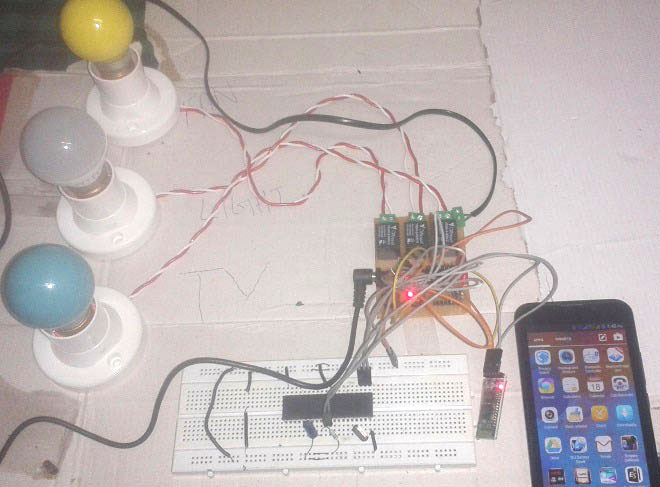
The Bluetooth Controlled Home Automation System using an 8051 microcontroller functions by establishing a wireless serial communication link between a mobile device and the microcontroller circuit. At the core of the system is the 8051 microcontroller, which manages incoming commands and drives output devices. A Bluetooth module, such as the HC-05, is interfaced with the microcontroller's UART pins to receive wireless data sent from a smartphone running a Bluetooth Controller Android App. When the user presses a button on the app, a specific character or data string is transmitted via Bluetooth radio waves to the HC-05 module, which relays this data serially to the 8051 microcontroller. The microcontroller, programmed using a compiler like Keil uVision, interprets these incoming digital commands. Depending on the command received, the 8051 changes the logic state of its general-purpose input/output (GPIO) pins. Because a microcontroller pin cannot directly supply the higher current or voltage required by heavy household loads, the output signals are routed through driver circuitry to actuate electromechanical relays. These relays act as electrically operated switches, physically opening or closing circuits to control connected home appliances. Power for the entire control circuit—including the microcontroller, Bluetooth module, and relay coils—is provided by a stable DC power supply unit, often built and prototyped on a breadboard using connecting wires before permanent installation.
Why Build This
Bridge theoretical embedded systems knowledge with practical smart home applications by implementing wireless serial communication on a classical 8051 architecture.
Gain hands-on engineering experience in interfacing low-voltage microcontroller logic with high-voltage electromechanical switching devices like relays.
Develop foundational competencies in mobile-to-microcontroller integration suitable for undergraduate capstone projects and assistive living technology design.
Real-World Application
Wireless control of home appliances, smart home automation, and assistive living technology.
Skills You'll Learn
UART serial communication
microcontroller GPIO programming
relay interfacing and load switching
embedded C firmware development
wireless module integration
Safety Precautions
Exercise caution when working with mains AC voltage for relay-controlled home appliances.
Technology Tags
8051 MICROCONTROLLER
BLUETOOTH
HC-05
HOME AUTOMATION
EMBEDDED SYSTEMS
Frequently Asked Questions
No, the 8051 microcontroller operates at low DC voltages and low current limits, which cannot drive household appliances directly. You must use intermediate electromechanical relays and proper driver circuits to safely isolate the low-voltage control logic from high-voltage AC circuits.
You will need an 8051-compatible C compiler and integrated development environment, such as Keil uVision, to write, compile, and generate the hex file for your firmware.
The smartphone pairs wirelessly via Bluetooth with an HC-05 module connected to the 8051's serial pins, transmitting commands whenever you interact with a Bluetooth controller app on your phone.
Gallery
This page is part of Kitkraft's Project Hub — a curated collection of electronics & robotics projects gathered from the maker community to help students and hobbyists discover and learn to build. Kitkraft does not claim authorship of the original project, and makes no representation as to the accuracy, completeness or safety of third-party source material. The summary and "How It Works" explanation above are AI-generated, rewritten with reference to the original tutorial — not a reproduction of it. Full credit and a direct link to the original source are provided above. If you're the original creator and have a concern about how your work is represented here, please contact us and we'll address it promptly.
Kitkraft Project Hub — curated from the maker community, credited at the source.
 ESP32 WiFi+Bluetooth CP2102 Development Board
Rs. 520.00
 5V 1 Channel Relay Module
Rs. 45.00
 Jumper Wire 10 Pin Male To Male 20cm
Rs. 45.00
 MB102 Adjustable Breadboard Power Supply Module (3.3V & 5V) for Arduino & Raspberry Pi
Rs. 139.00
 400 Points Mini Solderless Prototype PCB Breadboard High Quality
Rs. 89.00
 Jumper Wire 10 Pin Male To Female 20cm
Rs. 45.00


