This project is sourced from another site, not written by us — this list is our best match of their components against what we stock, not a verified bill of materials. Always check the original blog (linked above) for the actual parts list before buying.
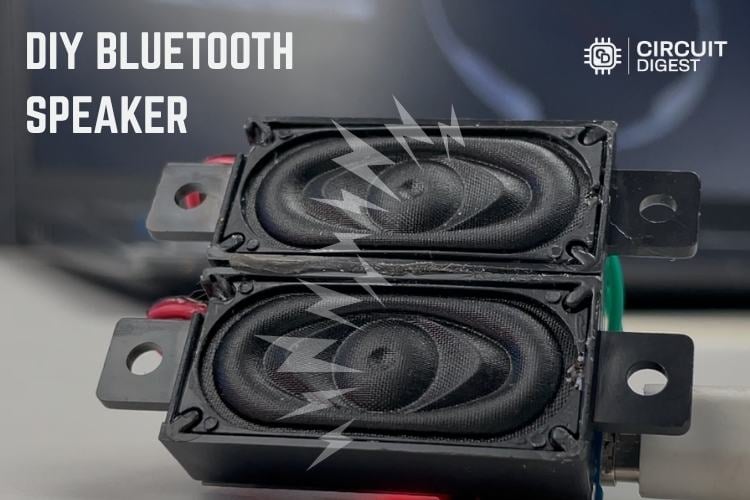
This compact wireless speaker system functions by bridging modern short-range wireless communication with analog audio amplification and electroacoustic conversion. The core signal path begins with the JDY-62 Bluetooth module, which receives digital audio streams wirelessly from a host device like a smartphone or computer. The module decodes the incoming Bluetooth transmission and outputs a standard, low-level analog stereo audio signal on its left and right channel outputs. Because this signal is too weak to directly drive physical speakers, it is routed into the PAM8403 stereo audio amplifier board. The PAM8403 is a dual-channel Class-D audio amplifier that increases the amplitude of the incoming audio waveforms. It operates using high-frequency pulse-width modulation to efficiently boost the signal power without generating excessive heat, which is ideal for portable, battery- or USB-powered electronics. The amplified stereo signals are then delivered directly to a pair of 2-watt, 8-ohm speakers. These transducers pass the alternating electrical audio current through an internal voice coil suspended within a permanent magnetic field, causing the attached speaker cone to physically vibrate and reproduce the original audio as audible sound waves through the air. The entire circuit is powered by a stable 5V DC power supply distributed across the components using 18-24 AWG wiring, secured together through permanent electrical connections made with a soldering iron and solder.
Why Build This
Design and assemble a functional, custom-enclosed wireless audio output device suitable for desktop or portable engineering lab use.
Gain practical hardware integration experience by interfacing a wireless communication module with an analog Class-D audio amplifier stage.
Analyze power distribution, signal routing, and impedance matching between active IC components and passive acoustic transducers.
Ensure correct polarity when connecting the power supply to prevent component damage. Use proper ventilation and safety gear when soldering.
Technology Tags
BLUETOOTH
AUDIO AMPLIFIER
PAM8403
JDY-62
SOLDERING
WIRELESS AUDIO
Frequently Asked Questions
Yes, a standard USB port provides a steady 5V DC power supply, which is ideal for powering both the JDY-62 Bluetooth module and the PAM8403 amplifier board.
Reversing the power supply polarity can cause permanent electrical damage to the integrated circuits on the JDY-62 and PAM8403 boards, which is why verifying correct polarity before powering on is critical.
No software or programming is required; the JDY-62 operates out-of-the-box as a standalone module that automatically handles wireless pairing and audio streaming.
Gallery
This page is part of Kitkraft's Project Hub — a curated collection of electronics & robotics projects gathered from the maker community to help students and hobbyists discover and learn to build. Kitkraft does not claim authorship of the original project, and makes no representation as to the accuracy, completeness or safety of third-party source material. The summary and "How It Works" explanation above are AI-generated, rewritten with reference to the original tutorial — not a reproduction of it. Full credit and a direct link to the original source are provided above. If you're the original creator and have a concern about how your work is represented here, please contact us and we'll address it promptly.
Kitkraft Project Hub — curated from the maker community, credited at the source.
 ESP32 WiFi+Bluetooth CP2102 Development Board
Rs. 520.00
 Jumper Wire 10 Pin Male To Male 20cm
Rs. 45.00
 MB102 Adjustable Breadboard Power Supply Module (3.3V & 5V) for Arduino & Raspberry Pi
Rs. 139.00
 400 Points Mini Solderless Prototype PCB Breadboard High Quality
Rs. 89.00
 Jumper Wire 10 Pin Male To Female 20cm
Rs. 45.00


