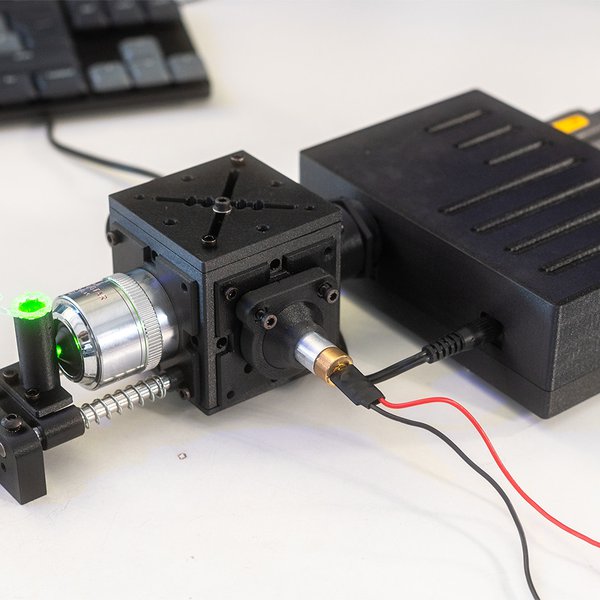
CubeRaman is an affordable, easily reproducible 3D-printed Raman spectrometer designed to non-destructively identify chemicals, polymers, and minerals using a back-scattering configuration.
We stock the boards, sensors and modules this project needs. A full parts list is coming soon — for now, browse our DIY Kits & components or search for AI / ML parts.
This project is sourced from another site, not written by us — this list is our best match of their components against what we stock, not a verified bill of materials. Always check the original blog (linked above) for the actual parts list before buying.
The CubeRaman system operates on the principle of Raman scattering to analyze the chemical composition of various materials non-destructively. At the core of the optical train is a 532nm laser pointer rated above 30mW, which provides the monochromatic excitation source directed at the sample. When the laser light interacts with the sample, most of the scattered light retains its original wavelength (Rayleigh scattering), but a tiny fraction undergoes inelastic scattering, shifting in wavelength based on the molecular vibrational modes of the substance. To manage this optical path, the system employs a Thorlabs DMLP550 dichroic mirror to cleanly separate the excitation laser wavelength from the returning Raman-scattered photons. A Thorlabs Achromatic Doublet Lens (AC127-019-A) focuses and collimates the light efficiently across the optical assembly, correcting for chromatic aberrations. Furthermore, a Thorlabs FELH0550 longpass filter blocks any residual 532nm laser scatter from reaching the detector, allowing only the longer-wavelength Stokes Raman signals to pass through. The filtered Raman spectrum is then captured by a B&W Tek BTC 100-2S Spectrometer. Finally, the digitized spectral data is sent to a host computer running the CubeRaman-SpectrumPro processing GUI, where users can visualize, process, and analyze the resulting spectrum to identify chemicals, polymers, or minerals.
Why Build This
Gain hands-on experience designing and aligning optical bench assemblies using commercial-grade optomechanical components like dichroic mirrors, achromatic doublets, and longpass filters.
Learn how inelastic light scattering principles are applied in instrumentation to perform non-destructive material identification for chemical, pharmaceutical, and mineralogical analysis.
Develop practical skills in integrating hardware spectrometers with specialized graphical user interfaces for advanced spectral data acquisition and processing.
Real-World Application
Non-destructive identification of chemicals, minerals, polymers, and pharmaceuticals, as well as educational photonics demonstrations.
Skills You'll Learn
optical alignment
spectroscopy data processing
laser safety protocols
optomechanical assembly
spectral analysis
Safety Precautions
Uses a Class 3B 532 nm laser (>30 mW) which can cause permanent eye damage; certified laser safety glasses rated for 532 nm are mandatory, and the laser must remain disconnected during assembly.
Technology Tags
RAMAN SPECTROSCOPY
3D PRINTING
OPTICS
LASERS
PHOTONICS
CHEMICAL ANALYSIS
PYTHON
SPECTRUM ANALYSIS
Frequently Asked Questions
While the dichroic mirror reflects or transmits specific wavelengths, stray laser light can still scatter through the system. The Thorlabs FELH0550 longpass filter provides essential secondary blocking to ensure that high-intensity 532nm laser scatter does not blind or saturate the spectrometer sensor.
Raman scattering is an inherently weak optical phenomenon. Using a laser below 30mW will likely yield a signal-to-noise ratio too low for the BTC 100-2S spectrometer to detect meaningful chemical signatures without excessive integration times.
An achromatic doublet corrects for chromatic aberration, ensuring that different wavelengths of light focus at the exact same plane, which is critical for maintaining high optical throughput and spectral resolution in a spectrometer.
Gallery
This page is part of Kitkraft's Project Hub — a curated collection of electronics & robotics projects gathered from the maker community to help students and hobbyists discover and learn to build. Kitkraft does not claim authorship of the original project, and makes no representation as to the accuracy, completeness or safety of third-party source material. The summary and "How It Works" explanation above are AI-generated, rewritten with reference to the original tutorial — not a reproduction of it. Full credit and a direct link to the original source are provided above. If you're the original creator and have a concern about how your work is represented here, please contact us and we'll address it promptly.
Kitkraft Project Hub — curated from the maker community, credited at the source.