This project is sourced from another site, not written by us — this list is our best match of their components against what we stock, not a verified bill of materials. Always check the original blog (linked above) for the actual parts list before buying.
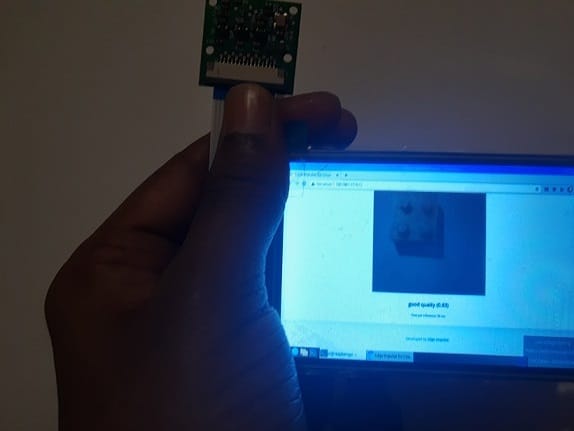
The DIY AI-based Quality Control Camera functions as an edge-computing inspection system driven by a Raspberry Pi 5. The core pipeline begins with the Raspberry Pi Camera module, which continuously captures visual feed of items moving along a simulated manufacturing assembly line, such as test objects built from Lego blocks. This video stream is processed locally using GStreamer for media handling and parsed through a machine learning model developed via the Edge Impulse platform, utilizing underlying frameworks like TensorFlow and Keras. Edge Impulse Linux CLI and Node.js manage the runtime environment, executing the trained TinyML model directly on the hardware without relying on cloud-based inference. As items pass the camera, the system classifies them in real-time, determining whether an item meets quality standards or exhibits defects. The classification results and visual output are then rendered directly to an attached HDMI or SPI LCD display, providing immediate feedback to operators. Power is supplied reliably to the entire assembly via a dedicated power supply, ensuring stable continuous operation during testing and deployment.
Why Build This
Gain practical experience deploying trained TensorFlow/Keras neural network models onto resource-constrained edge hardware like the Raspberry Pi 5.
Understand the end-to-end pipeline of industrial machine vision, bridging the gap between computer vision theory and automated manufacturing quality assurance.
Learn to integrate camera modules, display peripherals, and software runtimes into a cohesive, standalone embedded artificial intelligence system.
Real-World Application
Automated defect detection and quality assurance in industrial manufacturing assembly lines.
Skills You'll Learn
Edge AI deployment
TinyML model integration
computer vision pipeline configuration
embedded Linux command-line operations
real-time image classification
hardware peripheral interfacing
Safety Precautions
No specific precautions noted for this build — always follow general electronics safety practices.
Technology Tags
AI
MACHINE LEARNING
COMPUTER VISION
EDGE IMPULSE
PYTHON
LINUX
TENSORFLOW
CAMERA
Frequently Asked Questions
No. Once the Edge Impulse model is trained and deployed onto the Raspberry Pi 5 via the Edge Impulse Linux CLI, inference runs locally on the edge device without needing cloud connectivity.
While some older models can run basic inference, the Raspberry Pi 5 is recommended to handle the computational overhead of the camera stream, GStreamer, Node.js, and the machine learning model smoothly.
You can train the system to detect defects on small manufactured goods, electronic components, or even test items like Lego blocks arranged in specific configurations during your setup phase.
Gallery
This page is part of Kitkraft's Project Hub — a curated collection of electronics & robotics projects gathered from the maker community to help students and hobbyists discover and learn to build. Kitkraft does not claim authorship of the original project, and makes no representation as to the accuracy, completeness or safety of third-party source material. The summary and "How It Works" explanation above are AI-generated, rewritten with reference to the original tutorial — not a reproduction of it. Full credit and a direct link to the original source are provided above. If you're the original creator and have a concern about how your work is represented here, please contact us and we'll address it promptly.
 Raspberry Pi 3 - Model B+ 1.4Ghz 64-bit quad-core Processor with 1 GB Ram (Original)
Rs. 5,400.00
 MB102 Adjustable Breadboard Power Supply Module (3.3V & 5V) for Arduino & Raspberry Pi
Rs. 139.00
 400 Points Mini Solderless Prototype PCB Breadboard High Quality
Rs. 89.00
 Jumper Wire 10 Pin Male To Male 20cm
Rs. 45.00
 Jumper Wire 10 Pin Male To Female 20cm
Rs. 45.00


