Project Hub
/Basic Analog & Power Electronics/Power Supplies & Voltage Regulators/DIY PCL82 Tube Amplifier, Single-Ended
Beginner
ANALOG / DISCRETE
Project Specific
6 – 12 Hours
Partial Kit
DIY PCL82 Tube Amplifier, Single-Ended
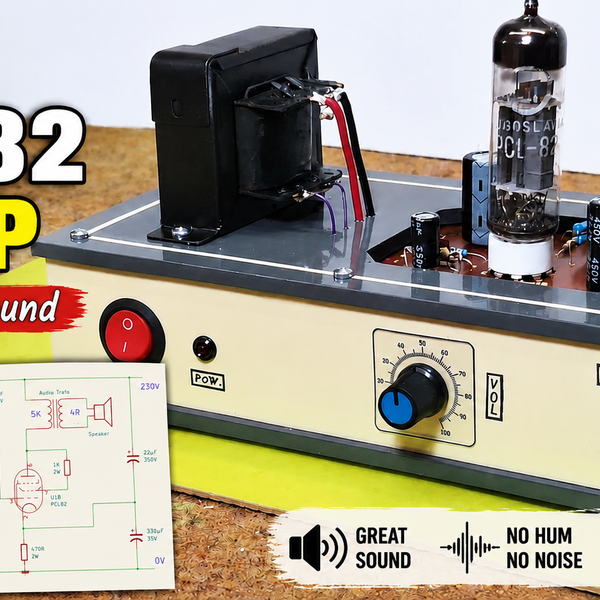
A classic single-ended tube audio amplifier modified to use PCL82 vacuum tubes and powered entirely by compact DC-DC boost converters from a 12V supply.
This project is sourced from another site, not written by us — this list is our best match of their components against what we stock, not a verified bill of materials. Always check the original blog (linked above) for the actual parts list before buying.
This DIY single-ended tube audio amplifier project leverages a hybrid approach by combining classic thermionic valve technology with modern solid-state power regulation. At the heart of the system is the PCL82 vacuum tube, a compact dual-section device containing both a triode for voltage amplification and a pentode for power output. An incoming audio signal is first routed through a 100K potentiometer, which acts as a manual volume control by attenuating the signal level before it reaches the triode grid. Once amplified by the triode stage, the signal drives the pentode section of the PCL82 to supply the necessary current for driving a loudspeaker. Because traditional tube amplifiers typically require heavy, expensive multi-tap mains transformers to generate high anode voltages, this design modernizes the power architecture by utilizing two dedicated DC-DC boost converters powered by a standard 12V DC input. One boost converter steps the 12V supply up to approximately 230V DC to provide the high-voltage plate (anode) supply required for the PCL82 tube to operate correctly. The second DC-DC boost converter provides the required lower voltage rail. Finally, an audio output transformer rated at 5K/4R matches the high impedance output of the PCL82 pentode to the low impedance of standard 4-ohm speakers, ensuring efficient power transfer and galvanic isolation.
Why Build This
Explore the distinct harmonic characteristics and warm sound reproduction of single-ended vacuum tube topologies in a desktop audio system.
Investigate modern power delivery techniques by powering high-voltage thermionic circuits safely from low-voltage DC sources using compact boost converters.
Gain hands-on circuit design experience with impedance matching and signal attenuation using output transformers and potentiometers.
Real-World Application
Home audio systems, desktop tube amplifiers, and vintage-style warm sound reproduction for music listening.
Skills You'll Learn
Vacuum tube biasing
high-voltage DC-DC boost conversion
audio impedance matching
potentiometer volume control integration
analog power supply distribution
Safety Precautions
High voltages (approx 230V DC) are present on the tube anodes and internal components, requiring caution during assembly and testing.
Technology Tags
VACUUM TUBES
PCL82
TUBE AMPLIFIER
AUDIO ELECTRONICS
DC-DC BOOST CONVERTERS
ANALOG AUDIO
SINGLE-ENDED AMPLIFIER
Frequently Asked Questions
The boost converters allow the amplifier to generate the necessary 230V DC plate voltage from a safer, low-voltage 12V power supply, reducing the need for heavy and complex traditional high-voltage mains transformers.
Vacuum tubes operate at very high output impedances, whereas standard speakers typically have a 4-ohm impedance. The 5K/4R transformer steps down the impedance so maximum power can be transferred safely to the speakers without distortion.
No. High voltages of approximately 230V DC are present on the tube anodes and internal circuitry during operation, which can cause severe electrical shock if touched.
Gallery
This page is part of Kitkraft's Project Hub — a curated collection of electronics & robotics projects gathered from the maker community to help students and hobbyists discover and learn to build. Kitkraft does not claim authorship of the original project, and makes no representation as to the accuracy, completeness or safety of third-party source material. The summary and "How It Works" explanation above are AI-generated, rewritten with reference to the original tutorial — not a reproduction of it. Full credit and a direct link to the original source are provided above. If you're the original creator and have a concern about how your work is represented here, please contact us and we'll address it promptly.
Kitkraft Project Hub — curated from the maker community, credited at the source.
 LM2596 Step Down DC-DC Buck Converter
Rs. 99.00
 400 Points Mini Solderless Prototype PCB Breadboard High Quality
Rs. 89.00
 MB102 Adjustable Breadboard Power Supply Module (3.3V & 5V) for Arduino & Raspberry Pi
Rs. 139.00
 Jumper Wire 10 Pin Male To Male 20cm
Rs. 45.00
 Jumper Wire 10 Pin Male To Female 20cm
Rs. 45.00


