This project is sourced from another site, not written by us — this list is our best match of their components against what we stock, not a verified bill of materials. Always check the original blog (linked above) for the actual parts list before buying.
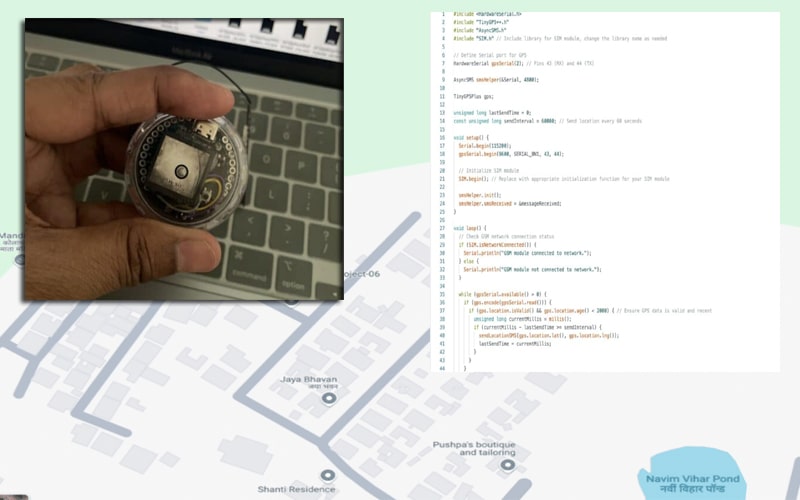
The DIY Smallest GPS Tracker is built around the Indusboard Coin microcontroller board, which serves as the central processing unit and coordinates data flow between the onboard subsystems. Location data is acquired using the connected L86 GPS module, which communicates with global navigation satellites to determine precise latitude, longitude, and time coordinates. To transmit this location information remotely, the system utilizes the SIM800l GSM module, enabling cellular communication capabilities such as sending SMS text messages or interacting with a remote server via mobile data networks. An optional SSD1306 OLED display can be integrated into the circuit via I2C to provide local visual feedback, showing real-time status updates or coordinates directly on a compact screen. The entire system is programmed using the Arduino IDE or compatible software, allowing developers to write custom logic that reads NMEA sentences from the GPS receiver, formats the coordinate data, and triggers the GSM transmitter. Additionally, an optional coin cell battery can be incorporated to maintain real-time clock (RTC) backup power, ensuring that timekeeping data is preserved even when the main power source is interrupted.
Why Build This
Design and deploy an ultra-compact, discreet tracking tag suitable for monitoring parcels, luggage, or vehicles in real-time.
Gain practical experience integrating multi-module embedded systems combining satellite navigation (GPS) and cellular communication (GSM).
Develop advanced undergraduate-level proficiency in serial communication protocols, power management, and microcontroller programming.
Real-World Application
Tracking children, pets, luggage, parcels, and vehicles discreetly using a compact tag-sized device.
Skills You'll Learn
GPS data parsing
cellular communication interfacing
I2C communication
serial UART communication
power management in embedded systems
microcontroller firmware development
Safety Precautions
Ensure correct voltage levels (2.8V to 4V range) are applied to the GPS and GSM modules to prevent permanent hardware damage.
Technology Tags
GPS
L86 GPS MODULE
SIM800L
GSM
IOT
TRACKING
SERIAL COMMUNICATION
MICROCONTROLLERS
Frequently Asked Questions
Without the GSM module, the Indusboard Coin and L86 GPS can still acquire location data and display it locally if an optional SSD1306 OLED is attached, but remote tracking capabilities will be disabled.
Both the L86 GPS and SIM800l GSM modules operate within a specific voltage range (typically 2.8V to 4V); exceeding 4V can cause permanent hardware damage to the internal components.
The coin cell battery acts as a backup power source specifically to maintain the real-time clock (RTC) data, ensuring time and configuration memory are preserved during main power loss.
Gallery
This page is part of Kitkraft's Project Hub — a curated collection of electronics & robotics projects gathered from the maker community to help students and hobbyists discover and learn to build. Kitkraft does not claim authorship of the original project, and makes no representation as to the accuracy, completeness or safety of third-party source material. The summary and "How It Works" explanation above are AI-generated, rewritten with reference to the original tutorial — not a reproduction of it. Full credit and a direct link to the original source are provided above. If you're the original creator and have a concern about how your work is represented here, please contact us and we'll address it promptly.
Kitkraft Project Hub — curated from the maker community, credited at the source.
 0.96 Inch I2C/IIC 4pin OLED Display Module White
Rs. 349.00
 Jumper Wire 10 Pin Male To Male 20cm
Rs. 45.00
 400 Points Mini Solderless Prototype PCB Breadboard High Quality
Rs. 89.00
 MB102 Adjustable Breadboard Power Supply Module (3.3V & 5V) for Arduino & Raspberry Pi
Rs. 139.00
 Jumper Wire 10 Pin Male To Female 20cm
Rs. 45.00


