ECG Analysis for Heart Disease Prediction with Vital Parameters
Project Hub
/Healthcare Biomedical & Assistive/Bio-signal Acquisition (ECG/EMG/EEG)/ECG Analysis for Heart Disease Prediction with Vital Parameters
Advanced
ARDUINO
₹1,500 – ₹5,000
6 – 12 Hours
Partial Kit
ECG Analysis for Heart Disease Prediction with Vital Parameters
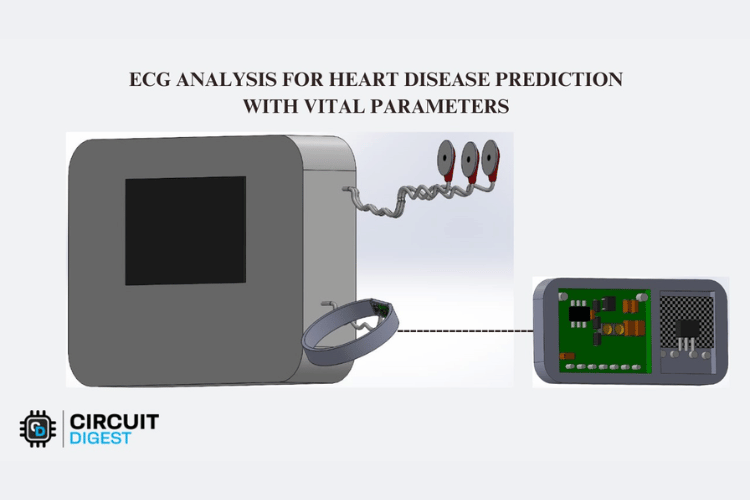
This project implements AI-based cardiovascular disease prediction from ECG waveforms and vital parameters using an Arduino UNO R4 WiFi, MAX30102 sensor, AD8232 ECG module, OLED display, and a MATLAB classification model.
This project is sourced from another site, not written by us — this list is our best match of their components against what we stock, not a verified bill of materials. Always check the original blog (linked above) for the actual parts list before buying.
This biomedical monitoring system captures and analyzes vital cardiac signals to assist in early heart disease prediction. At the front end, the AD8232 ECG module interfaces with the human body via electrodes to detect minute electrical potentials generated by the heart, filtering and amplifying the raw analog waveform. Simultaneously, the MAX30102 sensor uses optical plethysmography via infrared and red LEDs to measure pulse oximetry and heart rate parameters. Both the analog ECG signal and the digital sensor readings are routed into the Arduino UNO R4 WiFi. The Arduino processes these incoming bio-signals locally and renders real-time visual output, such as waveforms and vital statistics, onto a connected 0.96-inch OLED display using I2C communication. To perform advanced predictive diagnostics, the Arduino transmits the acquired telemetry data to a host computer running MATLAB. Within the MATLAB environment, a pre-trained classification model evaluates the combined ECG waveforms and vital parameters to identify potential cardiac abnormalities or disease indicators.
Why Build This
Design and deploy an end-to-end biomedical telemetry pipeline combining wearable hardware with advanced machine learning diagnostics in MATLAB.
Gain practical undergraduate-level experience interfacing complex bio-potential and optical sensors with a modern microcontroller platform.
Develop functional prototypes targeted at modern remote patient monitoring and point-of-care cardiac screening applications.
Real-World Application
Patient health monitoring systems, remote telemedicine, wearable medical devices for early detection of cardiac arrhythmias, and point-of-care diagnostics.
Skills You'll Learn
Bio-signal acquisition
Analog front-end signal conditioning
I2C communication protocol
Serial data transmission
Biomedical sensor integration
Machine learning model deployment
Safety Precautions
Ensure proper electrical isolation when connecting ECG electrodes to the human body to prevent any risk of electrical shock.
Technology Tags
ARDUINO
MATLAB
ECG
MAX30102
OLED DISPLAY
MACHINE LEARNING
DECISION TREE
SPO2
I2C
SERIAL COMMUNICATION
Frequently Asked Questions
The AD8232 measures the electrical activity of the heart (ECG), while the MAX30102 measures blood oxygen saturation and pulse. Combining both electrical and optical vital parameters provides a comprehensive dataset for accurate heart disease prediction.
MATLAB acts as the advanced computing environment where the classification model runs. The Arduino streams the raw sensor data to MATLAB, which executes the machine learning algorithm to predict potential cardiovascular anomalies.
The Arduino UNO R4 WiFi and OLED display can independently capture, process, and display real-time sensor data locally, but running the predictive AI classification model requires the connected MATLAB environment.
Gallery
This page is part of Kitkraft's Project Hub — a curated collection of electronics & robotics projects gathered from the maker community to help students and hobbyists discover and learn to build. Kitkraft does not claim authorship of the original project, and makes no representation as to the accuracy, completeness or safety of third-party source material. The summary and "How It Works" explanation above are AI-generated, rewritten with reference to the original tutorial — not a reproduction of it. Full credit and a direct link to the original source are provided above. If you're the original creator and have a concern about how your work is represented here, please contact us and we'll address it promptly.
Kitkraft Project Hub — curated from the maker community, credited at the source.
 0.96 Inch I2C/IIC 4pin OLED Display Module White
Rs. 349.00
 Jumper Wire 10 Pin Male To Male 20cm
Rs. 45.00
 400 Points Mini Solderless Prototype PCB Breadboard High Quality
Rs. 89.00
 MB102 Adjustable Breadboard Power Supply Module (3.3V & 5V) for Arduino & Raspberry Pi
Rs. 139.00
 Jumper Wire 10 Pin Male To Female 20cm
Rs. 45.00


