This project is sourced from another site, not written by us — this list is our best match of their components against what we stock, not a verified bill of materials. Always check the original blog (linked above) for the actual parts list before buying.
This list includes a generic resistor set
as a placeholder — it is not matched to the exact value or part number this circuit needs. The correct one is specified on the original source page linked above; check it before buying.
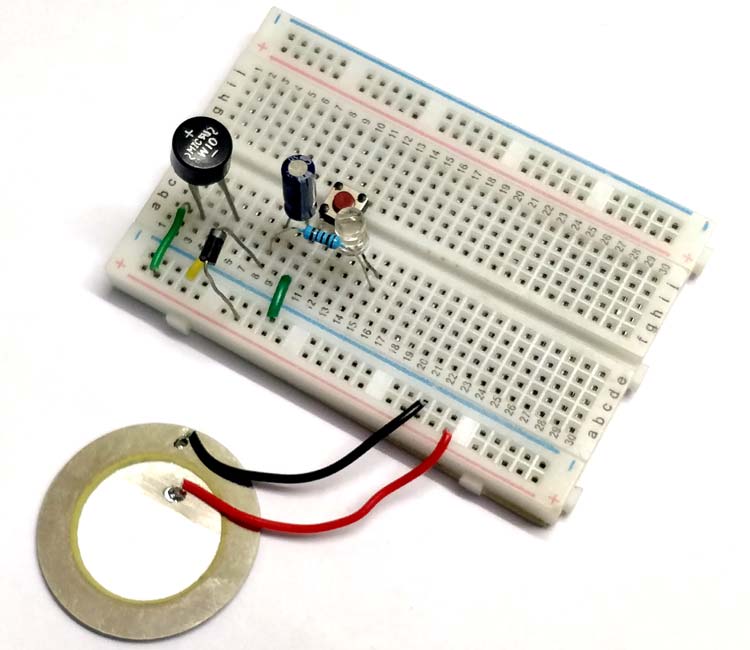
The Foot Step Power Generation Circuit operates by converting the mechanical stress of a human footstep into usable electrical energy using a piezoelectric sensor. Piezoelectric sensors are electromechanical transducers containing crystalline or ceramic materials that undergo mechanical deformation when pressure is applied. When a foot steps on or near the sensor, the physical compression displaces internal charges, generating a momentary high-voltage, low-current AC electrical pulse across the sensor terminals. Because footstep impacts are intermittent and produce irregular pulses, the raw output cannot directly power standard electronics. The signal is routed through a network of diodes arranged to rectify the AC-like spikes into a consistent direct current (DC). Diodes ensure that current flows in only one direction, preventing reverse-voltage discharge back into the sensor. To smooth out the sharp peaks and stabilize the erratic voltage output, a capacitor is connected in parallel to act as an energy reservoir, storing the harvested charge. Resistors are utilized within the circuit to manage current flow and provide proper load impedance. Finally, builders can use a multimeter to measure the generated voltage stored across the capacitor or observe transient voltage spikes in real-time as physical pressure is applied to the breadboard-mounted sensor setup.
Why Build This
Explore renewable energy harvesting concepts by converting ambient human kinetic motion into electrical voltage.
Gain practical undergraduate-level experience working with analog rectification circuits, discrete diodes, and charge-storage capacitors.
Measure and analyze transient electrical signals and voltage accumulation using standard laboratory instrumentation like a multimeter.
Real-World Application
Harvesting energy in crowded public spaces like railway stations, sidewalks, and dance floors to power streetlights or emergency devices.
Skills You'll Learn
Piezoelectric energy harvesting
AC to DC rectification
capacitive energy storage
discrete analog circuit prototyping on breadboards
voltage measurement using a multimeter
Safety Precautions
No specific precautions noted for this build — always follow general electronics safety practices.
Technology Tags
PIEZOELECTRIC SENSOR
POWER GENERATION
RENEWABLE ENERGY
FOOT STEP POWER
SENSORS
CIRCUIT DESIGN
Frequently Asked Questions
No, a single piezoelectric footstep generator produces very low current and momentary voltage spikes, which is insufficient for high-power devices without intermediary storage batteries and power management ICs.
The sensor produces erratic, instantaneous pulses of alternating polarity every time pressure changes. Diodes convert this irregular output into a single direction (rectification), and the capacitor smooths the fluctuating spikes into a steady, storable voltage.
Connecting a capacitor across the rectified output stores the harvested energy, allowing a multimeter set to DC voltage mode to display a stable and readable accumulation of voltage.
Gallery
This page is part of Kitkraft's Project Hub — a curated collection of electronics & robotics projects gathered from the maker community to help students and hobbyists discover and learn to build. Kitkraft does not claim authorship of the original project, and makes no representation as to the accuracy, completeness or safety of third-party source material. The summary and "How It Works" explanation above are AI-generated, rewritten with reference to the original tutorial — not a reproduction of it. Full credit and a direct link to the original source are provided above. If you're the original creator and have a concern about how your work is represented here, please contact us and we'll address it promptly.
Kitkraft Project Hub — curated from the maker community, credited at the source.
 10pcs - 220 ohm 1/4 W Resistor Set
Rs. 39.00
 MB102 Adjustable Breadboard Power Supply Module (3.3V & 5V) for Arduino & Raspberry Pi
Rs. 139.00
 Jumper Wire 10 Pin Male To Male 20cm
Rs. 45.00
 400 Points Mini Solderless Prototype PCB Breadboard High Quality
Rs. 89.00
 Jumper Wire 10 Pin Male To Female 20cm
Rs. 45.00


