This project is sourced from another site, not written by us — this list is our best match of their components against what we stock, not a verified bill of materials. Always check the original blog (linked above) for the actual parts list before buying.
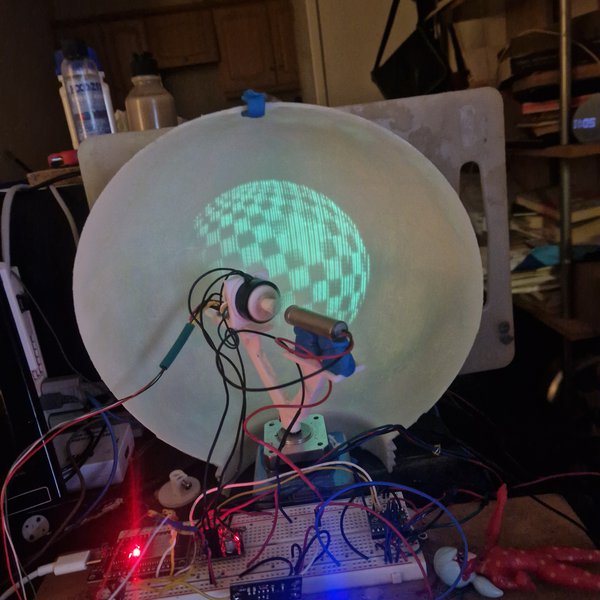
The Glow Engine operates by combining precision motion control with persistent luminescence to render vector graphics on a specialized phosphorescent screen. At the heart of the system is an ESP32 dual-core microcontroller running the Arduino environment and the SimpleFOC library, which manages the complex task of coordinated motion and laser modulation. The display medium utilizes strontium aluminate powder coated onto a screen, acting as a physical frame buffer that glows after being stimulated by light. To paint images onto this persistent surface, a 405nm ultraviolet engraving laser is directed onto a salvaged hard drive platter acting as a high-speed laser mirror. This mirror is precisely manipulated by a gimbal motor driven by a DRV8313 driver board, with its exact rotational position tracked in real-time by an AS5600 12-bit magnetic position sensor for closed-loop control. Meanwhile, a Nema 17 stepper motor and its dedicated driver board handle secondary positioning tasks to shift the projection frame or mechanical setup. Together, the ESP32 coordinates the high-speed deflection of the UV laser beam across the strontium aluminate surface, exciting the phosphorescent coating just long enough to trace shapes, lines, and vector images before the persistence of the material naturally fades.
Why Build This
Explore advanced closed-loop motor control algorithms and field-oriented control principles using the SimpleFOC library for atypical actuators like gimbal motors.
Investigate persistent luminescent materials and optical deflection techniques to design low-persistence or vector-based physical display systems.
Integrate high-speed mechanical mirror steering with microcontrollers to understand the complexities of optical scanning and vector graphics generation.
Real-World Application
Experimental visual displays, vector graphics exploration, physical computing art installations, and educational phosphorescence demonstrations.
Skills You'll Learn
Closed-loop motor control
magnetic sensor integration
SPI/I2C sensor communication
optical laser safety management
vector display rendering
dual-core microcontroller task allocation
stepper motor driver configuration
Safety Precautions
Handle strontium aluminate with care as powdered glass. Use extreme caution with the focused 405nm UV laser; always use appropriate laser safety glasses and observe proper safety measures.
Technology Tags
LASER SCANNING
STRONTIUM ALUMINATE
PHOSPHORESCENT SCREEN
ESP32
STEPPER MOTOR
GIMBAL MOTOR
SIMPLEFOC
AS5600 MAGNETIC SENSOR
NEMA 17
3D PRINTING
Frequently Asked Questions
A hard drive platter provides an exceptionally flat, lightweight, and reflective surface capable of being mounted directly to a gimbal motor to act as a precision optical mirror for deflecting the laser beam.
The AS5600 provides 12-bit absolute angular position feedback for the gimbal motor, allowing the SimpleFOC library to maintain precise, closed-loop control over the laser-steering mirror.
Yes, because this project incorporates a 405nm UV engraving laser and strontium aluminate powder, you must wear appropriate laser safety glasses and handle the powdered materials with extreme care to avoid exposure hazards.
Gallery
This page is part of Kitkraft's Project Hub — a curated collection of electronics & robotics projects gathered from the maker community to help students and hobbyists discover and learn to build. Kitkraft does not claim authorship of the original project, and makes no representation as to the accuracy, completeness or safety of third-party source material. The summary and "How It Works" explanation above are AI-generated, rewritten with reference to the original tutorial — not a reproduction of it. Full credit and a direct link to the original source are provided above. If you're the original creator and have a concern about how your work is represented here, please contact us and we'll address it promptly.
Kitkraft Project Hub — curated from the maker community, credited at the source.
 ESP32 WiFi+Bluetooth CP2102 Development Board
Rs. 520.00
 A4988 driver Stepper Motor Driver
Rs. 125.00
 400 Points Mini Solderless Prototype PCB Breadboard High Quality
Rs. 89.00
 MB102 Adjustable Breadboard Power Supply Module (3.3V & 5V) for Arduino & Raspberry Pi
Rs. 139.00
 Jumper Wire 10 Pin Male To Male 20cm
Rs. 45.00
 Jumper Wire 10 Pin Male To Female 20cm
Rs. 45.00


