We stock the boards, sensors and modules this project needs. A full parts list is coming soon — for now, browse our DIY Kits & components or search for Analog / Discrete parts.
This project is sourced from another site, not written by us — this list is our best match of their components against what we stock, not a verified bill of materials. Always check the original blog (linked above) for the actual parts list before buying.
We don't carry yet: Microcontroller IC (DIP) / Chip
Ethernet Cable / RJ45
Custom PCB / PCB Fab
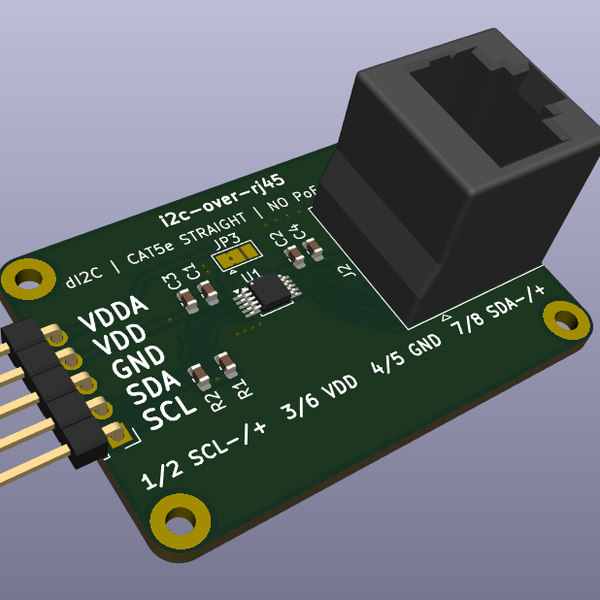
The i2c-over-rj45 project extends standard I2C communication beyond its normal physical limitations by converting standard single-ended I2C signals into differential signals. Standard I2C uses open-drain lines (SDA and SCL) referenced to ground, which suffer from high capacitance and signal degradation over distances greater than a fraction of a meter. To overcome this, the circuit uses PCA9615 buffer chips on custom PCBs placed at both ends of the communication link. The PCA9615 translates the traditional I2C signals into differential pair signals, which are then transmitted across twisted-pair wires inside a standard Cat5e cable using RJ45 connectors. Differential signaling relies on sending complementary voltage signals across a pair of wires; the receiver measures the voltage difference between the pair rather than the absolute voltage relative to ground. This method provides high immunity to electromagnetic interference (EMI) and common-mode noise, which are major challenges in industrial or multi-room environments. At the receiving end, a second PCA9615 chip converts the differential signals back into standard I2C logic levels, allowing microcontrollers and sensors to communicate seamlessly over distances up to 100 meters without requiring software modifications.
Why Build This
Deploy robust, long-distance sensor networks spanning up to 100 meters in industrial environments.
Interface remote I2C peripherals across multi-room setups using standardized Cat5e infrastructure.
Eliminate signal degradation and communication lockups caused by line capacitance in extended standard I2C buses.
Real-World Application
Long-distance sensor networks and remote I2C peripheral communication in industrial or multi-room setups.
Skills You'll Learn
Differential signaling
I2C protocol extension
hardware-level bus buffering
custom PCB integration
structured cabling practices
Safety Precautions
No specific precautions noted for this build — always follow general electronics safety practices.
Technology Tags
I2C
DIFFERENTIAL SIGNALING
PCA9615
CAT5E
RJ45
BUS EXTENDER
Frequently Asked Questions
No software changes are required. The PCA9615 operates entirely at the physical hardware layer, translating standard I2C signals into differential signals transparently to your code.
Yes, standard Cat5e patch cables with RJ45 connectors are used to connect the custom PCBs, utilizing the internal twisted pairs for differential data transmission.
Standard I2C has strict bus capacitance limits (typically 400pF) and lacks noise immunity, causing long wires to act like antennas that corrupt data and halt communication.
Gallery
This page is part of Kitkraft's Project Hub — a curated collection of electronics & robotics projects gathered from the maker community to help students and hobbyists discover and learn to build. Kitkraft does not claim authorship of the original project, and makes no representation as to the accuracy, completeness or safety of third-party source material. The summary and "How It Works" explanation above are AI-generated, rewritten with reference to the original tutorial — not a reproduction of it. Full credit and a direct link to the original source are provided above. If you're the original creator and have a concern about how your work is represented here, please contact us and we'll address it promptly.
Kitkraft Project Hub — curated from the maker community, credited at the source.