This project is sourced from another site, not written by us — this list is our best match of their components against what we stock, not a verified bill of materials. Always check the original blog (linked above) for the actual parts list before buying.
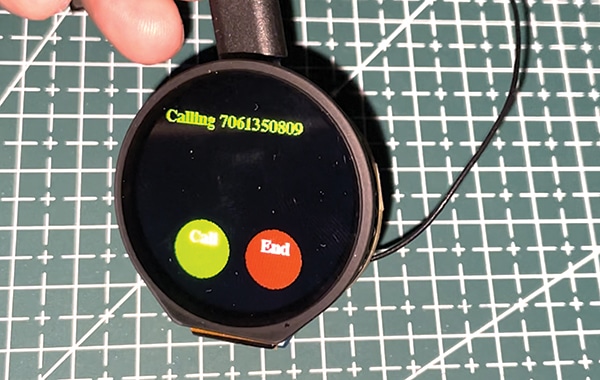
The IndusPhone is an ultra-compact programmable smartphone built around an ESP32 microcontroller board paired with specialized display, touch, audio, and communication hardware. At the core of the system is the ESP32 DevKit v1, which manages all processing, peripheral communication, and software execution. Visual output is rendered on a GC9A01 circular display, providing a vibrant graphical interface driven by the TFT_eSPI library. User input is captured by the CST816 Touch Round Display Glass, allowing for interactive navigation directly on the screen through touch communication protocols. For connectivity, the system integrates a SIM800L GSM module coupled with a Micro-SIM holder, enabling cellular network communication, text messaging, and voice capabilities. Audio output is handled by an SMD speaker driven by the ESP32, while power is supplied and managed via a Micro-USB connector and IndusBoard Coin power sources. Software-wise, the Arduino IDE serves as the development environment, utilizing the TFT_eSPI library for graphics, the CTS816 library for touch input, the GSMSim library for cellular modem control, and the official ESP32 board support package to tie the hardware and firmware together into a functional miniature mobile device.
Why Build This
Develop wearable communication devices and ultra-compact mobile gadgets for advanced embedded systems prototyping.
Integrate multiple complex peripherals—including cellular modems, round touch displays, and audio components—into a single constrained form factor.
Gain practical engineering experience in miniature IoT hardware design and custom firmware development for the ESP32 platform.
Real-World Application
Wearable communication devices, miniature IoT gadgets, ultra-compact mobile communication tools.
Skills You'll Learn
Embedded firmware development
Cellular module integration
SPI and I2C peripheral communication
Graphic display rendering
Touch input processing
Audio output interfacing
Power management in portable devices
Safety Precautions
No specific precautions noted for this build — always follow general electronics safety practices.
Technology Tags
ESP32
GSM
SIM800L
TOUCHSCREEN
UI DESIGN
ARDUINO IDE
IOT
MINIATURE ELECTRONICS
SMARTPHONE
Frequently Asked Questions
The project is programmed using the Arduino IDE in C/C++, leveraging the ESP32 board support package alongside specialized libraries like TFT_eSPI, CTS816, and GSMSim.
Yes, it integrates a SIM800L GSM module and a Micro-SIM holder, which enables basic cellular communication features such as voice calls and SMS when paired with an active SIM card.
User input is handled by a CST816 Touch Round Display Glass overlaid on the GC9A01 circular display, allowing touch-based navigation and control directly on the UI.
Gallery
This page is part of Kitkraft's Project Hub — a curated collection of electronics & robotics projects gathered from the maker community to help students and hobbyists discover and learn to build. Kitkraft does not claim authorship of the original project, and makes no representation as to the accuracy, completeness or safety of third-party source material. The summary and "How It Works" explanation above are AI-generated, rewritten with reference to the original tutorial — not a reproduction of it. Full credit and a direct link to the original source are provided above. If you're the original creator and have a concern about how your work is represented here, please contact us and we'll address it promptly.
Kitkraft Project Hub — curated from the maker community, credited at the source.
 Cable for Arduino Nano (USB 2.0 A to USB 2.0 Mini B) 30cm
Rs. 69.00
 400 Points Mini Solderless Prototype PCB Breadboard High Quality
Rs. 89.00
 MB102 Adjustable Breadboard Power Supply Module (3.3V & 5V) for Arduino & Raspberry Pi
Rs. 139.00
 Jumper Wire 10 Pin Male To Male 20cm
Rs. 45.00
 Jumper Wire 10 Pin Male To Female 20cm
Rs. 45.00


