This project is sourced from another site, not written by us — this list is our best match of their components against what we stock, not a verified bill of materials. Always check the original blog (linked above) for the actual parts list before buying.
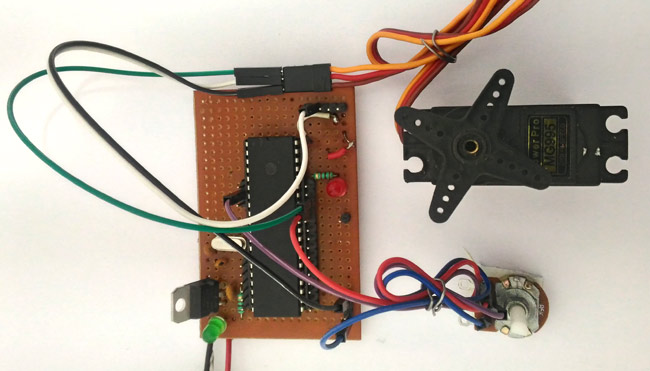
This project enables precise angular control of a servo motor using a PIC microcontroller programmed via the MPLAB X IDE and XC8 compiler. The core mechanism relies on pulse-width modulation (PWM), where the PIC microcontroller generates a repeating square wave signal with a specific pulse width. Standard hobby servo motors interpret this pulse width to determine the exact shaft position, typically expecting pulses between 1 millisecond and 2 milliseconds sent at a fixed frequency of 50 hertz. The power supply provides the necessary electrical energy for both the low-power logic circuitry of the PIC microcontroller and the higher current demands of the servo motor. Connecting wires establish the essential electrical pathways between the microcontroller's output pins, the servo motor's control and power lines, and the shared power rails. Using the programmer/debugger, the developer writes and flashes C code compiled through XC8 onto the PIC microcontroller, establishing the timing loops or hardware peripheral registers required to maintain the continuous control pulses. As the microcontroller program updates the pulse width—often driven by internal logic or external inputs—the internal feedback circuitry inside the servo motor adjusts its internal DC motor and gear train to match the commanded position.
Why Build This
Develop foundational embedded systems programming skills using industry-standard tools like MPLAB X IDE and the XC8 compiler.
Gain practical undergraduate-level experience in generating precise timing signals to control electromechanical actuators.
Understand power distribution requirements and signal interfacing between digital microcontrollers and analog-driven motors.
Real-World Application
Robotics, automation, camera gimbals, and radio-controlled vehicles.
Skills You'll Learn
PWM signal generation
actuator control
microcontroller firmware development
embedded C programming
power supply distribution
Safety Precautions
No specific precautions noted for this build — always follow general electronics safety practices.
Technology Tags
PIC MICROCONTROLLER
SERVO MOTOR
MPLAB X IDE
XC8
PWM
EMBEDDED C
Frequently Asked Questions
It is strongly recommended to use an external power supply for the servo motor. Servo motors draw significant current, especially under load, which can cause voltage drops that reset the microcontroller if powered from the same regulated logic rail.
The programmer/debugger is required to transfer the compiled XC8 code from your computer into the flash memory of the PIC microcontroller.
If the frequency or pulse width falls outside the standard operating parameters of the servo, the motor may jitter, fail to hold its position, or refuse to respond to control signals.
Gallery
This page is part of Kitkraft's Project Hub — a curated collection of electronics & robotics projects gathered from the maker community to help students and hobbyists discover and learn to build. Kitkraft does not claim authorship of the original project, and makes no representation as to the accuracy, completeness or safety of third-party source material. The summary and "How It Works" explanation above are AI-generated, rewritten with reference to the original tutorial — not a reproduction of it. Full credit and a direct link to the original source are provided above. If you're the original creator and have a concern about how your work is represented here, please contact us and we'll address it promptly.
Kitkraft Project Hub — curated from the maker community, credited at the source.
 TowerPro SG90 Mini Servo – 180 degree Rotation – Standard Quality
Rs. 179.00
 MB102 Adjustable Breadboard Power Supply Module (3.3V & 5V) for Arduino & Raspberry Pi
Rs. 139.00
 Jumper Wire 10 Pin Male To Male 20cm
Rs. 45.00
 400 Points Mini Solderless Prototype PCB Breadboard High Quality
Rs. 89.00
 Jumper Wire 10 Pin Male To Female 20cm
Rs. 45.00


