This project is sourced from another site, not written by us — this list is our best match of their components against what we stock, not a verified bill of materials. Always check the original blog (linked above) for the actual parts list before buying.
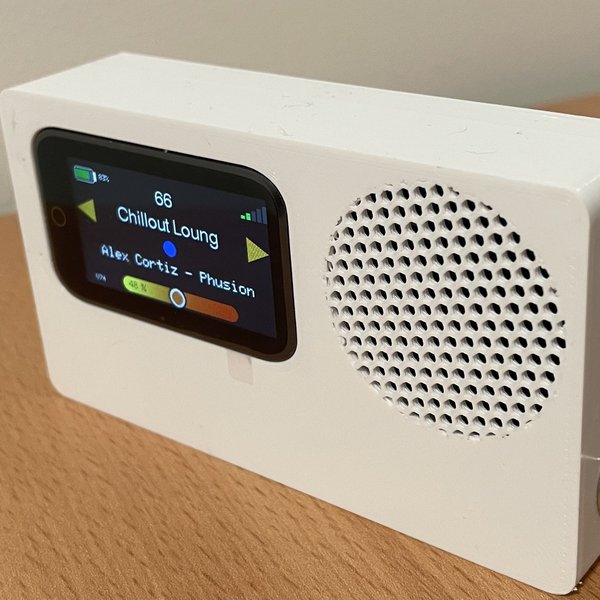
This internet radio system is powered by a Lilygo T-Display S3 microcontroller, which features an integrated ESP32 chip capable of connecting to local Wi-Fi networks and utilizing Bluetooth audio streaming. When operating as an internet radio, the ESP32 fetches digital audio streams over the internet using its Wi-Fi connection. Alternatively, it can receive wireless audio data via Bluetooth from a smartphone or other compatible host device. Once the digital audio stream is processed by the ESP32, it transmits the audio data out via the Inter-IC Sound (I2S) digital audio protocol. This I2S signal is fed directly into the MAX98357A Class D amplifier breakout board, which converts the digital audio signals into amplified analog power suitable for driving a physical load. The MAX98357A powers a 5W 4 Ohm 40mm speaker to produce audible sound output. For user interaction and visual feedback, the Lilygo T-Display S3 provides an integrated display screen, allowing users to view station information, menus, or track data. The entire assembly is powered independently by an 18650 lithium-ion battery housed in a dedicated battery holder, regulated through an ON/Off rocker switch for safe power control. A U.FL Wi-Fi antenna ensures reliable wireless connectivity, while all hardware components are housed neatly inside a custom 3D-printed enclosure connected using standard wiring.
Why Build This
Design a portable, network-connected audio appliance capable of accessing global internet radio broadcasts without standard FM receiver limitations.
Integrate high-efficiency Class D amplification and digital I2S audio protocols with an ESP32 microcontroller for undergraduate-level embedded audio engineering practice.
Construct a completely standalone, battery-powered streaming speaker system housed in a custom 3D-printed enclosure for home, office, or travel deployment.
Real-World Application
Portable internet radio device for home, office, or travel use, streaming global online audio content without traditional FM subscription limits.
Skills You'll Learn
I2S digital audio communication
Wi-Fi network configuration
Bluetooth audio streaming integration
embedded microcontroller firmware operation
Class D amplifier integration
power management with lithium-ion cells
Safety Precautions
Take proper precautions when handling Lithium-ion 18650 batteries and using a hot glue gun during assembly.
Technology Tags
ESP32
WI-FI
BLUETOOTH
AUDIO STREAMING
I2S DAC
MAX98357A
TOUCHSCREEN
3D PRINTING
Frequently Asked Questions
You should use a speaker that matches the electrical characteristics (such as impedance ratings around 4 Ohms and power handling up to 5W) supported by the MAX98357A amplifier breakout board to prevent distortion or hardware damage.
The Lilygo T-Display S3 utilizes its onboard ESP32 Wi-Fi capabilities, supplemented by a U.FL Wi-Fi antenna, to connect to your local wireless network and fetch online audio streams.
No, the project utilizes pre-programmed firmware designed specifically for the ESP32 platform, simplifying the software deployment process for builders.
Gallery
This page is part of Kitkraft's Project Hub — a curated collection of electronics & robotics projects gathered from the maker community to help students and hobbyists discover and learn to build. Kitkraft does not claim authorship of the original project, and makes no representation as to the accuracy, completeness or safety of third-party source material. The summary and "How It Works" explanation above are AI-generated, rewritten with reference to the original tutorial — not a reproduction of it. Full credit and a direct link to the original source are provided above. If you're the original creator and have a concern about how your work is represented here, please contact us and we'll address it promptly.
Kitkraft Project Hub — curated from the maker community, credited at the source.
 2-Slot 18650 Holder with Protective Cover and On/Off Switch – Case
Rs. 109.00
 Jumper Wire 10 Pin Male To Male 20cm
Rs. 45.00
 400 Points Mini Solderless Prototype PCB Breadboard High Quality
Rs. 89.00
 MB102 Adjustable Breadboard Power Supply Module (3.3V & 5V) for Arduino & Raspberry Pi
Rs. 139.00
 Jumper Wire 10 Pin Male To Female 20cm
Rs. 45.00


