Project Hub/Artificial Intelligence & Edge ML/License Plate Recognition (ANPR)/Long Distance Wired Serial Communication with Arduino using RS485 and CAT Cables
Intermediate
ARDUINO
₹500 – ₹1,500
3 – 6 Hours
Long Distance Wired Serial Communication with Arduino using RS485 and CAT Cables
Learn how to establish reliable long-distance serial communication between two Arduino Nano boards up to 1200 meters using the RS485 protocol, MAX485 transceiver modules, and CAT-6E Ethernet cables.
Originally published by Shivam Upadhyaya on CircuitDigest
View original tutorial
How It Works
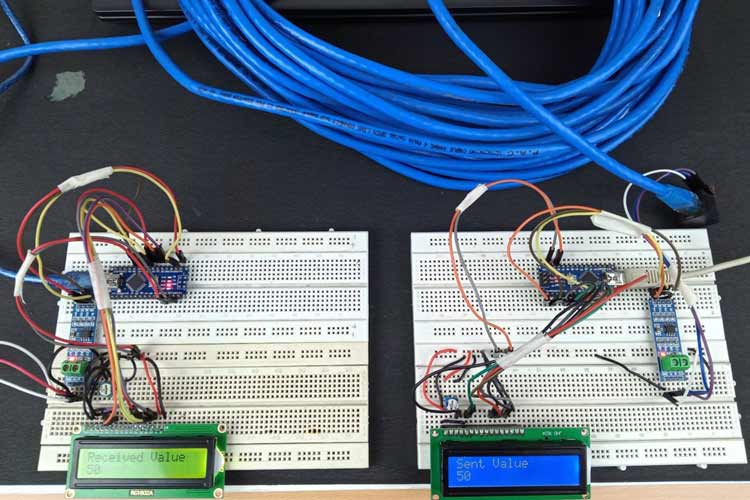
This project establishes reliable long-distance serial communication between two Arduino Nano boards using the RS485 protocol and CAT-6E Ethernet cables. At the heart of the setup are two MAX485 converter modules, which translate standard TTL serial signals from the Arduino Nano into differential voltage signals suitable for long cable runs. Because RS485 uses differential signaling across twisted-pair wires inside the Cat-6E cable, it effectively cancels out electromagnetic interference, allowing data to travel up to 1200 meters. On each end of the communication link, an Arduino Nano processes the incoming or outgoing data. The transmitting Arduino sends messages over serial, which the MAX485 module drives down the Ethernet cable. At the receiving end, the second MAX485 module converts the differential signals back into TTL levels for the receiving Arduino Nano. To display the transmitted or received messages locally, each circuit includes a 16x2 alphanumeric LCD paired with a 10k wiper potentiometer to adjust screen contrast. Breadboards and jumper wires are used to neatly connect all components together. Programming is handled via the Arduino IDE using the LiquidCrystal Library to manage the character displays, while the built-in hardware serial communication handles data transfer between the microcontrollers and their respective transceiver modules.
Why Build This
Learn how to extend communication distances between microcontrollers far beyond standard USB or simple jumper wire limits.
Gain practical experience implementing industrial differential signaling protocols suitable for noisy electrical environments.
Build a multi-node display system capable of sending and viewing text messages across remote locations using affordable networking cables.
Real-World Application
Industrial control systems, remote sensor data logging, and multi-drop communication networks where controllers are placed far apart in high-noise environments.
Skills You'll Learn
RS485 protocol implementation
differential signaling
serial communication between microcontrollers
CAT-6E cable wiring
16x2 LCD interfacing
potentiometer contrast adjustment
Safety Precautions
No specific precautions noted for this build — always follow general electronics safety practices.
Technology Tags
ARDUINO
RS485
MAX485
UART
CAT-6E
SERIAL COMMUNICATION
DIFFERENTIAL SIGNALING
Ready to build this?
We stock the boards, sensors and modules this project needs. A full parts list is coming soon — for now, browse our DIY Kits & components or search for Arduino parts.
Frequently Asked Questions
Why do I need MAX485 modules instead of connecting the Arduino serial pins directly with long wires?
Standard Arduino serial pins use TTL logic levels, which degrade quickly over long distances and are highly susceptible to electrical noise. The MAX485 modules convert these signals into differential voltages that can travel much farther reliably.
Can I use a standard Ethernet patch cable like CAT-6E for this project?
Yes, CAT-6E cables contain twisted pairs of wires that are ideal for carrying RS485 differential signals while rejecting external electromagnetic interference.
What is the purpose of the 10k wiper potentiometers?
The potentiometers are connected to the 16x2 alphanumeric LCD screens to adjust the display contrast so that text rendered by the LiquidCrystal Library is clearly visible.
Gallery


Kitkraft Project Hub — curated from the maker community, credited at the source.
PRJ-00274