This project is sourced from another site, not written by us — this list is our best match of their components against what we stock, not a verified bill of materials. Always check the original blog (linked above) for the actual parts list before buying.
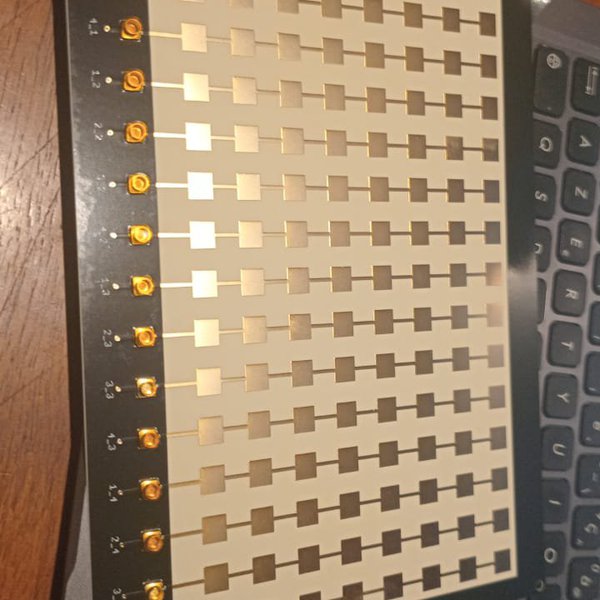
The Open Source PLFM RADAR system operates by utilizing a sophisticated combination of hardware boards and components to transmit, steer, and receive 10.5 GHz radio frequency signals. At the heart of the system is the Main Board, which features an XC7A100T FPGA acting as the central processing and timing controller. The Frequency Synthesizer Board, built around the AD9523-1 clock generator and ADF4382 synthesizer, generates the precise local oscillator and reference signals required for the radar's operation. A Digital-to-Analog Converter (DAC) creates the Phase-Coded Linear Frequency Modulation (PLFM) waveform. This signal is conditioned and sent to the antenna structure—either an 8x16 patch antenna array or a 32x16 dielectric-filled slotted waveguide antenna array—via ADAR1000 Phase Shifters and ADTR1107 Front End chips. The phase shifters allow the radar beam to be electronically steered without physically moving the entire massive assembly, though a stepper motor can be integrated for mechanical positioning. When transmitted pulses reflect off distant targets (up to 20km away), the returning signals are captured by the antenna array, routed through the ADTR1107 front-end chips, and mixed down using LT5552 Microwave Mixers for digital sampling and processing by the FPGA. A Python GUI running on a connected computer manages the user interface, visualization, and high-level control of the radar parameters, while a dedicated Power Management Board ensures stable voltage distribution across all sensitive RF and digital circuits.
Why Build This
Gain hands-on engineering experience with advanced microwave frequencies, phased array beamforming, and radar signal processing principles relevant to aerospace and defense tracking.
Develop practical skills in integrating complex mixed-signal systems involving high-speed FPGAs, precision frequency synthesizers, microwave mixers, and custom antenna arrays.
Explore open-source RF architectures for real-world applications such as drone detection, weather monitoring, and advanced university-level radar research.
Real-World Application
Drone detection, aerospace tracking, defense applications, weather monitoring, and university-level research in RF engineering.
Skills You'll Learn
Phased array beamforming
FPGA gateware design
microwave mixer operation
RF frequency synthesis
high-speed data conversion
antenna array integration
Python GUI development
Safety Precautions
No specific precautions noted for this build — always follow general electronics safety practices.
Technology Tags
RADAR
PHASED ARRAY
SDR
RF
FPGA
PYTHON
PLFM
BEAM STEERING
ANALOG
DIGITAL SIGNAL PROCESSING
Frequently Asked Questions
PLFM stands for Phase-Coded Linear Frequency Modulation. It is a pulse compression technique that allows the radar to achieve high range resolution and long detection ranges (up to 20km) simultaneously while operating at lower peak transmitter power.
The Python GUI is required for proper visualization and high-level control of the radar parameters, operating as the primary software interface for the system.
You can use either an 8x16 patch antenna array or a 32x16 dielectric-filled slotted waveguide antenna array, depending on your specific gain, beamwidth, and physical integration requirements for the 10.5 GHz operating frequency.
Gallery
This page is part of Kitkraft's Project Hub — a curated collection of electronics & robotics projects gathered from the maker community to help students and hobbyists discover and learn to build. Kitkraft does not claim authorship of the original project, and makes no representation as to the accuracy, completeness or safety of third-party source material. The summary and "How It Works" explanation above are AI-generated, rewritten with reference to the original tutorial — not a reproduction of it. Full credit and a direct link to the original source are provided above. If you're the original creator and have a concern about how your work is represented here, please contact us and we'll address it promptly.
Kitkraft Project Hub — curated from the maker community, credited at the source.
 A4988 driver Stepper Motor Driver
Rs. 125.00
 400 Points Mini Solderless Prototype PCB Breadboard High Quality
Rs. 89.00
 MB102 Adjustable Breadboard Power Supply Module (3.3V & 5V) for Arduino & Raspberry Pi
Rs. 139.00
 Jumper Wire 10 Pin Male To Male 20cm
Rs. 45.00
 Jumper Wire 10 Pin Male To Female 20cm
Rs. 45.00


