This project is sourced from another site, not written by us — this list is our best match of their components against what we stock, not a verified bill of materials. Always check the original blog (linked above) for the actual parts list before buying.
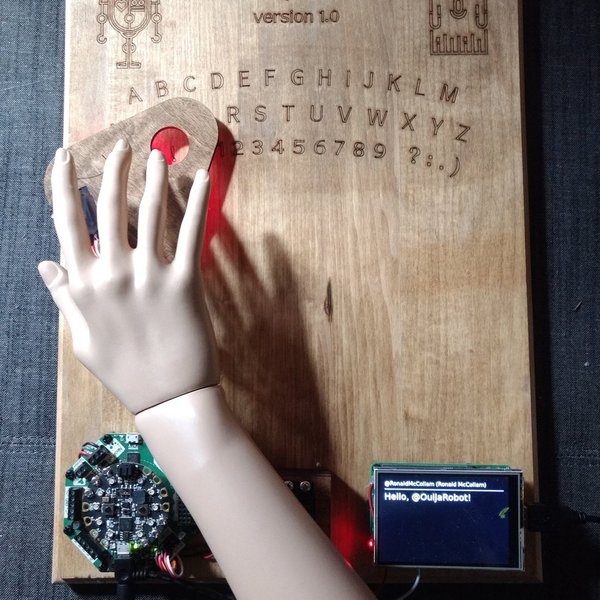
The Ouija Robot operates by combining cloud-based software, single-board computing, and precision mechatronics to physically render digital text. At the heart of the system is a Raspberry Pi, which runs a custom script designed to interface with the Twitter API. This script continuously monitors a specific account or feed for incoming tweets. Once a new tweet is captured, the Raspberry Pi processes the text string character by character, translating the letters into spatial coordinates mapped across the custom laser-cut Ouija board. To execute the physical movement, the Raspberry Pi communicates with the Adafruit Crickit expansion board. The Crickit manages the actuation signals, driving the motors connected to the mannequin arm and the laser-cut planchette. As the arm articulates, it guides the planchette smoothly across the board's surface, pausing at the appropriate letters to spell out the received message. A local 3.5" TFT display attached to the Raspberry Pi provides a convenient visual interface, allowing operators to monitor system status, view incoming tweets in real time, and troubleshoot the script without needing an external desktop monitor. Through this integrated pipeline, ephemeral data from social media is successfully translated into a kinetic, physical performance.
Why Build This
Design and implement a complete cyber-physical system that bridges cloud APIs with hardware actuation for undergraduate coursework or advanced prototyping portfolios.
Gain practical experience integrating specialized motor-controller HATs with single-board computers for multi-axis coordinate tracking.
Develop engaging, interactive social media installations suitable for automated public art displays or high-impact seasonal exhibits.
Real-World Application
Interactive Halloween decorations, automated art installations, and social media-driven physical displays.
Skills You'll Learn
API integration
motor control
coordinate mapping
kinetic sculpture programming
I2C communication
embedded display interfacing
Safety Precautions
Flagged during content review — not in the original source
Ensure the motorized mannequin arm has a clear, unobstructed range of motion to prevent mechanical binding, motor stalling, or pinching hazards during operation.
Technology Tags
ROBOTICS
IOT
TWITTER API
SERVOS
MOTORS
LASER CUTTING
PYTHON
ADAFRUIT CRICKIT
Frequently Asked Questions
The system relies on the Adafruit Crickit and a 3.5" TFT display, which generally mount or connect easily to standard 40-pin header Raspberry Pi models, though software dependencies and physical mounting space should be verified for older boards.
The Twitter interface script maps out a coordinate grid corresponding to the layout of the custom laser-cut Ouija board, translating each letter of the incoming tweet into specific motor movements.
The TFT display provides a local graphical interface to monitor system status, view the text of incoming tweets, and check for script errors without requiring an HDMI monitor and desktop setup.
Gallery
This page is part of Kitkraft's Project Hub — a curated collection of electronics & robotics projects gathered from the maker community to help students and hobbyists discover and learn to build. Kitkraft does not claim authorship of the original project, and makes no representation as to the accuracy, completeness or safety of third-party source material. The summary and "How It Works" explanation above are AI-generated, rewritten with reference to the original tutorial — not a reproduction of it. Full credit and a direct link to the original source are provided above. If you're the original creator and have a concern about how your work is represented here, please contact us and we'll address it promptly.
 Raspberry Pi 3 - Model B+ 1.4Ghz 64-bit quad-core Processor with 1 GB Ram (Original)
Rs. 9,810.00
 400 Points Mini Solderless Prototype PCB Breadboard High Quality
Rs. 89.00
 MB102 Adjustable Breadboard Power Supply Module (3.3V & 5V) for Arduino & Raspberry Pi
Rs. 139.00
 Jumper Wire 10 Pin Male To Male 20cm
Rs. 45.00
 Jumper Wire 10 Pin Male To Female 20cm
Rs. 45.00


