This project is sourced from another site, not written by us — this list is our best match of their components against what we stock, not a verified bill of materials. Always check the original blog (linked above) for the actual parts list before buying.
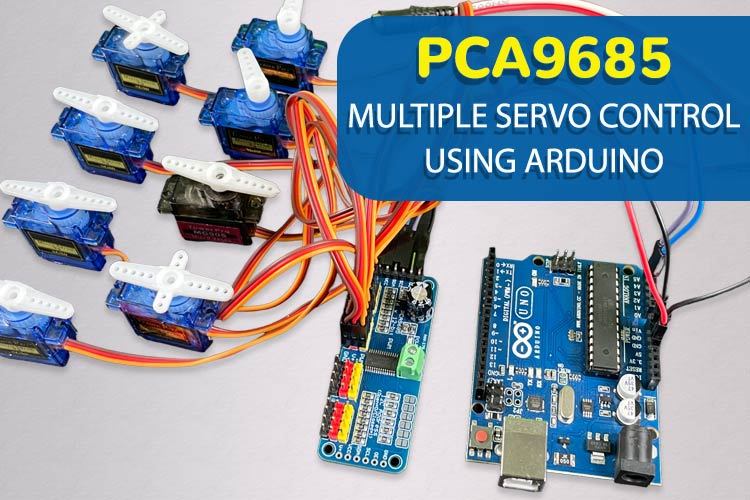
The PCA9685 - Multiple Servo Control Using Arduino project relies on offloading pulse-width modulation (PWM) generation from an Arduino Uno R3 to a dedicated PCA9685 16-Channel PWM Servo Driver Module. An Arduino Uno R3 has a limited number of hardware PWM pins, which makes driving eight or more servo motors simultaneously challenging without running out of timer resources or processing power. The PCA9685 module solves this bottleneck by communicating with the Arduino over the I2C protocol, requiring only two data lines (SDA and SCL) to control up to 16 independent PWM channels. Powered by an external 5V power adapter to safely handle the high current draw of the motors, the driver features an onboard clock that continuously generates the necessary PWM signals to hold the SG90 servo motor positions steady. The Arduino IDE, utilizing the Adafruit PWM Servo Driver Library, sends simple I2C commands containing target channel and pulse-width data to the PCA9685. The driver translates these commands into precise duty cycle signals that dictate the exact angular position of each of the eight SG90 servos. Common ground must be established between the external power supply, the PCA9685, and the Arduino Uno R3 to ensure a stable reference voltage for the I2C logic signals.
Why Build This
Develop reliable multi-axis motion control systems essential for undergraduate robotics projects like robotic arms and hexapods.
Master advanced actuator interfacing techniques that overcome the physical pin and power limitations of standard microcontrollers.
Implement I2C communication protocols to scale up peripheral control without consuming scarce general-purpose input/output pins.
Real-World Application
Robotic arms, multi-legged walking robots, pan-tilt camera platforms, automated gantry systems, and complex animatronics.
Skills You'll Learn
I2C serial communication protocol
external power management for inductive loads
PWM signal generation
multi-axis motor control
hardware abstraction using software libraries
Safety Precautions
Ensure an adequate external power supply is used for multiple servos to avoid browning out the microcontroller, and make sure the ground pins of the external power supply and Arduino are shared.
Technology Tags
ARDUINO
PCA9685
I2C
PWM
SERVO MOTOR
ADAFRUIT PWM SERVO DRIVER LIBRARY
C++
ELECTRONICS
Frequently Asked Questions
Servo motors draw significant startup and stall current that far exceeds the current-handling capacity of the Arduino's onboard voltage regulator, which would cause voltage sags, unexpected microcontroller resets, or permanent hardware damage.
Sharing a common ground establishes a uniform reference voltage level, ensuring that the I2C control signals sent from the Arduino are correctly interpreted by the PCA9685 module.
A single PCA9685 module provides up to 16 independent PWM channels, allowing you to control up to 16 individual servo motors simultaneously.
Gallery
This page is part of Kitkraft's Project Hub — a curated collection of electronics & robotics projects gathered from the maker community to help students and hobbyists discover and learn to build. Kitkraft does not claim authorship of the original project, and makes no representation as to the accuracy, completeness or safety of third-party source material. The summary and "How It Works" explanation above are AI-generated, rewritten with reference to the original tutorial — not a reproduction of it. Full credit and a direct link to the original source are provided above. If you're the original creator and have a concern about how your work is represented here, please contact us and we'll address it promptly.
Kitkraft Project Hub — curated from the maker community, credited at the source.
 Arduino UNO R3 Board (Compatible) – ATmega328P Microcontroller with USB Cable
Rs. 999.00
 TowerPro SG90 Mini Servo – 180 degree Rotation – Standard Quality
Rs. 179.00
 MB102 Adjustable Breadboard Power Supply Module (3.3V & 5V) for Arduino & Raspberry Pi
Rs. 139.00
 Jumper Wire 10 Pin Male To Male 20cm
Rs. 45.00
 400 Points Mini Solderless Prototype PCB Breadboard High Quality
Rs. 89.00
 Jumper Wire 10 Pin Male To Female 20cm
Rs. 45.00


