This project is sourced from another site, not written by us — this list is our best match of their components against what we stock, not a verified bill of materials. Always check the original blog (linked above) for the actual parts list before buying.
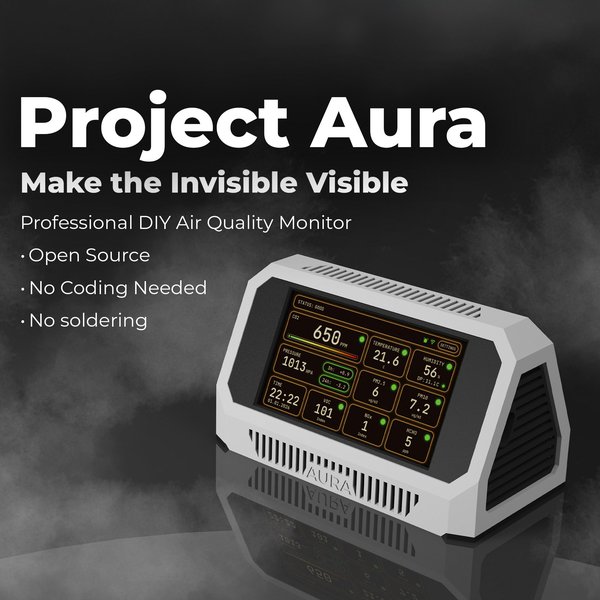
Project Aura operates as an integrated, plug-and-play environmental sensing station centered around the Waveshare ESP32-S3-Touch-LCD-4.3 main controller board. The system's primary sensory input comes from the Sensirion SEN66 all-in-one environmental sensor module, connected via an Adafruit SEN6x breakout adapter board, which measures comprehensive air quality parameters such as particulate matter, carbon dioxide, and volatile organic compounds. Optional expansion is supported through the Seeed Studio Grove SFA30 formaldehyde sensor module for targeted pollutant tracking, alongside an Adafruit BMP580, DPS310, or BMP581 barometric pressure sensor to capture atmospheric changes. The ESP32-S3 microcontroller gathers data from these I2C and digital peripheral sensors, processing the raw telemetry internally. A custom firmware running the LVGL graphical user interface renders real-time charts, metrics, and system status directly onto the integrated 4.3-inch touch display. Additionally, the ESP32-S3 utilizes its onboard wireless capabilities to transmit this data over Wi-Fi using Home Assistant MQTT Auto-Discovery support. This allows the hardware to seamlessly integrate into broader home automation networks without requiring manual topic configuration, enabling automated triggers for ventilation systems or remote environmental tracking from any smart device dashboard.
Why Build This
Deploy a comprehensive, open-source indoor air quality station in homes, offices, or engineering workshops to monitor CO2, particulate matter, and VOC levels.
Integrate physical environmental sensors with cloud-based home automation platforms using MQTT protocols and automated discovery frameworks.
Design and deploy custom embedded graphical user interfaces using LVGL and high-resolution touchscreen microcontrollers.
Real-World Application
Indoor air quality monitoring in homes, offices, and workshops to detect high CO2, particulate matter, and VOC levels, and automatically trigger ventilation systems.
Skills You'll Learn
I2C communication
MQTT protocol implementation
embedded GUI design with LVGL
environmental sensor data acquisition
wireless IoT integration
microcontroller firmware deployment
Safety Precautions
No specific precautions noted for this build — always follow general electronics safety practices.
Technology Tags
ESP32-S3
SENSIRION SEN66
LVGL
MQTT
HOME ASSISTANT
IOT
TOUCHSCREEN
I2C
STEMMA QT
Frequently Asked Questions
No, this is a zero-soldering project utilizing breakout adapter boards and modular connectors like the Seeed Studio Grove system for straightforward physical assembly.
The custom firmware implements Home Assistant MQTT Auto-Discovery support, which automatically transmits configuration payloads over Wi-Fi so Home Assistant instantly recognizes the sensors upon connection.
Yes, the Seeed Studio Grove SFA30 formaldehyde sensor module is completely optional; the core environmental monitoring functions rely primarily on the Sensirion SEN66 module.
Gallery
This page is part of Kitkraft's Project Hub — a curated collection of electronics & robotics projects gathered from the maker community to help students and hobbyists discover and learn to build. Kitkraft does not claim authorship of the original project, and makes no representation as to the accuracy, completeness or safety of third-party source material. The summary and "How It Works" explanation above are AI-generated, rewritten with reference to the original tutorial — not a reproduction of it. Full credit and a direct link to the original source are provided above. If you're the original creator and have a concern about how your work is represented here, please contact us and we'll address it promptly.
Kitkraft Project Hub — curated from the maker community, credited at the source.
 ESP32-C3 Development Board with Berg Pins - Unsoldered
Rs. 390.00
 MB102 Adjustable Breadboard Power Supply Module (3.3V & 5V) for Arduino & Raspberry Pi
Rs. 139.00
 GY-BMP280-3.3 HIGH PRECISION ATMOSPHERIC PRESSURE SENSOR MODULE
Rs. 69.00
 400 Points Mini Solderless Prototype PCB Breadboard High Quality
Rs. 89.00
 Jumper Wire 10 Pin Male To Male 20cm
Rs. 45.00
 Jumper Wire 10 Pin Male To Female 20cm
Rs. 45.00


