Create an IoT-based RFID attendance system using the IndusBoard Coin (ESP32-S2) and MFRC522 reader to log punch-ins/outs with precise NTP time stamps on a local web page.
This project is sourced from another site, not written by us — this list is our best match of their components against what we stock, not a verified bill of materials. Always check the original blog (linked above) for the actual parts list before buying.
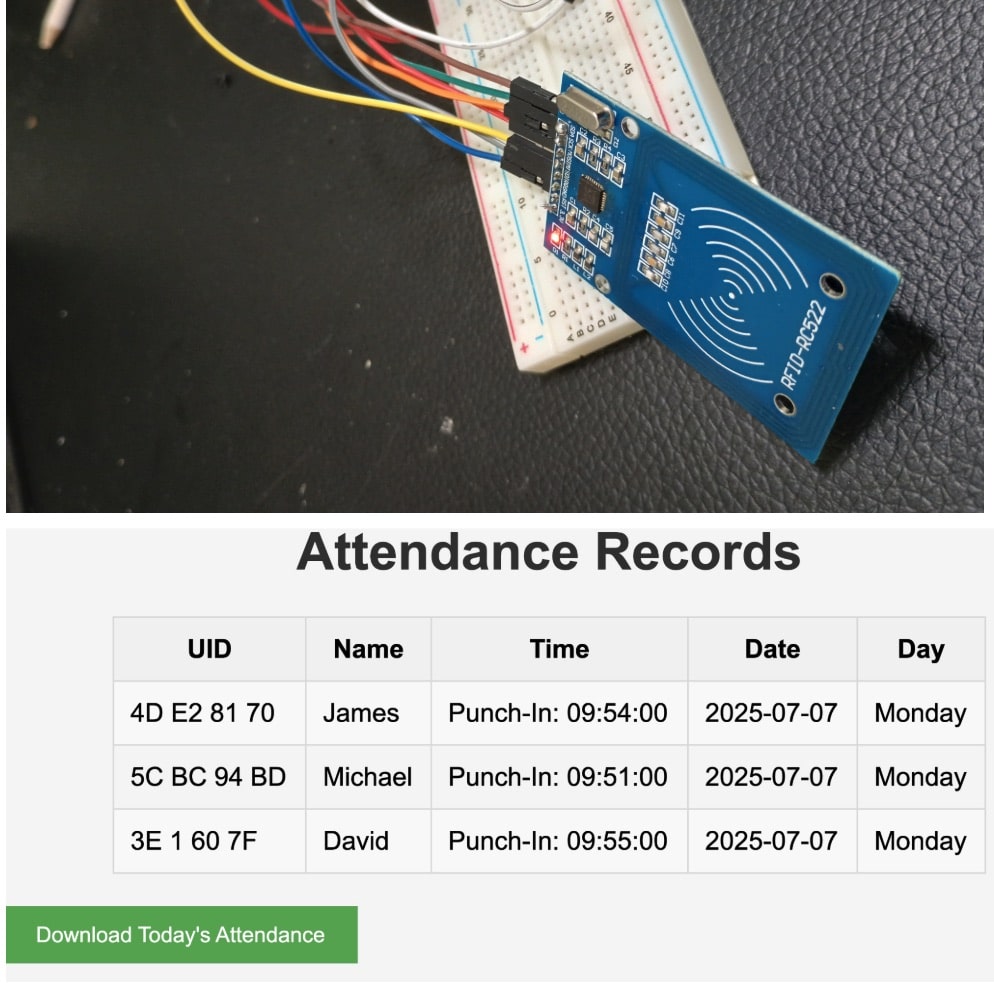
The RFID Attendance IoT System functions by integrating wireless identification technology with network-connected microcontroller processing. At the core of the system is the IndusBoard Coin V2, powered by an ESP32-S2 microcontroller, which connects to a local wireless network using the WiFi and WebServer libraries. When an NTAG 215 RFID card is brought close to the MFRC522 RFID Reader Writer Module, the module communicates with the microcontroller via the SPI protocol to read the unique identifier (UID) encoded on the card. Upon successfully reading a card, the IndusBoard queries an online time server using the NTPClient library to retrieve an accurate, real-time timestamp for the punch-in or punch-out event. The ESP32-S2 then processes this attendance data and hosts a local web page via the WebServer library, allowing users to view logged attendance records directly through a web browser on the same network. The entire system is powered reliably by a 5V DC USB-C adapter supplying 1A of current, ensuring stable operation of both the microcontroller and the peripheral RFID hardware.
Why Build This
Design and deploy a scalable, IoT-based automated attendance logging solution suitable for undergraduate laboratories, lecture halls, or professional office spaces.
Gain practical experience integrating SPI-based RFID peripheral modules with microcontroller firmware to capture and process physical identification data.
Learn how to synchronize embedded systems with network time protocols (NTP) and host a local web server to serve dynamic data without external cloud dependencies.
Real-World Application
Automated attendance tracking for educational institutions, offices, and secure facilities.
Skills You'll Learn
SPI communication protocol
RFID tag reading and parsing
NTP network time synchronization
ESP32 Wi-Fi connection management
local web server hosting
Safety Precautions
No specific precautions noted for this build — always follow general electronics safety practices.
Technology Tags
RFID
MFRC522
IOT
ESP32
WI-FI
NTPCLIENT
WEBSERVER
SPI
ATTENDANCE SYSTEM
C++
Frequently Asked Questions
Yes, as long as they operate on the 13.56MHz frequency and are compatible with the MFRC522 reader module, though the included NTAG 215 cards are guaranteed to work out of the box.
An active Wi-Fi network with internet access is required initially to fetch accurate time stamps via the NTPClient library, though the local web page can be accessed by devices on the same local network.
This basic configuration logs events in the volatile memory of the ESP32-S2 and serves them via the web server; persistent data logging would require adding external storage like an SD card module or connecting to a database.
Gallery
This page is part of Kitkraft's Project Hub — a curated collection of electronics & robotics projects gathered from the maker community to help students and hobbyists discover and learn to build. Kitkraft does not claim authorship of the original project, and makes no representation as to the accuracy, completeness or safety of third-party source material. The summary and "How It Works" explanation above are AI-generated, rewritten with reference to the original tutorial — not a reproduction of it. Full credit and a direct link to the original source are provided above. If you're the original creator and have a concern about how your work is represented here, please contact us and we'll address it promptly.
Kitkraft Project Hub — curated from the maker community, credited at the source.
 RFID Reader/Writer RC522 SPI S50 with RFID Card and Tag
Rs. 190.00
 MB102 Adjustable Breadboard Power Supply Module (3.3V & 5V) for Arduino & Raspberry Pi
Rs. 139.00
 400 Points Mini Solderless Prototype PCB Breadboard High Quality
Rs. 89.00
 Jumper Wire 10 Pin Male To Male 20cm
Rs. 45.00
 Jumper Wire 10 Pin Male To Female 20cm
Rs. 45.00


