This project is sourced from another site, not written by us — this list is our best match of their components against what we stock, not a verified bill of materials. Always check the original blog (linked above) for the actual parts list before buying.
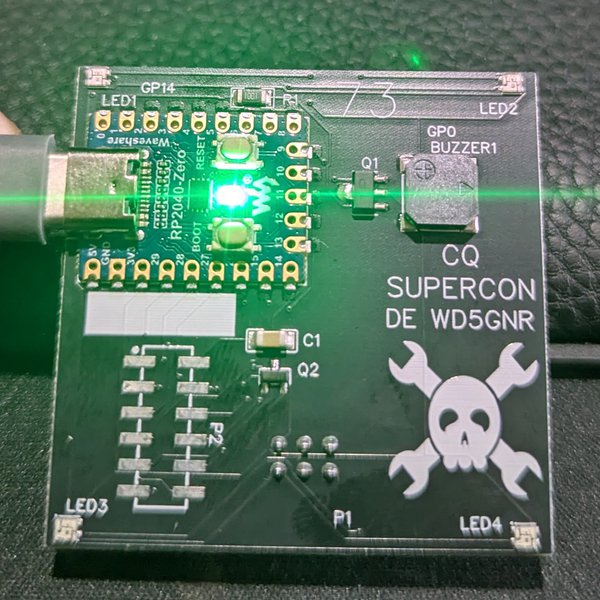
The SAOGNR is a specialized Shitty Add-On (SAO) circuit built around a custom PCB designed to facilitate Morse code communication and interaction. At the core of the system, microcontroller and logic components execute programmed sequences to drive both visual and auditory outputs. When triggered, the logic circuitry generates timed electrical pulses that correspond to Morse code patterns. These signals simultaneously route to a built-in speaker, which translates the timed current pulses into audible audio tones, and to onboard LEDs, which flash synchronously to provide a visual indicator of the transmitted dots and dashes. Additionally, the inclusion of I2C capability allows the SAOGNR to interface with compatible host badges or external microcontrollers, enabling data exchange and expanded communication features beyond standalone operation. Power management components on the board ensure stable voltage distribution to the logic ICs, speaker driver, and LEDs, allowing the system to reliably playback canned messages or respond to interactive commands. Through the integration of discrete electronic components, a custom PCB, and standard communication protocols, the circuit transforms basic electrical switching into a functional, interactive Morse code transceiver and display system.
Why Build This
Explore practical serial communication by implementing I2C protocols between custom hardware modules.
Gain hands-on experience interfacing digital logic with audio transducers and visual indicators for multi-sensory output.
Apply embedded systems concepts to amateur radio traditions and conference badge customization.
Real-World Application
Amateur radio communication, badge customization, and conference hardware tinkering.
Skills You'll Learn
I2C communication protocols
digital logic timing
audio transducer driving
LED circuit design
PCB hardware integration
Safety Precautions
No specific precautions noted for this build — always follow general electronics safety practices.
Technology Tags
MORSE CODE
I2C
PCB DESIGN
HAM RADIO
SOLDERING
SHITTY ADD-ON
Frequently Asked Questions
An SAO (Shitty Add-On) is a small hardware accessory standard primarily used on electronic conference badges. This project can connect to any host device or badge featuring a compatible standard SAO port supporting power and I2C communication.
The project description lists no required software, as the system utilizes canned messages, but customization depends on the specific microcontroller and logic components included in your Bill of Materials.
The onboard microcontroller or logic components route the same timed Morse code pulse train simultaneously to the speaker driver circuit and the LED drivers, ensuring the sounds and flashes match perfectly.
Gallery
This page is part of Kitkraft's Project Hub — a curated collection of electronics & robotics projects gathered from the maker community to help students and hobbyists discover and learn to build. Kitkraft does not claim authorship of the original project, and makes no representation as to the accuracy, completeness or safety of third-party source material. The summary and "How It Works" explanation above are AI-generated, rewritten with reference to the original tutorial — not a reproduction of it. Full credit and a direct link to the original source are provided above. If you're the original creator and have a concern about how your work is represented here, please contact us and we'll address it promptly.
Kitkraft Project Hub — curated from the maker community, credited at the source.
 10pcs 5mm RED Diffused Light Emitting Diodes - LEDs Set
Rs. 39.00
 400 Points Mini Solderless Prototype PCB Breadboard High Quality
Rs. 89.00
 MB102 Adjustable Breadboard Power Supply Module (3.3V & 5V) for Arduino & Raspberry Pi
Rs. 139.00
 Jumper Wire 10 Pin Male To Male 20cm
Rs. 45.00
 Jumper Wire 10 Pin Male To Female 20cm
Rs. 45.00


