Project Hub
/Artificial Intelligence & Edge ML/Object Detection & Tracking/Simple Object Recognition with the UNIHIKER K10
Advanced
ESP32
Project Specific
3 – 6 Hours
Partial Kit
Simple Object Recognition with the UNIHIKER K10
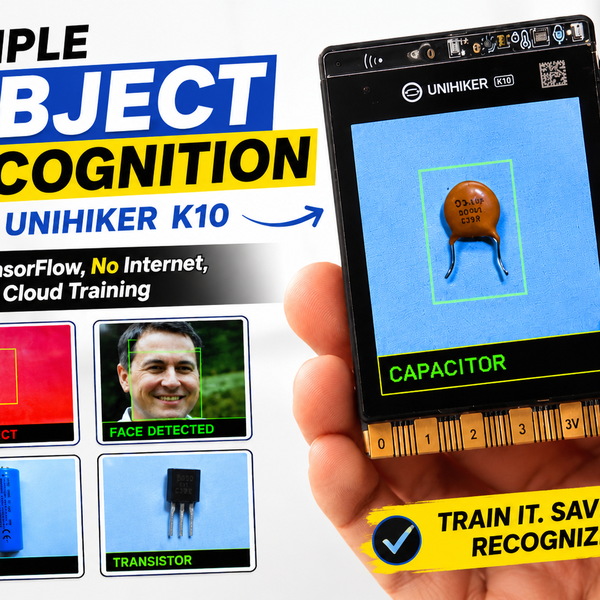
A lightweight object recognition system built on the UNIHIKER K10 that uses visual signatures and region brightness instead of complex machine learning frameworks.
This project is sourced from another site, not written by us — this list is our best match of their components against what we stock, not a verified bill of materials. Always check the original blog (linked above) for the actual parts list before buying.
This object recognition system operates entirely on the UNIHIKER K10 development board, leveraging its integrated ESP32-S3 microcontroller, built-in camera, color display, speaker, microphone, and onboard PSRAM. Instead of relying on heavy cloud servers or complex, resource-intensive neural network frameworks, the system processes visual input locally on the edge. The built-in camera captures real-time video frames, which are temporarily stored and managed using the board's PSRAM to handle the memory demands of image processing. Rather than running deep learning models, the firmware analyzes visual signatures and region brightness directly from the captured pixel data to detect and identify objects. When a targeted object or visual signature is recognized based on these brightness and pattern parameters, the UNIHIKER K10 can trigger immediate feedback locally. This feedback is delivered through its integrated color display—which can render visual indicators or status data—and its onboard speaker or microphone for audio alerts or cues. Coded using C++ through the Arduino IDE, the system combines hardware-level camera management with lightweight computer vision heuristics, demonstrating how powerful edge-based classification can be achieved on a compact microcontroller architecture.
Why Build This
Explore resource-constrained edge machine learning concepts by implementing visual detection algorithms directly on an ESP32-S3 microcontroller without cloud dependencies.
Design and deploy offline smart camera applications suitable for automated sorting, educational robotics, and lightweight industrial maker prototypes.
Integrate multiple onboard peripherals—including a camera, display, and audio components—into a cohesive C++ application using the Arduino IDE.
Real-World Application
Offline smart camera object identification and sorting in educational or lightweight maker projects.
Skills You'll Learn
Edge AI implementation
camera frame buffer management
computer vision heuristics
embedded C++ programming
peripheral integration
local sensory feedback generation
Safety Precautions
No specific precautions noted for this build — always follow general electronics safety practices.
Technology Tags
ESP32-S3
COMPUTER VISION
EMBEDDED AI
OBJECT DETECTION
CAMERA
DISPLAY
OFFLINE AI
Frequently Asked Questions
No. All image capture, processing, and object recognition happen entirely offline on the UNIHIKER K10 board's ESP32-S3 processor.
Microcontrollers like the ESP32-S3 have limited processing power and memory compared to desktop computers, so lightweight heuristic methods allow for real-time performance without crashing the system.
Yes, the project utilizes custom C++ code developed and uploaded via the Arduino IDE tailored for the UNIHIKER K10 hardware.
Gallery
This page is part of Kitkraft's Project Hub — a curated collection of electronics & robotics projects gathered from the maker community to help students and hobbyists discover and learn to build. Kitkraft does not claim authorship of the original project, and makes no representation as to the accuracy, completeness or safety of third-party source material. The summary and "How It Works" explanation above are AI-generated, rewritten with reference to the original tutorial — not a reproduction of it. Full credit and a direct link to the original source are provided above. If you're the original creator and have a concern about how your work is represented here, please contact us and we'll address it promptly.
Kitkraft Project Hub — curated from the maker community, credited at the source.
 ESP32-C3 Development Board with Berg Pins - Unsoldered
Rs. 390.00
 400 Points Mini Solderless Prototype PCB Breadboard High Quality
Rs. 89.00
 MB102 Adjustable Breadboard Power Supply Module (3.3V & 5V) for Arduino & Raspberry Pi
Rs. 139.00
 Jumper Wire 10 Pin Male To Male 20cm
Rs. 45.00
 Jumper Wire 10 Pin Male To Female 20cm
Rs. 45.00


