This project is sourced from another site, not written by us — this list is our best match of their components against what we stock, not a verified bill of materials. Always check the original blog (linked above) for the actual parts list before buying.
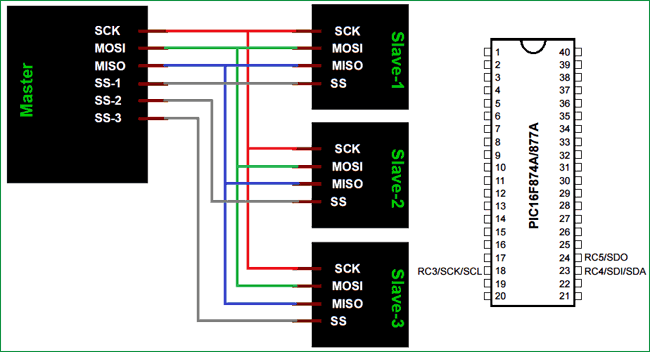
This project establishes a synchronous serial communication link using the Serial Peripheral Interface (SPI) protocol implemented on a PIC16F877A microcontroller. The setup utilizes a breadboard to connect the microcontroller, a power supply, and a programmer/debugger, with connecting wires routing the signals. SPI communication operates on a master-peripheral architecture, relying on dedicated clock and data lines to transfer information between devices at high speeds. In this system, the PIC16F877A acts as one of the communicating nodes, utilizing its internal hardware peripherals to manage the synchronous data exchange. Programming and debugging are handled through the MPLAB X IDE and MPLAB XC8 Compiler, which allow the developer to write, build, and flash the C code directly onto the microcontroller. The power supply ensures stable voltage delivery to the breadboard circuit during operation, while the programmer/debugger facilitates the necessary physical interface between the development computer and the PIC16F877A. Through proper configuration of the microcontroller's control registers via the software toolchain, the system successfully transmits and receives bytes of data synchronously across the shared bus lines.
Why Build This
Master high-speed synchronous serial communication protocols essential for interfacing microcontrollers with modern peripheral hardware like sensors and ADCs.
Gain practical experience configuring hardware communication modules within midrange PIC microcontrollers using standard industry development tools.
Develop foundational skills in embedded systems integration required for undergraduate engineering design and hardware prototyping.
Real-World Application
Used in embedded systems for high-speed synchronous serial communication between microcontrollers and peripheral devices like sensors, ADCs, DACs, and SD cards.
Skills You'll Learn
SPI communication configuration
microcontroller register programming
embedded C software development
digital bus debugging
hardware prototyping on breadboards
Safety Precautions
No specific precautions noted for this build — always follow general electronics safety practices.
Technology Tags
PIC16F877A
SPI
MICROCONTROLLER
EMBEDDED SYSTEMS
C PROGRAMMING
SERIAL COMMUNICATION
Frequently Asked Questions
You will need the MPLAB X IDE and the MPLAB XC8 Compiler to write, compile, and flash your code to the microcontroller.
Yes, SPI is commonly used in embedded systems for high-speed synchronous communication with sensors, ADCs, DACs, and SD cards.
Yes, a programmer/debugger is required to transfer the compiled program from your computer to the PIC16F877A microcontroller.
Gallery
This page is part of Kitkraft's Project Hub — a curated collection of electronics & robotics projects gathered from the maker community to help students and hobbyists discover and learn to build. Kitkraft does not claim authorship of the original project, and makes no representation as to the accuracy, completeness or safety of third-party source material. The summary and "How It Works" explanation above are AI-generated, rewritten with reference to the original tutorial — not a reproduction of it. Full credit and a direct link to the original source are provided above. If you're the original creator and have a concern about how your work is represented here, please contact us and we'll address it promptly.
Kitkraft Project Hub — curated from the maker community, credited at the source.
 Jumper Wire 10 Pin Male To Male 20cm
Rs. 45.00
 MB102 Adjustable Breadboard Power Supply Module (3.3V & 5V) for Arduino & Raspberry Pi
Rs. 139.00
 400 Points Mini Solderless Prototype PCB Breadboard High Quality
Rs. 89.00
 Jumper Wire 10 Pin Male To Female 20cm
Rs. 45.00


