We stock the boards, sensors and modules this project needs. A full parts list is coming soon — for now, browse our DIY Kits & components or search for ESP32 parts.
This project is sourced from another site, not written by us — this list is our best match of their components against what we stock, not a verified bill of materials. Always check the original blog (linked above) for the actual parts list before buying.
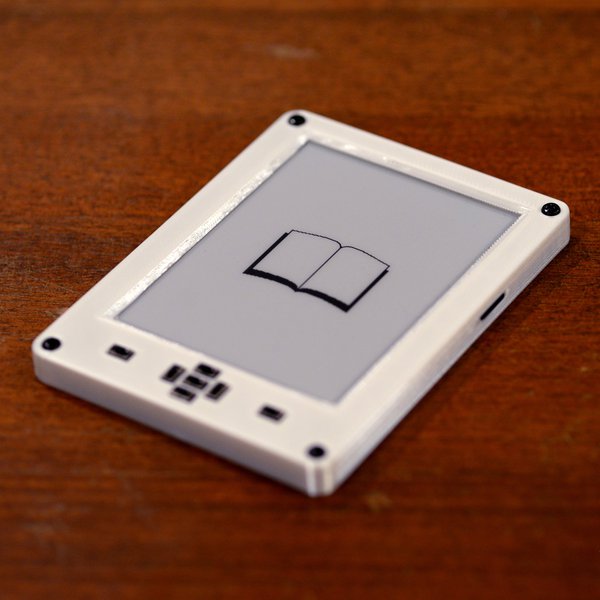
The Open Book is an open-source e-reader built around an ESP32-S3 microcontroller board, which serves as the central processing unit and coordinates all system operations. When you power on the device using a rechargeable LiPo battery, the ESP32-S3 boots the Open Book firmware (Libros) stored in its memory. To display text, the microcontroller communicates with an E-Paper display, which retains images and text using microcapsules without continuously drawing power, mimicking real paper. Books and documents are stored externally on a MicroSD card and accessed by the microcontroller via the SDFat library, allowing users to load vast digital libraries onto the device. All of these core electronic components are securely mounted onto a custom PCB designed to integrate the circuitry cleanly. Finally, the entire assembly is housed inside custom 3D printed enclosure parts that are fastened together using M2.5 screws, creating a portable, self-contained electronic gadget.
Why Build This
Create your own fully customizable, open-source personal electronic reading device from scratch.
Learn practical hardware hacking and embedded systems development suitable for advanced school projects.
Build an accessible reading aid capable of supporting diverse languages and custom firmware modifications.
Real-World Application
Open-source personal electronic reading device, educational platform for hardware hacking, and accessible reading aid for diverse languages.
Skills You'll Learn
Microcontroller programming
E-Paper display integration
SPI and SD card file system management
LiPo battery power management
CAD modeling and 3D printing assembly
custom PCB integration
Safety Precautions
Flagged during content review — not in the original source
This project uses a rechargeable LiPo battery; handle the battery with care to avoid punctures, short circuits, or overcharging, and ensure proper polarity during assembly.
Technology Tags
ESP32-S3
E-PAPER
OPEN SOURCE HARDWARE
C++
OPENSCAD
3D PRINTING
MICROSD
Frequently Asked Questions
Yes, text files and supported formats can be loaded onto a MicroSD card and read using the device's firmware and SDFat library.
You will need the Arduino IDE or ESP-IDF development framework to compile and upload the Open Book firmware (Libros).
Yes, the 3D printed parts and M2.5 screws form the physical enclosure that protects the custom PCB, E-Paper screen, and LiPo battery.
Gallery
This page is part of Kitkraft's Project Hub — a curated collection of electronics & robotics projects gathered from the maker community to help students and hobbyists discover and learn to build. Kitkraft does not claim authorship of the original project, and makes no representation as to the accuracy, completeness or safety of third-party source material. The summary and "How It Works" explanation above are AI-generated, rewritten with reference to the original tutorial — not a reproduction of it. Full credit and a direct link to the original source are provided above. If you're the original creator and have a concern about how your work is represented here, please contact us and we'll address it promptly.
Kitkraft Project Hub — curated from the maker community, credited at the source.