Project Hub/Robotics & Autonomous Systems/Obstacle Avoiding/Triangle Wave Generator Circuit using Op-amp
Intermediate
ANALOG / DISCRETE
< ₹500
3 – 6 Hours
Triangle Wave Generator Circuit using Op-amp
A simple triangle wave generator circuit built using an LM358 operational amplifier and a few discrete passive components.
Originally published by V Vivekanand on CircuitDigest
View original tutorial
How It Works
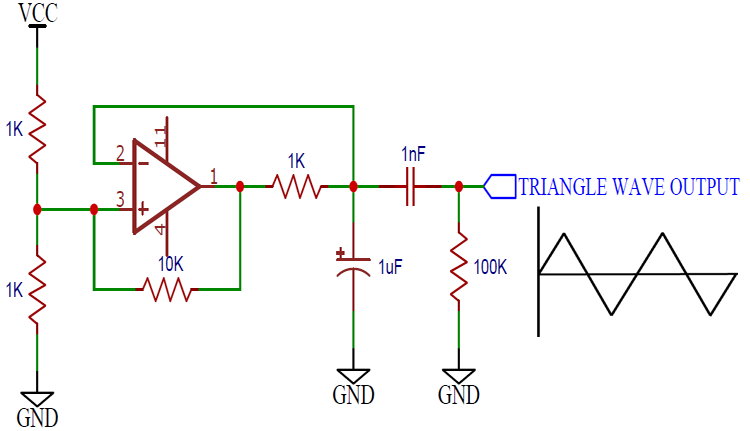
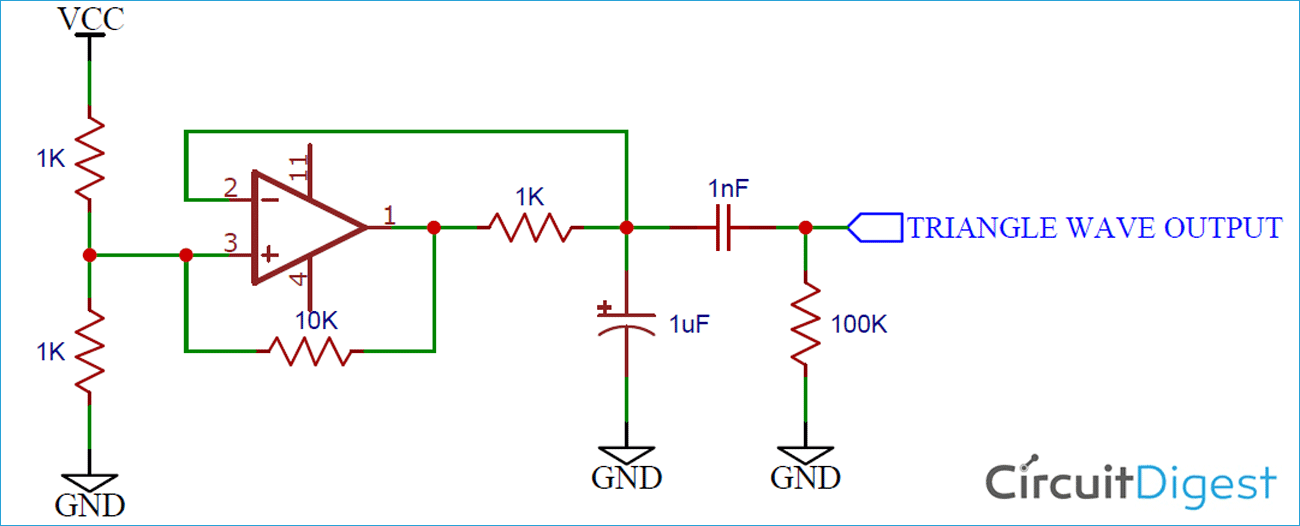
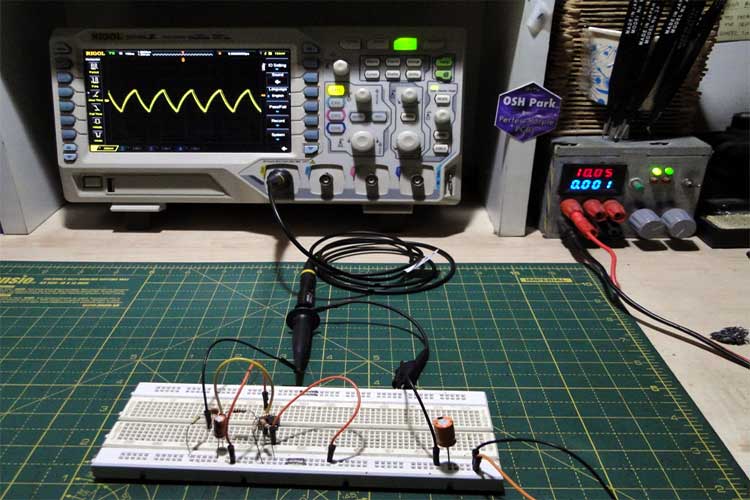
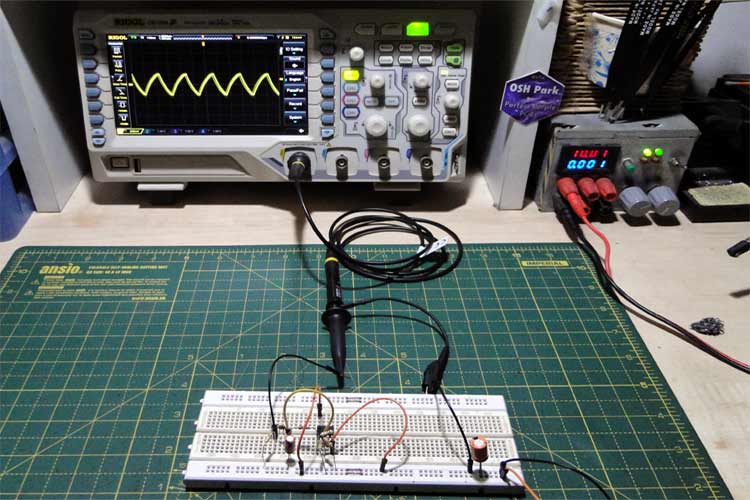
The Triangle Wave Generator Circuit uses an LM358 operational amplifier along with resistors, ceramic and electrolytic capacitors configured on a breadboard to produce a continuous triangular waveform. At its core, the circuit relies on a feedback loop combining an integrator and a comparator stage. The op-amp configuration continuously charges and discharges the capacitors through the resistor network, alternating the output voltage between positive and negative saturation limits. As the 1nF ceramic capacitor and 1uF electrolytic capacitor charge and discharge, the voltage across them ramps up and down linearly rather than switching instantly. This linear charging action creates the sloping sides of the triangle wave. The 1K, 10K, and 100K resistors set the precise voltage thresholds and time constants that dictate the frequency and amplitude of the output signal. By using the oscilloscope, you can visually observe how the switching thresholds trigger the reversal of the capacitor charging direction, resulting in a clean, repeating triangle wave output without needing any microcontroller or software programming.
Why Build This
Generate custom analog signals for testing audio tone generators and PWM controllers.
Learn fundamental analog circuit design principles relevant to physics and engineering curricula.
Practice using an oscilloscope to measure, visualize, and debug analog waveforms on a breadboard.
Real-World Application
Used in function generators, transistor curve tracers, PWM controllers, class D amplifiers, and audio tone generators.
Skills You'll Learn
Analog circuit assembly
Operational amplifier applications
Waveform analysis
Oscilloscope operation
RC charging time constants
Safety Precautions
Standard low-voltage DC electronics safety precautions apply.
Technology Tags
OP-AMP
LM358
WAVEFORM GENERATOR
TRIANGLE WAVE
RELAXATION OSCILLATOR
ANALOG CIRCUITRY
Ready to build this?
We stock the boards, sensors and modules this project needs. A full parts list is coming soon — for now, browse our DIY Kits & components or search for Analog / Discrete parts.
Frequently Asked Questions
Do I need a microcontroller or software to program this circuit?
No, this is a purely analog circuit built using discrete passive components and an op-amp, so no programming or software is required.
Why do I need an oscilloscope for this project?
An oscilloscope is essential for visualizing the generated triangle wave, measuring its frequency and amplitude, and confirming that the circuit is oscillating correctly.
Can I substitute different resistor or capacitor values?
While you can experiment with different values, changing the resistors and capacitors will directly alter the frequency and amplitude of the output triangle wave.
Gallery
Kitkraft Project Hub — curated from the maker community, credited at the source.
PRJ-00160