Ultrasonic Liquid Level Monitoring System Using MATLAB
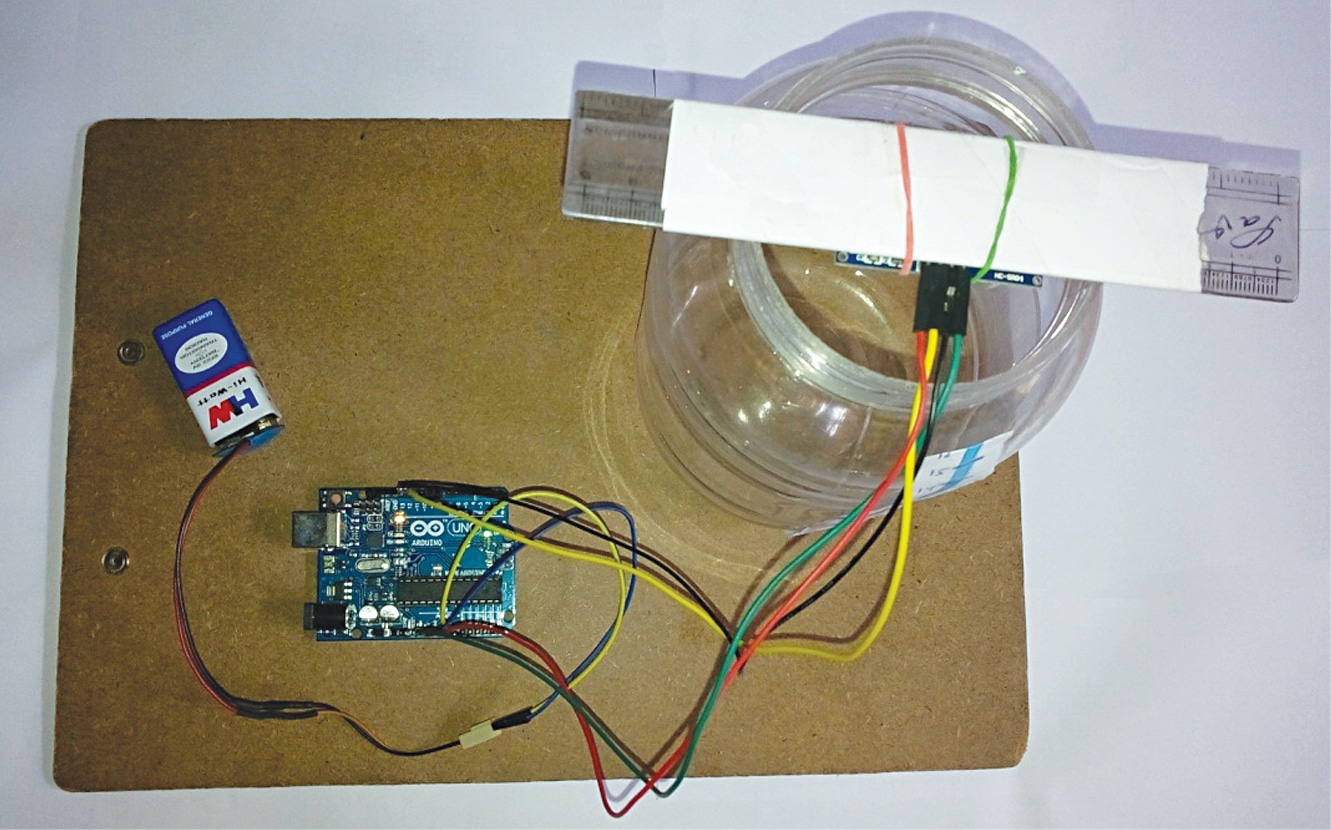
An ultrasonic liquid level monitoring system that uses an Arduino and HC-SR04 sensor mounted on a tank to measure liquid height, communicating the data to a custom MATLAB GUI.
This project is sourced from another site, not written by us — this list is our best match of their components against what we stock, not a verified bill of materials. Always check the original blog (linked above) for the actual parts list before buying.
The Ultrasonic Liquid Level Monitoring System operates by utilizing high-frequency sound waves to measure the distance between the top of a liquid tank and the surface of the liquid. At the core of the system is an Arduino Uno, which acts as the central processing unit and controller. Connected to the Arduino is an HC-SR04 ultrasonic sensor module, positioned securely above the liquid tank pointing downward toward the fluid. The Arduino sends a short trigger signal to the HC-SR04, prompting it to emit an ultrasonic burst. This sound wave travels downward, reflects off the surface of the liquid, and bounces back to the sensor as an echo. The HC-SR04 detects this reflection and outputs an echo pulse whose duration is directly proportional to the total travel time. By measuring the length of this pulse using the Arduino Uno, the system calculates the exact distance using the known speed of sound. Once the distance from the sensor to the liquid surface is determined, the Arduino transmits this data over a serial communication link to a connected PC. Running on the PC is a custom MATLAB interface, which receives the serial data, processes it, and displays the liquid level in real-time through a graphical user interface (GUI). This allows users to continuously monitor liquid height, assess volume changes, and maintain safe operational thresholds from a remote workstation.
Why Build This
Gain hands-on experience in interfacing hardware sensors with advanced engineering software like MATLAB for real-time data acquisition and visualization.
Understand industrial automation principles by designing a functional prototype used in water treatment and chemical storage monitoring.
Develop practical programming skills in both C++ (via the Arduino IDE) and MATLAB scripting to bridge embedded systems with desktop applications.
Real-World Application
Process industries, chemical plants, water treatment facilities, and fuel storage tanks where monitoring flammable, corrosive, or expensive liquids is crucial to prevent spills and overflow.
Skills You'll Learn
Ultrasonic time-of-flight measurement
serial communication between Arduino and MATLAB
GUI design in MATLAB
microcontroller digital input/output operations
real-time data acquisition
Safety Precautions
No specific precautions noted for this build — always follow general electronics safety practices.
Technology Tags
ARDUINO
ULTRASONIC SENSOR
MATLAB
GUI
LIQUID LEVEL MONITORING
SENSORS
MICROCONTROLLER
Frequently Asked Questions
No, you will need to install the MATLAB Support Package for Arduino Hardware, which allows MATLAB to execute commands and read serial data directly from the board.
The sensor measures the empty space from the top of the tank to the liquid surface. By subtracting this measured distance from the total known height of the tank, the system calculates the actual liquid level.
The ultrasonic sensor relies on sound wave reflections. Highly turbulent liquids, heavy foam, or corrosive vapors can scatter or absorb the sound waves, potentially causing inaccurate readings.
Gallery
This page is part of Kitkraft's Project Hub — a curated collection of electronics & robotics projects gathered from the maker community to help students and hobbyists discover and learn to build. Kitkraft does not claim authorship of the original project, and makes no representation as to the accuracy, completeness or safety of third-party source material. The summary and "How It Works" explanation above are AI-generated, rewritten with reference to the original tutorial — not a reproduction of it. Full credit and a direct link to the original source are provided above. If you're the original creator and have a concern about how your work is represented here, please contact us and we'll address it promptly.
 Arduino UNO R3 Board (Compatible) – ATmega328P Microcontroller with USB Cable
Rs. 999.00
 Ultrasonic Sensor Module HC-SR04
Rs. 89.00
 Jumper Wire 10 Pin Male To Male 20cm
Rs. 45.00
 400 Points Mini Solderless Prototype PCB Breadboard High Quality
Rs. 89.00
 MB102 Adjustable Breadboard Power Supply Module (3.3V & 5V) for Arduino & Raspberry Pi
Rs. 139.00
 Jumper Wire 10 Pin Male To Female 20cm
Rs. 45.00


