Project Hub
/Basic Analog & Power Electronics/Discrete & Component Electronics/Unbeatable purely mechanical Tic Tac Toe Machine
Advanced
ANALOG / DISCRETE
₹1,500 – ₹5,000
1 – 2 Days
Partial Kit
Unbeatable purely mechanical Tic Tac Toe Machine
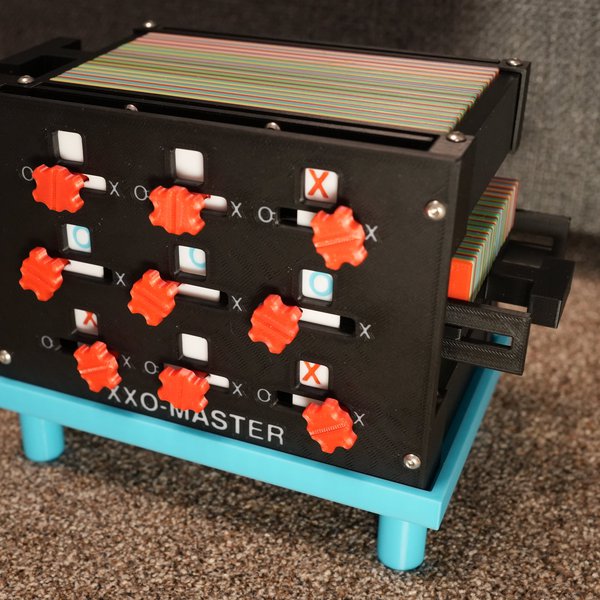
A fully 3D-printed, purely mechanical machine that plays a flawless game of Tic Tac Toe using an edge-notched card lookup table system without any electronics.
We stock the boards, sensors and modules this project needs. A full parts list is coming soon — for now, browse our DIY Kits & components or search for Analog / Discrete parts.
This project is sourced from another site, not written by us — this list is our best match of their components against what we stock, not a verified bill of materials. Always check the original blog (linked above) for the actual parts list before buying.
We don't carry yet: 3D Printed Parts / Filament / Printer
EEPROM / Memory IC
horizontal rods with gears
indicator plates
knobs
release handle
The Unbeatable Purely Mechanical Tic Tac Toe Machine operates entirely through physical kinematics, mechanical logic, and combinatorial data storage without relying on electricity or microcontrollers. The computational core of the machine consists of 65 custom 3D-printed edge-notched logic cards. These cards function as a physical read-only lookup table generated using a Python script running the Minimax algorithm, mapping every possible valid board state to the optimal counter-move. When a human player inputs their move using the mechanical knobs and indicator plates, the physical configuration shifts the internal assembly. A release handle actuates the mechanism, driving a system of 9 horizontal rods equipped with gears and custom printed rack-and-pinion frames. As the rack-and-pinion mechanisms move past the stack of edge-notched cards, the physical presence or absence of notches on the cards allows specific pins or levers to drop or block. This mechanical decoding process selects the correct response card, which physically pushes the corresponding indicator plate to display the machine's optimal move. Through this purely mechanical interaction of gears, racks, pins, and notched cards, the device physically processes data and executes algorithmic game theory in real time.
Why Build This
Explore foundational concepts of mechanical computing and physical data storage by replacing digital transistors with mechanical linkages and punched cards.
Bridge theoretical computer science and mechanical engineering by translating algorithmic game trees generated via Python into physical logic gates.
Gain advanced fabrication experience by combining precision 3D printing tolerances with complex multi-axis mechanical assemblies.
Real-World Application
Demonstration of mechanical computing principles, physical data storage, and lookup table logic without microprocessors.
Skills You'll Learn
Mechanical logic design
algorithmic game tree generation
rack-and-pinion kinematic assembly
physical data encoding
3D printing tolerance tuning
combinatorial lookup table implementation
Safety Precautions
No specific precautions noted for this build — always follow general electronics safety practices.
Technology Tags
3D PRINTING
MECHANICAL COMPUTING
EDGE-NOTCHED CARDS
RACK AND PINION
MINIMAX ALGORITHM
PYTHON
Frequently Asked Questions
No, the device is completely mechanical and powered entirely by user-actuated knobs and a release handle, utilizing zero electrical power.
A Python script using the Minimax algorithm computes the complete game tree for Tic Tac Toe and translates the optimal moves into the specific notch patterns required for the 3D-printed cards.
No, because the lookup table is generated using the Minimax algorithm, the physical mechanism will always execute the mathematically optimal counter-move, resulting in either a win for the machine or a draw.
Gallery
This page is part of Kitkraft's Project Hub — a curated collection of electronics & robotics projects gathered from the maker community to help students and hobbyists discover and learn to build. Kitkraft does not claim authorship of the original project, and makes no representation as to the accuracy, completeness or safety of third-party source material. The summary and "How It Works" explanation above are AI-generated, rewritten with reference to the original tutorial — not a reproduction of it. Full credit and a direct link to the original source are provided above. If you're the original creator and have a concern about how your work is represented here, please contact us and we'll address it promptly.
Kitkraft Project Hub — curated from the maker community, credited at the source.