This DIY project details the first phase of building a vehicle anti-collision system by interfacing a LIDAR sensor using Python and a single-board computer.
This project is sourced from another site, not written by us — this list is our best match of their components against what we stock, not a verified bill of materials. Always check the original blog (linked above) for the actual parts list before buying.
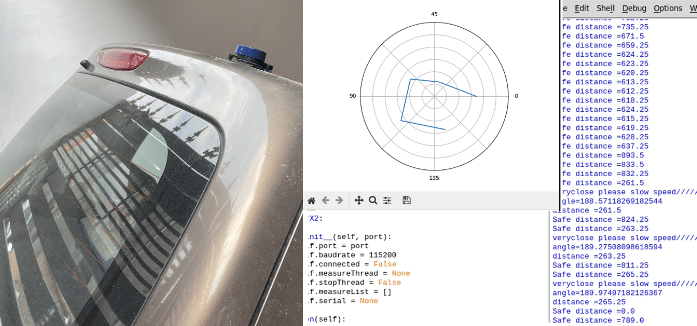
The Vehicle Anti-Collision System operates by deploying a LIDAR sensor connected to a Raspberry Pi 5 single-board computer via connecting cables. The LIDAR sensor emits pulsed laser beams into the surrounding environment and measures the exact time it takes for the light reflections to bounce back from nearby objects, applying time-of-flight principles to calculate precise distance data. The Raspberry Pi runs a Python environment utilizing the sensor's official SDK and associated software libraries to continuously poll, capture, and interpret this continuous stream of spatial measurement data. By processing the incoming point clouds or distance arrays in real-time, the single-board computer can evaluate proximity metrics and determine if an obstacle enters a predefined safety threshold relative to the vehicle's trajectory. Mounting hardware physically secures the sensor to the vehicle frame or test rig to ensure stable optical alignment during movement. While this project establishes the foundational sensing and data-acquisition phase rather than full mechanical braking actuation, it demonstrates how optical ranging data is digitally acquired and evaluated by an embedded Linux computer to form the baseline perception layer for modern advanced driver assistance systems.
Why Build This
Gain hands-on experience designing the perception layer for autonomous electric vehicles and advanced driver assistance systems (ADAS).
Learn to interface high-speed optical ranging sensors with a single-board computer using Python SDKs.
Develop practical undergraduate-level engineering skills in real-time sensor data processing and spatial distance monitoring.
Real-World Application
Automotive safety, advanced driver assistance systems (ADAS), obstacle detection for autonomous vehicles and electric vehicles (EVs), and mobile robotics navigation.
Skills You'll Learn
LIDAR data acquisition
Python sensor integration
real-time distance calculation
embedded Linux interfacing
spatial perception programming
Safety Precautions
Be mindful of laser safety and government regulations regarding LIDAR/laser class usage in outdoor and public environments.
Technology Tags
LIDAR
PYTHON
ADAS
AUTONOMOUS VEHICLES
OBSTACLE DETECTION
SENSORS
ROBOTICS
Frequently Asked Questions
The project can accommodate various LIDAR modules (such as the YDlidar X2 or RPI Lidar), provided you install the corresponding Python SDK and libraries compatible with your specific hardware model.
No, this project covers the initial data acquisition and distance-sensing phase. Integrating physical vehicle controls or electronic braking actuators would require additional hardware phases beyond this tutorial.
The Raspberry Pi 5 runs a full operating system capable of executing resource-intensive Python SDKs, processing complex LIDAR point clouds, and handling high-bandwidth sensor communication more effectively than a basic microcontroller.
Gallery
This page is part of Kitkraft's Project Hub — a curated collection of electronics & robotics projects gathered from the maker community to help students and hobbyists discover and learn to build. Kitkraft does not claim authorship of the original project, and makes no representation as to the accuracy, completeness or safety of third-party source material. The summary and "How It Works" explanation above are AI-generated, rewritten with reference to the original tutorial — not a reproduction of it. Full credit and a direct link to the original source are provided above. If you're the original creator and have a concern about how your work is represented here, please contact us and we'll address it promptly.
 Jumper Wire 10 Pin Male To Male 20cm
Rs. 45.00
 400 Points Mini Solderless Prototype PCB Breadboard High Quality
Rs. 89.00
 MB102 Adjustable Breadboard Power Supply Module (3.3V & 5V) for Arduino & Raspberry Pi
Rs. 139.00
 Jumper Wire 10 Pin Male To Female 20cm
Rs. 45.00


