This project is sourced from another site, not written by us — this list is our best match of their components against what we stock, not a verified bill of materials. Always check the original blog (linked above) for the actual parts list before buying.
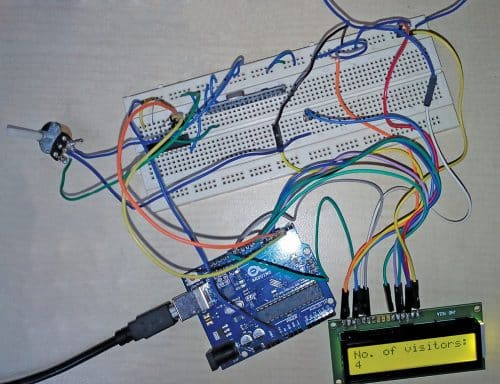
The Wireless Visitors Counter system operates by detecting individuals passing through a monitored entrance and wirelessly relaying the updated tally to a display unit. At the detection site, an infrared (IR) sensor emits a beam of light towards a receiver. When a person walks through the doorway, the IR beam is temporarily broken, causing a change in the analog voltage level from the sensor. This analog signal is conditioned by an LM358 operational amplifier to ensure a clean, reliable digital threshold transition. The processed signal is then read by the Arduino Uno board, which maintains the running count of visitors. To transmit this data without wires, the count is fed into an HT12E encoder IC, which serializes the parallel data bits into a format suitable for the 434MHz RF transmitter module. On the receiving end, the 434MHz RF receiver module captures the transmitted radio frequency signals and passes them to an HT12D decoder IC. The decoder reverses the encoding process, converting the serial data back into parallel signals that represent the visitor count. Finally, the receiving circuitry interfaces with a 16x2 character LCD screen to visually present the real-time occupancy data to the user, allowing for seamless remote monitoring.
Why Build This
Develop practical engineering competence in deploying wireless telemetry systems using cost-effective RF modules for real-world space management.
Gain hands-on experience integrating analog signal conditioning circuits, such as operational amplifiers, with digital microcontroller logic.
Design and implement complete embedded data pipelines that bridge physical sensor interrupts with remote visual displays.
Real-World Application
Useful for monitoring occupancy in buildings like hospitals, shopping malls, and factories during normal operations or emergency situations.
Skills You'll Learn
RF communication principles
IR sensor interfacing
operational amplifier signal conditioning
encoder and decoder IC multiplexing
microcontroller digital I/O handling
character LCD interfacing
Safety Precautions
No specific precautions noted for this build — always follow general electronics safety practices.
Technology Tags
ARDUINO
IR SENSOR
RF MODULE
HT12E
HT12D
LCD
EMBEDDED SYSTEMS
WIRELESS COMMUNICATION
Frequently Asked Questions
The 434MHz RF transmitter and receiver modules simply transmit raw radio frequency waves. The HT12E and HT12D ICs encode the data into a secure, addressable serial stream at the transmitting end and decode it accurately at the receiving end to prevent data corruption or interference.
The LM358 operational amplifier acts as a comparator or signal conditioner, taking the raw analog output from the IR sensor components and converting it into a sharp, reliable digital voltage level that the Arduino Uno can accurately interpret as an interrupt.
The 434MHz RF transmitter and receiver modules are typically designed for short to medium-range wireless communication within line-of-sight or typical indoor environments, making them ideal for room or building entryways but limited across vast distances without external antennas or signal boosters.
Gallery
This page is part of Kitkraft's Project Hub — a curated collection of electronics & robotics projects gathered from the maker community to help students and hobbyists discover and learn to build. Kitkraft does not claim authorship of the original project, and makes no representation as to the accuracy, completeness or safety of third-party source material. The summary and "How It Works" explanation above are AI-generated, rewritten with reference to the original tutorial — not a reproduction of it. Full credit and a direct link to the original source are provided above. If you're the original creator and have a concern about how your work is represented here, please contact us and we'll address it promptly.
 Arduino UNO R3 Board (Compatible) – ATmega328P Microcontroller with USB Cable
Rs. 999.00
 IR Proximity Sensor Module With Pot
Rs. 55.00
 400 Points Mini Solderless Prototype PCB Breadboard High Quality
Rs. 89.00
 MB102 Adjustable Breadboard Power Supply Module (3.3V & 5V) for Arduino & Raspberry Pi
Rs. 139.00
 Jumper Wire 10 Pin Male To Male 20cm
Rs. 45.00
 Jumper Wire 10 Pin Male To Female 20cm
Rs. 45.00


