An Arduino-based automatic water tank filling system that monitors water levels and intelligently selects between municipal supply and an underground tank.
This project is sourced from another site, not written by us — this list is our best match of their components against what we stock, not a verified bill of materials. Always check the original blog (linked above) for the actual parts list before buying.
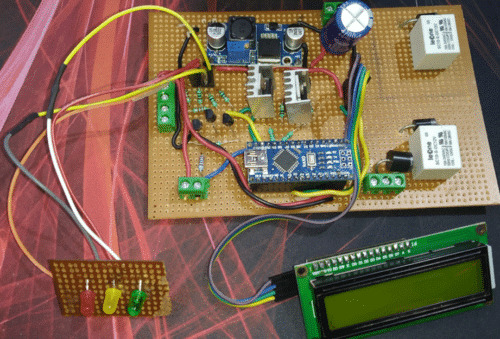
The Automatic Water Tank Filling System operates through a coordinated network of sensing elements, processing hardware, and power-switching components designed to automate fluid management. At the heart of the system is an Arduino Nano, which continuously monitors fluid levels via a set of electrodes submerged in the water tank. These electrodes detect changes in electrical conductivity as water rises or falls, providing real-time digital feedback to the microcontroller's input pins. To bridge the voltage gap between the delicate low-voltage logic signals and the higher power requirements of the system's actuators, the circuit employs three BC548 NPN bipolar junction transistors. These transistors act as solid-state switches to drive two IRF530 power MOSFETs and a mechanical relay. Depending on the logic state determined by the water level readings, the Arduino triggers the relay and power MOSFETs to intelligently route power to the connected water pump and solenoid valve. This enables the system to dynamically select between a municipal supply line and an underground storage reservoir, ensuring the tank is replenished efficiently without overflowing. Simultaneously, a 16x2 LCD panel connected via an I2C interface provides a continuous visual readout of the current system status and fluid levels, keeping operators fully informed of the automated filling cycle.
Why Build This
Apply embedded microcontroller programming to solve complex fluid-routing and resource management problems typical of automated civil engineering systems.
Design robust hardware interfaces that safely isolate low-voltage digital control logic from higher-power electromechanical actuators like relays, pumps, and solenoids.
Implement real-time sensor feedback loops and user interfaces using I2C communication and discrete semiconductor switching devices.
Real-World Application
Household water management, preventing tank overflow, and automating water supply in residential or commercial buildings.
Skills You'll Learn
Microcontroller GPIO interfacing
I2C communication protocol
transistor and MOSFET switching circuit design
relay control
sensor signal conditioning
Safety Precautions
Ensure proper electrical insulation when dealing with water pumps and AC mains powered contactors or solenoids.
Technology Tags
ARDUINO
MICROCONTROLLER
SENSORS
SOLENOID VALVE
WATER PUMP
RELAY
MOSFET
BJT
LCD DISPLAY
Frequently Asked Questions
The system uses discrete sensing pins configured to draw minimal current, reducing electrochemical degradation, though regular inspection of the electrodes is still recommended in permanent installations.
The BC548 transistors handle low-power signal conditioning and translation, while the IRF530 MOSFETs and relay provide the necessary high-current switching capacity required to drive the water pump and solenoid valve.
While standard parallel connection is possible, the I2C interface is specifically utilized here to minimize the number of required digital input/output pins on the Arduino Nano, leaving more pins available for sensor inputs.
Gallery
This page is part of Kitkraft's Project Hub — a curated collection of electronics & robotics projects gathered from the maker community to help students and hobbyists discover and learn to build. Kitkraft does not claim authorship of the original project, and makes no representation as to the accuracy, completeness or safety of third-party source material. The summary and "How It Works" explanation above are AI-generated, rewritten with reference to the original tutorial — not a reproduction of it. Full credit and a direct link to the original source are provided above. If you're the original creator and have a concern about how your work is represented here, please contact us and we'll address it promptly.
 Arduino Nano C Type V3 ATMEGA328 with Soldered Headers
Rs. 608.00
 5V 1 Channel Relay Module
Rs. 87.00
 400 Points Mini Solderless Prototype PCB Breadboard High Quality
Rs. 89.00
 MB102 Adjustable Breadboard Power Supply Module (3.3V & 5V) for Arduino & Raspberry Pi
Rs. 139.00
 Jumper Wire 10 Pin Male To Male 20cm
Rs. 45.00
 Jumper Wire 10 Pin Male To Female 20cm
Rs. 45.00


