A DIY smart water tap system built without a microcontroller that automatically turns on when hands or a container are detected and shuts off when the container is filled.
This project is sourced from another site, not written by us — this list is our best match of their components against what we stock, not a verified bill of materials. Always check the original blog (linked above) for the actual parts list before buying.
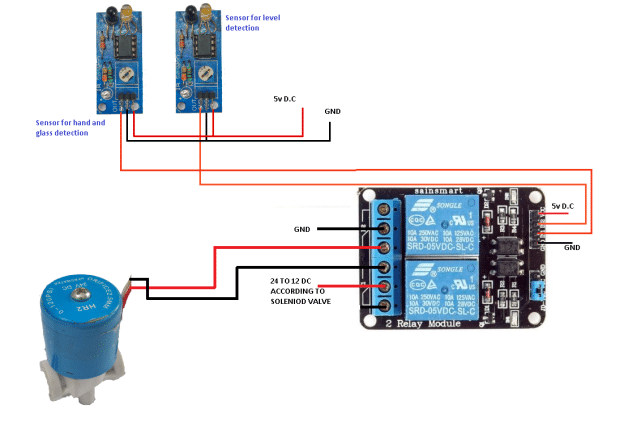
The Smart Water Tap system operates entirely through hardwired discrete logic and analog sensing, completely bypassing the need for a programmable microcontroller. The core of the system relies on two infrared (I.R.) sensor modules that continuously monitor the area beneath the water pipe and tap. When the first I.R. sensor detects the presence of hands or a container, it generates a low-voltage trigger signal. This signal is fed into a 2-channel relay board, which acts as an electromechanical switch. Upon receiving the trigger, the relay changes state, allowing power from the 12 to 24V AC-to-DC power adapter to flow directly to the solenoid valve. Once energized, the solenoid valve opens, allowing water to flow freely through the pipe. A second I.R. sensor module is strategically positioned to monitor the fill level or presence of the container; when the target condition is met, it sends a complementary signal to the second channel of the relay board. This action cuts off power to the solenoid valve, instantly closing it and stopping the flow of water. The entire circuit is powered by a combination of a 5V DC battery to run the sensitive sensor and relay logic, and the higher-voltage adapter dedicated to driving the heavy-duty solenoid valve. By routing signals directly from sensors to relays, the system automates water dispensing reliably without writing a single line of software code.
Why Build This
Learn how to automate everyday household plumbing fixtures using basic electronics without needing complex programming skills.
Practice water conservation by building a practical hands-free tap system that prevents accidental water overflow and waste.
Gain hands-on experience integrating multiple power sources, sensors, and electromechanical relays into a single functioning hardware assembly.
Real-World Application
Industrial automation, water vending machines, and household water conservation to prevent wastage from running taps.
Skills You'll Learn
Infrared sensor integration
electromechanical relay switching
solenoid valve control
multi-voltage circuit wiring
automated fluid management
Safety Precautions
Ensure proper isolation and handling when working with AC-to-DC power adapters and solenoid valves operating at higher voltages.
Technology Tags
IR SENSOR
RELAY MODULE
SOLENOID VALVE
WATER CONSERVATION
ANALOG ELECTRONICS
AUTOMATION
Frequently Asked Questions
Yes, this project is specifically designed to work entirely through hardware logic, using sensors and relays to control the valve directly without a microcontroller or software.
The 5V DC battery supplies stable power to the sensitive I.R. sensor modules and relay board logic, while the higher-voltage 12 to 24V adapter provides the necessary power to reliably actuate the heavy-duty solenoid valve.
The second I.R. sensor module is positioned to detect when a container is filled or present, sending a signal back to the relay board to cut power to the solenoid valve and close the water flow.
Gallery
This page is part of Kitkraft's Project Hub — a curated collection of electronics & robotics projects gathered from the maker community to help students and hobbyists discover and learn to build. Kitkraft does not claim authorship of the original project, and makes no representation as to the accuracy, completeness or safety of third-party source material. The summary and "How It Works" explanation above are AI-generated, rewritten with reference to the original tutorial — not a reproduction of it. Full credit and a direct link to the original source are provided above. If you're the original creator and have a concern about how your work is represented here, please contact us and we'll address it promptly.
 5V 1 Channel Relay Module
Rs. 45.00
 Jumper Wire 10 Pin Male To Male 20cm
Rs. 45.00
 MB102 Adjustable Breadboard Power Supply Module (3.3V & 5V) for Arduino & Raspberry Pi
Rs. 139.00
 400 Points Mini Solderless Prototype PCB Breadboard High Quality
Rs. 89.00
 Jumper Wire 10 Pin Male To Female 20cm
Rs. 45.00


