This project is sourced from another site, not written by us — this list is our best match of their components against what we stock, not a verified bill of materials. Always check the original blog (linked above) for the actual parts list before buying.
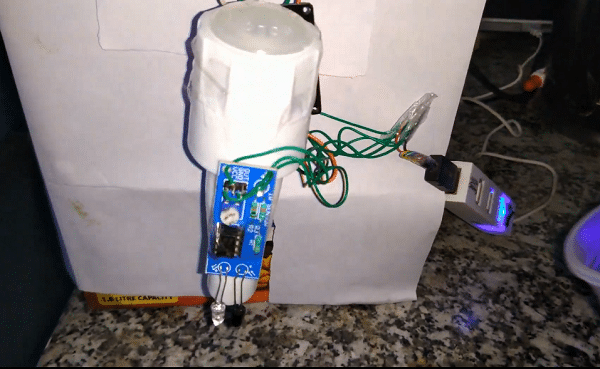
The Cheapest Touchless Water Dispenser operates as an open-loop electromechanical control system leveraging analog proximity detection. The core of the circuit centers on an infrared (IR) sensor, which continuously emits modulated infrared light and monitors for reflections off nearby objects, such as a user's hands. When an object enters the detection threshold, the IR sensor's output state transitions, generating a control signal sent to the input pin of a relay module. The relay module acts as an electrically operated switch, utilizing an internal electromagnetic coil to physically close a high-current circuit powered by a 5V/12V battery or external power source. Once the relay triggers, current flows directly into the solenoid valve. The solenoid valve uses this electrical current to energize an internal inductive coil, generating a magnetic field that lifts a plunger against a spring, thereby opening the valve orifice and allowing water to flow freely through the connected pipe and hose infrastructure. When the user removes their hands, the IR sensor detects the absence of a reflection, drops the control signal, de-energizes the relay, and cuts power to the solenoid valve. A mechanical spring inside the valve forces the seal closed instantly, stopping the water flow without requiring any physical contact from the user.
Why Build This
Design and prototype a cost-effective, hygienic public sanitation station suitable for deployment in resource-constrained environments.
Gain practical experience integrating discrete analog sensors with electromechanical actuators like relays and solenoid valves for automation tasks.
Analyze DC power distribution, switching transients, and mechanical fluid control principles within an undergraduate engineering curriculum.
Real-World Application
Hygienic, touchless public water and hand sanitizer dispensing stations to prevent germ transmission.
Skills You'll Learn
IR proximity sensing
electromechanical relay interfacing
inductive load control
fluid valve actuation
DC power management
Safety Precautions
Ensure proper electrical insulation when working with DC power sources and water pumps or solenoid valves.
Technology Tags
IR SENSOR
RELAY MODULE
SOLENOID VALVE
TOUCHLESS DISPENSER
AUTOMATION
HARDWARE DIY
Frequently Asked Questions
An IR sensor typically outputs a low-current logic signal that cannot directly drive the heavy electrical load of a solenoid valve. The relay module acts as an isolated electronic switch, using the low-power sensor signal to safely control the higher current required by the valve.
Yes, provided the power source can supply sufficient current for both devices simultaneously. However, you must account for voltage drops and ensure the battery voltage matches the operating specifications of both your specific IR sensor and solenoid valve.
Ensure all electronic modules, batteries, and wiring connections are housed in a water-resistant enclosure physically separated from the fluid path, pipe fittings, and the solenoid valve.
Gallery
This page is part of Kitkraft's Project Hub — a curated collection of electronics & robotics projects gathered from the maker community to help students and hobbyists discover and learn to build. Kitkraft does not claim authorship of the original project, and makes no representation as to the accuracy, completeness or safety of third-party source material. The summary and "How It Works" explanation above are AI-generated, rewritten with reference to the original tutorial — not a reproduction of it. Full credit and a direct link to the original source are provided above. If you're the original creator and have a concern about how your work is represented here, please contact us and we'll address it promptly.
 IR Proximity Sensor Module With Pot
Rs. 55.00
 5V 1 Channel Relay Module
Rs. 45.00
 400 Points Mini Solderless Prototype PCB Breadboard High Quality
Rs. 89.00
 MB102 Adjustable Breadboard Power Supply Module (3.3V & 5V) for Arduino & Raspberry Pi
Rs. 139.00
 Jumper Wire 10 Pin Male To Male 20cm
Rs. 45.00
 Jumper Wire 10 Pin Male To Female 20cm
Rs. 45.00


