This project is sourced from another site, not written by us — this list is our best match of their components against what we stock, not a verified bill of materials. Always check the original blog (linked above) for the actual parts list before buying.
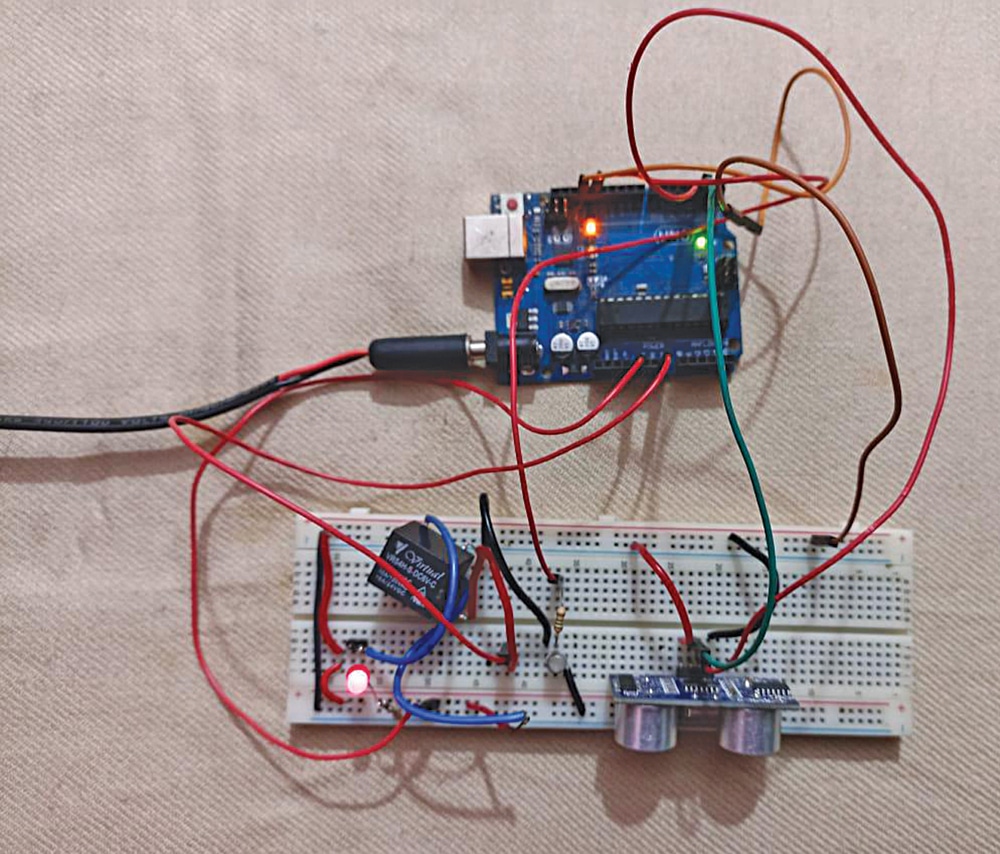
The Automatic Wash Basin Tap project operates by combining distance sensing logic with electromechanical fluid control, coordinated through an Arduino Uno microcontroller. At the core of the sensing mechanism is the HC-SR04 ultrasonic sensor, which is mounted near the wash basin. This sensor emits high-frequency sound waves and measures the time it takes for the echo to return after bouncing off an object, such as a user's hands. The Arduino Uno continuously processes these distance calculations. When a user places their hands within a pre-programmed threshold range, the Arduino detects that the measured distance is shorter than the baseline value. Upon recognizing this proximity event, the microcontroller changes the digital output state of its control pin. Because the Arduino's digital output cannot directly drive high-power loads, this signal typically interfaces with a switching transistor or relay circuit to safely control the 12V normally closed solenoid valve. A 12V power supply provides the necessary electrical energy to actuate the valve. When triggered, the solenoid coil energizes, creating a magnetic field that lifts the internal plunger and opens the valve, allowing water to flow freely through the tap. Once the user removes their hands, the ultrasonic sensor registers an open space or a distance exceeding the threshold. The Arduino immediately drops the control signal, causing the solenoid valve to de-energize and return to its normally closed mechanical state, halting the water flow. This automated loop ensures water is dispensed only when actively needed, integrating microcontroller programming with basic power electronics and sensor integration.
Why Build This
Design and prototype an automated, touchless water dispensing system suitable for public health infrastructure in hospitals, restaurants, and restrooms.
Apply undergraduate-level microcontroller programming to interface low-voltage digital sensors with higher-voltage electromechanical actuators like 12V solenoid valves.
Implement resource-conservation engineering principles to actively prevent water wastage in domestic or commercial wash basin environments.
Real-World Application
Public restrooms, hospitals, restaurants, and domestic wash basins to maintain hygiene and prevent water wastage.
Skills You'll Learn
Ultrasonic distance measurement
digital sensor interfacing
electromechanical load control
microcontroller GPIO programming
circuit prototyping on breadboards
Safety Precautions
Ensure proper insulation and waterproof housing when dealing with 12V water valves and electrical circuits near water sources.
Technology Tags
ARDUINO
ULTRASONIC SENSOR
SOLENOID VALVE
AUTOMATION
HYGIENE
DIY ELECTRONICS
Frequently Asked Questions
No. The Arduino Uno digital pins operate at 5V and cannot supply the current or voltage required by a 12V solenoid valve. You must use an external 12V power supply along with an intermediate switching component like a relay or transistor.
A normally closed solenoid valve remains shut by default, blocking water flow when no electrical power is applied to it. It only opens when the Arduino triggers the circuit upon detecting a user's hands.
The sensor calculates distance by measuring the time elapsed between sending out an ultrasonic sound pulse and receiving its reflection off the user's hands.
Gallery
This page is part of Kitkraft's Project Hub — a curated collection of electronics & robotics projects gathered from the maker community to help students and hobbyists discover and learn to build. Kitkraft does not claim authorship of the original project, and makes no representation as to the accuracy, completeness or safety of third-party source material. The summary and "How It Works" explanation above are AI-generated, rewritten with reference to the original tutorial — not a reproduction of it. Full credit and a direct link to the original source are provided above. If you're the original creator and have a concern about how your work is represented here, please contact us and we'll address it promptly.
 Ultrasonic Sensor Module HC-SR04
Rs. 89.00
 MB102 Adjustable Breadboard Power Supply Module (3.3V & 5V) for Arduino & Raspberry Pi
Rs. 139.00
 Jumper Wire 10 Pin Male To Male 20cm
Rs. 45.00
 400 Points Mini Solderless Prototype PCB Breadboard High Quality
Rs. 89.00
 Jumper Wire 10 Pin Male To Female 20cm
Rs. 45.00


