Project Hub/Basic Analog & Power Electronics/Power Supplies & Voltage Regulators/Bluetooth Controlled Data Logger Robot For Soil Testing
Intermediate
ARDUINO
₹1,500 – ₹5,000
3 – 6 Hours
Bluetooth Controlled Data Logger Robot For Soil Testing
A smartphone-controlled robotic rover equipped with multiple sensors to measure soil moisture, temperature, humidity, and ambient light intensity for agricultural and environmental monitoring.
Originally published by Ashutosh M. Bhatt on ElectronicsForU
View original tutorial
How It Works
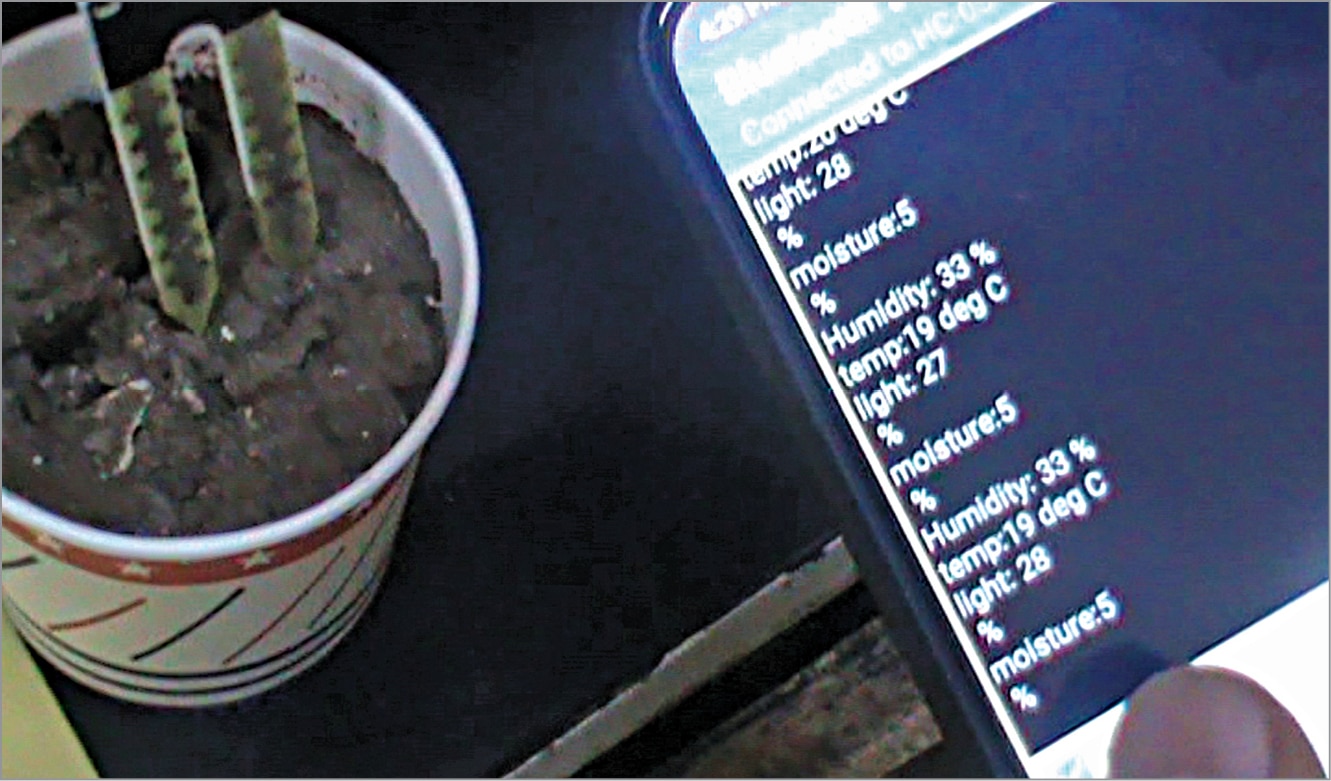
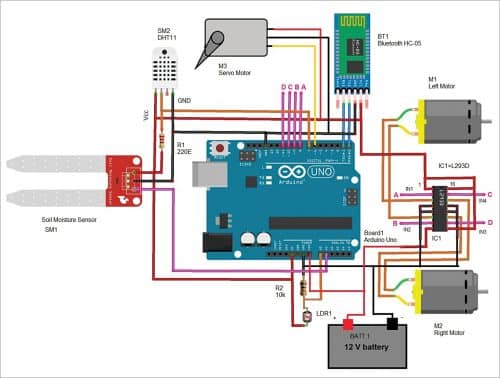
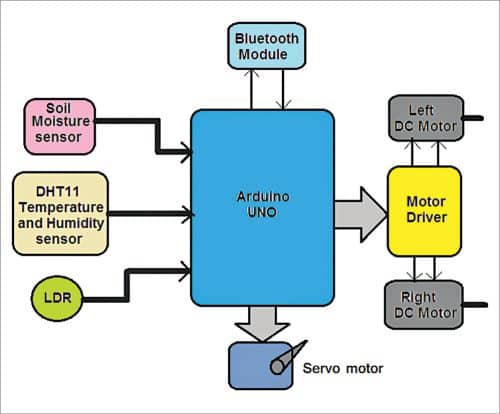
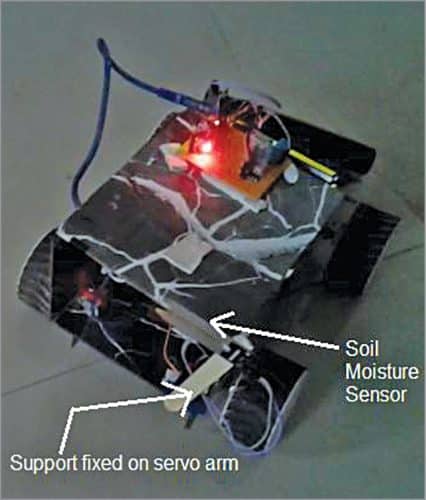
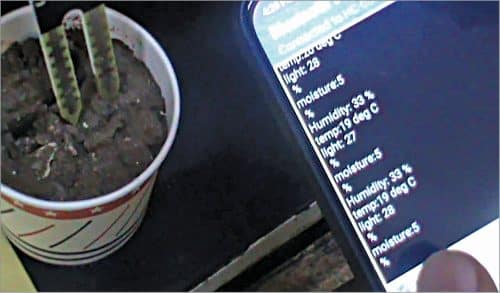
The Bluetooth Controlled Data Logger Robot For Soil Testing operates by integrating wireless communication, motor control, and environmental sensing on an Arduino Uno development board. The system is powered by an onboard power supply or battery, providing regulated voltage to the microcontroller, sensors, and actuators. For mobility, the Arduino interfaces with an L293D motor driver chip, which manages the current and directional logic required by the two DC gear motors for navigation, alongside a DC servo motor for positioning specific components. Wireless commands are sent from an Android smartphone via an HC-05 Bluetooth module, which transmits serial data to the Arduino Uno. Upon receiving movement instructions, the microcontroller adjusts the motor driver outputs to steer the rover. Simultaneously, data collection is performed by an array of onboard sensors: a soil moisture sensor evaluates the conductive properties of the earth, a DHT11 sensor measures ambient temperature and humidity, and an LDR (Light Dependent Resistor) captures light intensity levels. Connecting wires route all signals and power distribution between the microcontroller pins, sensor modules, and actuators, allowing the rover to simultaneously navigate terrain and gather multi-parameter environmental data for analysis.
Why Build This
Design an autonomous or remotely operated agricultural rover capable of multi-parameter environmental data acquisition.
Implement wireless serial communication by interfacing an HC-05 Bluetooth module with an Android smartphone application.
Gain practical undergraduate-level experience integrating motor drivers, sensors, and microcontrollers into a cohesive embedded system.
Real-World Application
Greenhouses, smart farming, agricultural soil testing, environmental monitoring, and automated field data collection.
Skills You'll Learn
Serial communication protocol implementation
Motor driver integration and control
Analog and digital sensor interfacing
Wireless data acquisition
Power distribution management in mobile robotics
Safety Precautions
No specific precautions noted for this build — always follow general electronics safety practices.
Technology Tags
ARDUINO
BLUETOOTH
HC-05
SENSORS
SOIL MOISTURE
DHT11
ROBOTICS
L293D
Ready to build this?
We stock the boards, sensors and modules this project needs. A full parts list is coming soon — for now, browse our DIY Kits & components or search for Arduino parts.
Frequently Asked Questions
How does the Android smartphone communicate with the robot?
Communication relies on the HC-05 Bluetooth module, which pairs with an Android Bluetooth control app on your phone and sends serial commands to the Arduino Uno.
What is the purpose of the L293D motor driver chip?
The Arduino Uno cannot supply enough current directly to drive the DC gear motors, so the L293D safely handles the higher current and directional control required by the motors.
Can this robot log data automatically while moving?
Yes, the onboard sensors (soil moisture, DHT11, and LDR) can continuously read environmental parameters while the rover navigates via smartphone commands.
Gallery

Kitkraft Project Hub — curated from the maker community, credited at the source.
PRJ-00587