Project Hub/IoT & Connected Devices/Smart Home & Building Automation/DIY Electromagnetic Levitation Device

Intermediate
ANALOG / DISCRETE
< ₹500
3 – 6 Hours
DIY Electromagnetic Levitation Device
Build a DIY electromagnetic levitation device that suspends an object in mid-air using a custom electromagnet, Hall effect sensor, and MOSFET switching circuit.
Originally published by Nilanjan Roy on CircuitDigest
View original tutorial
How It Works
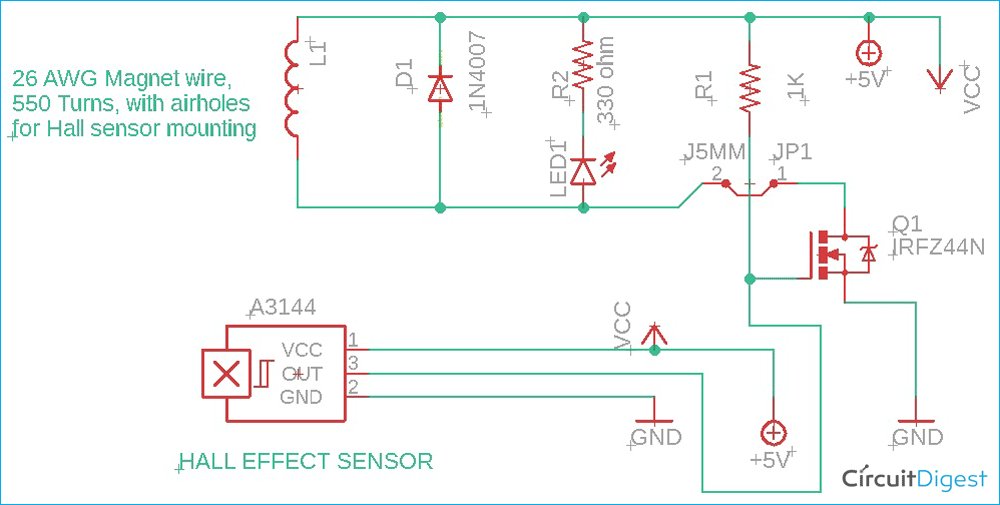
This DIY electromagnetic levitation device operates on a continuous feedback loop to suspend a neodymium magnet in mid-air. At the core of the system is a custom electromagnet made by wrapping 26 or 27 gauge magnet wire around a structural core of cardboard or PVC piping. The electromagnet is powered through an analog circuit built on a dotted Vero board. As the neodymium magnet floats closer to or further from the electromagnet, its magnetic field changes. This change is detected by a Hall Effect Sensor A3144, which acts as a magnetic field detector. Because the sensor's output varies depending on the proximity of the floating magnet, it drives the gate of an IRFZ44N MOSFET transistor through a 1k resistor. The MOSFET acts as an electronic switch, rapidly modulating the current flowing through the magnet wire coil to dynamically adjust the strength of the electromagnet. A 330-ohm resistor limits current to the 5mm indicating LED, which shows when the power is active, while a 1N4007 flyback diode is placed across the electromagnet coil to protect the MOSFET from voltage spikes and back-EMF generated when the magnetic field collapses. Together, these analog components constantly measure the position of the floating object and adjust the magnetic pull in real time to keep it suspended.
Why Build This
Explore real-world physics concepts like electromagnetism and closed-loop feedback systems firsthand.
Gain practical experience soldering and assembling analog electronic circuits on a Vero board without relying on a microcontroller.
Create a striking physics demonstration project suitable for a high school science fair or classroom display.
Real-World Application
Magnetic levitation principles are used in high-speed Maglev trains, contactless bearings, and industrial float sensors.
Skills You'll Learn
Analog circuit design
magnetic field sensing
power MOSFET switching
inductive load protection
manual coil winding
breadboard and Vero board assembly
Safety Precautions
Ensure proper voltage regulation if using higher power supplies to protect the Hall effect sensor, and monitor component temperatures to prevent overheating.
Technology Tags
ELECTROMAGNETISM
HALL EFFECT SENSOR
MOSFET
ANALOG CIRCUITS
COIL WINDING
PHYSICS DEMONSTRATION
Ready to build this?
We stock the boards, sensors and modules this project needs. A full parts list is coming soon — for now, browse our DIY Kits & components or search for Analog / Discrete parts.
Frequently Asked Questions
Do I need to write any code or program a microcontroller for this project?
No, this is a completely analog circuit built on a dotted Vero board. It relies on hardware feedback between the Hall effect sensor and the MOSFET rather than software.
How do I make the custom electromagnet?
You wind the provided 26 or 27 gauge magnet wire tightly around a piece of cardboard or PVC piping to create the coil, leaving leads to connect into your analog circuit.
What is the purpose of the 1N4007 diode in the circuit?
The diode acts as a flyback or freewheeling diode, protecting the IRFZ44N MOSFET transistor from damaging voltage spikes produced by the electromagnet coil when the current changes.
Gallery


Kitkraft Project Hub — curated from the maker community, credited at the source.
PRJ-00246