Project Hub/IoT & Connected Devices/Smart Energy / Water Metering/ESP32 Development Board Talking Clock
Intermediate
ESP32
₹500 – ₹1,500
3 – 6 Hours
ESP32 Development Board Talking Clock
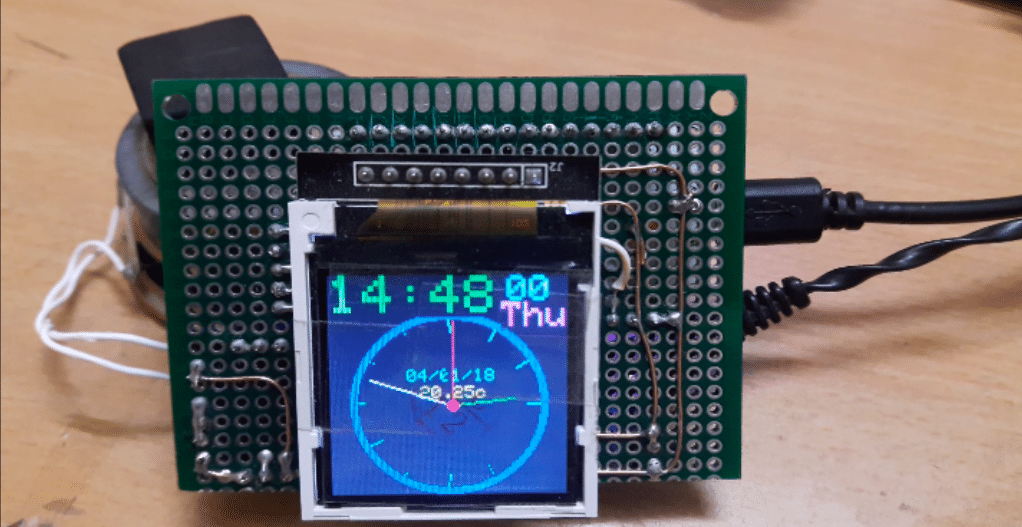
A custom talking clock built around an ESP32 microcontroller, featuring an MP3 shield for audio output and a precise DS3231 RTC module.
Originally published by Somnath Bera on ElectronicsForU
View original tutorial
How It Works
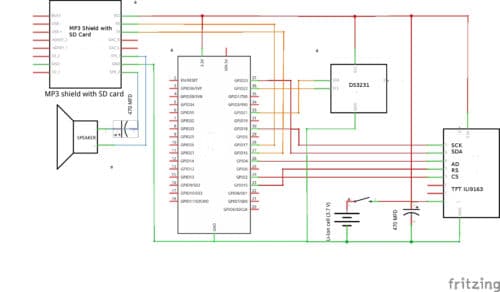
The ESP32 Development Board Talking Clock operates as an integrated IoT and audio system governed by the ESP32 microcontroller. Timekeeping is managed by the DS3231 Real-Time Clock (RTC) module, which communicates accurate date and time data to the ESP32 over a standard serial communication bus, ensuring reliable time tracking even when disconnected from external networks. When an alarm is triggered or a time-announcement event occurs, the ESP32 orchestrates audio playback by commanding the MP3 Shield. The MP3 shield reads pre-rendered audio files stored on its micro SD card, decoding the digital audio data and driving an external speaker to produce audible speech. If the optional ILI9163 TFT display is integrated into the circuit, the ESP32 simultaneously updates the screen to provide a visual readout of the current time alongside the audio output. Software tools like Python, pyttsx, and gTTS are used externally to generate and process the spoken voice files in Audacity before they are loaded onto the micro SD card, allowing the microcontroller to simply trigger the appropriate pre-recorded audio tracks dynamically during operation.
Why Build This
Design and prototype accessible assistive technology devices tailored for the visually impaired using embedded microcontrollers.
Integrate multiple hardware peripherals—such as precision RTC modules, MP3 audio shields, and TFT displays—into a cohesive embedded system.
Gain practical experience in bridging off-line audio generation scripts (Python, gTTS) with real-time microcontroller hardware.
Real-World Application
Customizable talking alarms, accessibility aids for the visually impaired, and smart home notification clocks.
Skills You'll Learn
I2C communication
SPI communication
audio file management on micro SD cards
peripheral integration
embedded software architecture
display interfacing
Safety Precautions
No specific precautions noted for this build — always follow general electronics safety practices.
Technology Tags
ESP32
PYTHON
TEXT-TO-SPEECH
MP3 SHIELD
DS3231 RTC
AUDIO PROCESSING
MICROCONTROLLERS
Ready to build this?
We stock the boards, sensors and modules this project needs. A full parts list is coming soon — for now, browse our DIY Kits & components or search for ESP32 parts.
Frequently Asked Questions
Why is an external MP3 shield used instead of the ESP32's internal DAC for audio?
While the ESP32 has basic audio capabilities, an MP3 shield with a micro SD card handles file decoding and audio amplification more reliably, ensuring clear speech output through the speaker.
Do I need to write Python code to run directly on the ESP32?
No, Python along with libraries like gTTS and pyttsx are typically used on your computer beforehand to generate and convert the voice audio files, while the ESP32 runs C/C++ firmware to control the hardware logic.
Is the TFT display strictly required for the clock to function?
No, the ILI9163 TFT display is listed as optional; the core talking clock functionality relies primarily on the ESP32, DS3231 RTC, and the MP3 shield.
Gallery
Kitkraft Project Hub — curated from the maker community, credited at the source.
PRJ-00267