This project is sourced from another site, not written by us — this list is our best match of their components against what we stock, not a verified bill of materials. Always check the original blog (linked above) for the actual parts list before buying.
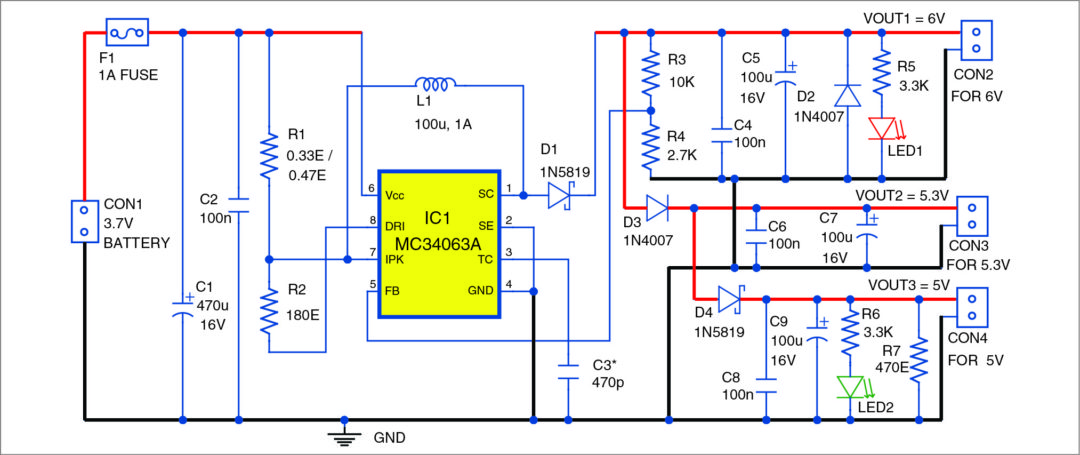
This DC-to-DC step-up converter circuit transforms a lower input voltage of 3.6V to 3.7V from a single-cell Li-ion battery into higher regulated output levels of 5V, 5.3V, and 6V. At the heart of the circuit is the MC34063A IC (IC1), a versatile monolithic control circuit specifically designed to contain the primary building blocks needed for DC-to-DC converters, including an internal temperature-compensated reference, a comparator, a duty cycle controlled oscillator, and a high-current output switch. When power is applied via the input connector (CON1 or CON2), the internal oscillator within IC1 triggers the switching cycle, repeatedly storing and releasing energy through inductor L1. As the internal switch cycles, the inductor generates high-voltage flyback pulses, which are then rectified and smoothed by a network of diodes and capacitors. Specifically, 1N5819 Schottky diodes (D1, D4) are utilized for their fast switching speeds and low forward voltage drop to efficiently route the high-frequency pulses, while 1N4007 diodes (D2, D3) and capacitors like C3 help stabilize the intermediate rails and final outputs at CON3 and CON4. The circuit also incorporates 5mm LEDs (LED1, LED2) to visually indicate power status and active output rails. By managing the switching duty cycle, the MC34063A continuously monitors and maintains the desired stepped-up voltage levels across varying load conditions, providing a steady power source from a fading battery.
Why Build This
Design and analyze a switch-mode power supply topology suitable for powering portable audio equipment, MP3 players, and DIY digital or analog circuits using standard single-cell Li-ion batteries.
Gain practical undergraduate-level experience in calculating component values for step-up (boost) converter configurations using industry-standard control ICs.
Evaluate the efficiency and transient response of inductive boost conversion compared to linear regulation when stepping up low-voltage sources.
Real-World Application
Powering portable audio equipment, MP3 players, and DIY digital or analog circuits using standard single-cell Li-ion batteries.
Skills You'll Learn
Switch-mode power supply design
inductive boost conversion principles
diode selection and rectification
schematic layout on printed circuit boards
power regulation and filtering
Safety Precautions
Exercise caution when working with rechargeable Li-ion batteries to prevent short circuits.
Technology Tags
DC-DC CONVERTER
MC34063A
STEP-UP CONVERTER
POWER SUPPLY
BATTERY MANAGEMENT
ANALOG ELECTRONICS
Frequently Asked Questions
The MC34063A acts as the primary controller and switch, managing the internal oscillator and duty cycle required to boost the lower battery voltage up to the desired 5V, 5.3V, or 6V output levels.
Schottky diodes offer fast switching speeds and low forward voltage drops, making them ideal for high-frequency rectification in the boost converter path, while the other diodes serve general rectification and indicator roles within the multi-voltage output structure.
Yes, the circuit is designed to step up standard single-cell Li-ion battery voltage to stable 5V, 5.3V, and 6V outputs suitable for portable audio equipment, MP3 players, and various DIY digital or analog circuits.
Gallery
This page is part of Kitkraft's Project Hub — a curated collection of electronics & robotics projects gathered from the maker community to help students and hobbyists discover and learn to build. Kitkraft does not claim authorship of the original project, and makes no representation as to the accuracy, completeness or safety of third-party source material. The summary and "How It Works" explanation above are AI-generated, rewritten with reference to the original tutorial — not a reproduction of it. Full credit and a direct link to the original source are provided above. If you're the original creator and have a concern about how your work is represented here, please contact us and we'll address it promptly.
 10pcs 5mm RED Diffused Light Emitting Diodes - LEDs Set
Rs. 39.00
 400 Points Mini Solderless Prototype PCB Breadboard High Quality
Rs. 89.00
 MB102 Adjustable Breadboard Power Supply Module (3.3V & 5V) for Arduino & Raspberry Pi
Rs. 139.00
 Jumper Wire 10 Pin Male To Male 20cm
Rs. 45.00
 Jumper Wire 10 Pin Male To Female 20cm
Rs. 45.00


