An AI-powered automated door control system using Maixduino and facial detection to open doors only when a person approaches and faces the entrance, preventing accidental triggers from passersby.
This project is sourced from another site, not written by us — this list is our best match of their components against what we stock, not a verified bill of materials. Always check the original blog (linked above) for the actual parts list before buying.
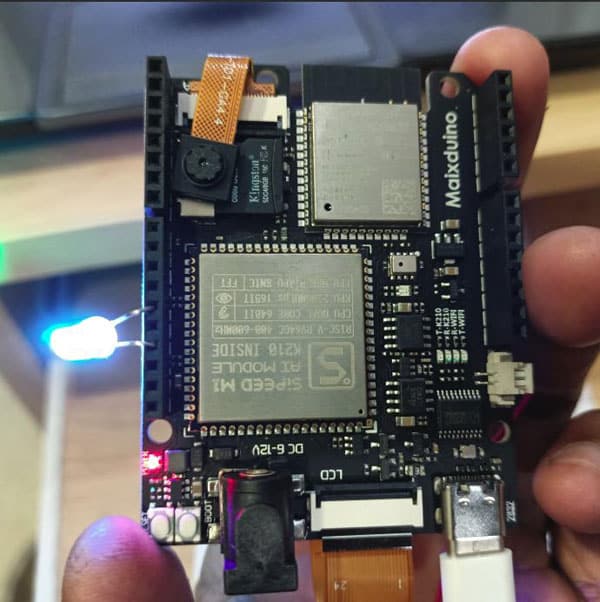
The Maixduino Powered Doorman is an edge-AI vision system designed to intelligently control automated doors using on-board machine learning. At the core of the setup is the Maixduino microcontroller, equipped with an integrated camera module and an LCD screen. The system runs a YOLOv2 facial detection model (flashed using Kflash_gui and programmed via MaixPyIDE) to analyze real-time video feeds directly on the device without relying on cloud computing. When a person approaches the entrance and looks toward the camera, the Maixduino processes the visual data and detects a valid face. Upon successful detection, the microcontroller outputs a control signal from its digital pins. Because the microcontroller's GPIO pins cannot directly drive high-current inductive loads, this weak control signal is fed into two BC545 transistors configured as electronic switches. These transistors amplify the signal to drive two 5V relays. The relays act as electrically isolated switches that can interface with external door-opening mechanisms. A dedicated 5V, 3A power supply provides stable, continuous power to both the Maixduino board and the relay switching circuit, ensuring reliable operation during active processing and relay actuation. By requiring a deliberate facial orientation rather than simple motion detection, the system prevents false triggers from casual hallway traffic.
Why Build This
Design and deploy a localized edge-AI computer vision system using a specialized microcontroller without relying on external cloud servers.
Implement real-time object detection models like YOLOv2 on resource-constrained embedded hardware for practical automation tasks.
Interface low-voltage microcontroller logic with electromechanical relays and switching transistors to safely control external hardware mechanisms.
Real-World Application
Automated cleanrooms, industrial control rooms, and secure office entrances where preventing false-trigger door openings from hallway traffic is critical for climate control and noise reduction.
Skills You'll Learn
Edge AI deployment
real-time object detection
firmware flashing with Kflash_gui
Python scripting in MaixPyIDE
transistor switching circuits
relay interfacing
embedded computer vision
Safety Precautions
Ensure proper electrical isolation when connecting 5V relays to high-voltage gate opening mechanisms.
Technology Tags
AI
MACHINE LEARNING
COMPUTER VISION
YOLOV2
MICROPYTHON
RELAYS
PROXIMITY DETECTION
FACE RECOGNITION
Frequently Asked Questions
The Maixduino microcontroller pins output low current, which is insufficient to directly drive the electromagnetic coil of a 5V relay. The BC545 transistor acts as a current amplifier and electronic switch, allowing the microcontroller's small digital signal to safely control the higher-current relay.
No, all processing happens locally on the Maixduino MCU. The YOLOv2 face detection model runs entirely on the edge using the board's on-board hardware accelerators and MaixPy environment.
Running an edge AI camera board alongside an LCD screen and dual relays demands stable, continuous current. A 3-amp power supply ensures that voltage sags do not occur when the relays trigger or when the camera actively processes video frames.
Gallery
This page is part of Kitkraft's Project Hub — a curated collection of electronics & robotics projects gathered from the maker community to help students and hobbyists discover and learn to build. Kitkraft does not claim authorship of the original project, and makes no representation as to the accuracy, completeness or safety of third-party source material. The summary and "How It Works" explanation above are AI-generated, rewritten with reference to the original tutorial — not a reproduction of it. Full credit and a direct link to the original source are provided above. If you're the original creator and have a concern about how your work is represented here, please contact us and we'll address it promptly.
 ESP32 CAM WiFi Module Bluetooth with OV2640 Camera
Rs. 1,483.00
 5V 1 Channel Relay Module
Rs. 87.00
 MB102 Adjustable Breadboard Power Supply Module (3.3V & 5V) for Arduino & Raspberry Pi
Rs. 139.00
 400 Points Mini Solderless Prototype PCB Breadboard High Quality
Rs. 89.00
 Jumper Wire 10 Pin Male To Male 20cm
Rs. 45.00
 Jumper Wire 10 Pin Male To Female 20cm
Rs. 45.00


