Super Capacitors for Atmanirbhar and Swachh Bharat (Wall Clock Power Supply)
Explore the use of supercapacitors as an eco-friendly and long-lasting alternative to lithium-ion batteries for low-power energy storage applications like wall clock power supplies.
This project is sourced from another site, not written by us — this list is our best match of their components against what we stock, not a verified bill of materials. Always check the original blog (linked above) for the actual parts list before buying.
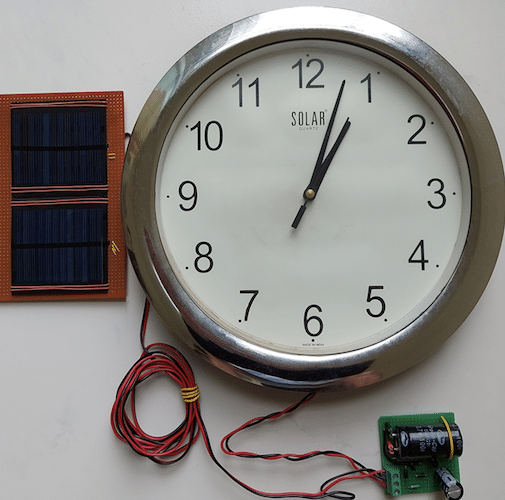
This project implements a sustainable, battery-free power supply for a standard household wall clock using solar photovoltaic (PV) panels and high-capacity supercapacitors. During daylight hours, the solar PV panels absorb light energy and convert it into electrical current. This electrical energy is directed into the supercapacitors, which act as electrostatic energy storage devices capable of holding a large electrical charge (such as 100F or 500F ratings). Unlike traditional chemical batteries that rely on slow, degradation-prone redox reactions, supercapacitors store energy physically through electrostatic charge separation, allowing them to charge rapidly and undergo countless cycles without significant capacity loss. A dummy cell is used in the clock's battery compartment to physically adapt the circuit, allowing the stored energy from the supercapacitors to interface seamlessly with the clock's power terminals. As the supercapacitors store energy during the day, they continuously discharge a steady, low-current supply to keep the wall clock running reliably, even through periods of darkness or low ambient light.
Why Build This
Design an autonomous, eco-friendly household power supply that eliminates reliance on disposable chemical batteries and imported energy storage components.
Apply advanced analog energy harvesting principles to power low-consumption loads continuously using renewable solar resources.
Gain practical engineering experience in sizing and integrating high-capacity electrostatic storage devices with low-power electromechanical loads.
Real-World Application
Powering low-consumption household devices like wall clocks using solar energy and supercapacitors, reducing dependence on imports and short-lived chemical batteries.
Skills You'll Learn
Solar energy harvesting
Supercapacitor charge management
Energy storage sizing
Low-power circuit integration
Renewable power supply design
Safety Precautions
Flagged during content review — not in the original source
Ensure correct polarity when connecting the solar panels and supercapacitors to prevent short circuits, and avoid puncturing or over-voltage charging the supercapacitors.
Technology Tags
SUPERCAPACITORS
SOLAR PHOTOVOLTAIC
POWER SUPPLY
ENERGY STORAGE
WALL CLOCK
ECO-FRIENDLY ELECTRONICS
Frequently Asked Questions
Supercapacitors offer exceptionally long operational lifespans and rapid charge-discharge cycles without the chemical degradation typical of traditional batteries, making them ideal for maintenance-free low-power devices like wall clocks.
The dummy cell acts as a physical adapter placed inside the wall clock's battery compartment to safely route the power coming from the external supercapacitor circuit to the clock's terminals.
Yes, a properly sized supercapacitor (such as a 100F or 500F variant) stores enough electrical energy during the day to power the minimal electrical draw of a standard wall clock through extended periods of darkness.
Gallery
This page is part of Kitkraft's Project Hub — a curated collection of electronics & robotics projects gathered from the maker community to help students and hobbyists discover and learn to build. Kitkraft does not claim authorship of the original project, and makes no representation as to the accuracy, completeness or safety of third-party source material. The summary and "How It Works" explanation above are AI-generated, rewritten with reference to the original tutorial — not a reproduction of it. Full credit and a direct link to the original source are provided above. If you're the original creator and have a concern about how your work is represented here, please contact us and we'll address it promptly.
 Jumper Wire 10 Pin Male To Male 20cm
Rs. 45.00
 400 Points Mini Solderless Prototype PCB Breadboard High Quality
Rs. 89.00
 MB102 Adjustable Breadboard Power Supply Module (3.3V & 5V) for Arduino & Raspberry Pi
Rs. 139.00
 Jumper Wire 10 Pin Male To Female 20cm
Rs. 45.00


