This project is sourced from another site, not written by us — this list is our best match of their components against what we stock, not a verified bill of materials. Always check the original blog (linked above) for the actual parts list before buying.
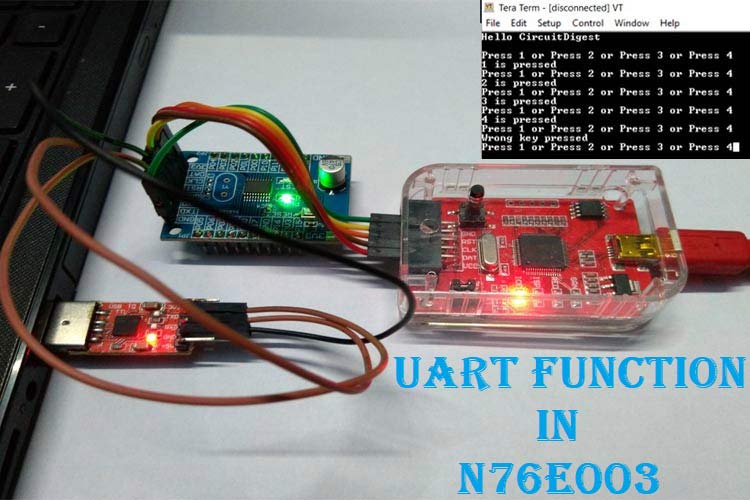
The UART Communication project with the Nuvoton N76E003 microcontroller establishes serial data transmission between the development board and a host computer or external peripherals. At the heart of the setup is the N76E003 microcontroller, which utilizes its internal Universal Asynchronous Receiver-Transmitter (UART) peripheral to convert parallel data bytes into serial bitstreams, and vice versa. Because accurate timing is critical for asynchronous communication, Timer 3 within the microcontroller is configured specifically to act as the internal baud rate generator, establishing the correct data transmission speed (such as 9600 or 115200 baud). To interface the 3.3V or 5V logic levels of the development board with a computer, a USB to UART converter module—such as a CP2102—is connected to the microcontroller's designated TX (transmit) and RX (receive) pins. The USB-to-UART converter bridges the physical USB port of the PC to the serial pins of the N76E003, translating UART logic transitions into USB data packets that a software terminal like Tera Term can render as readable text. Programming and flashing the firmware onto the N76E003 are handled through the Nu-Link programmer, which connects via dedicated programming pins to transfer the compiled Keil C51 hex file into the microcontroller's flash memory. Once powered and programmed, the system allows bidirectional data flow, enabling the N76E003 to send debug logs, sensor readings, or status updates directly to a terminal monitor on the host workstation.
Why Build This
Master low-level serial communication protocols essential for undergraduate engineering telemetry and debugging tasks.
Learn to configure hardware timer peripherals like Timer 3 to generate precise communication baud rates.
Develop practical skills in interfacing microcontrollers with external hardware modules such as USB-to-UART bridges, GPS units, and Bluetooth transceivers.
Real-World Application
Serial debugging, PC-to-microcontroller communication, and interfacing with GPS modules, Bluetooth modules, or sensors.
Skills You'll Learn
UART serial communication
baud rate generation
microcontroller timer configuration
hardware debugging via serial terminal
firmware flashing
Safety Precautions
No specific precautions noted for this build — always follow general electronics safety practices.
Technology Tags
UART
SERIAL COMMUNICATION
EMBEDDED SYSTEMS
C PROGRAMMING
KEIL C51
MICROCONTROLLER
Frequently Asked Questions
The N76E003 development board often requires an external module like a CP2102 to translate TTL serial signals from the microcontroller pins into a USB protocol that modern computers can recognize as a virtual COM port.
This specific project implementation relies on the Keil C51 development environment and the official N76E003 BSP library to properly configure registers and initialize the UART and Timer 3 peripherals.
Timer 3 is configured to act as the dedicated baud rate generator for the UART module, ensuring that data transmission and reception happen at a synchronized, precise speed.
Gallery
This page is part of Kitkraft's Project Hub — a curated collection of electronics & robotics projects gathered from the maker community to help students and hobbyists discover and learn to build. Kitkraft does not claim authorship of the original project, and makes no representation as to the accuracy, completeness or safety of third-party source material. The summary and "How It Works" explanation above are AI-generated, rewritten with reference to the original tutorial — not a reproduction of it. Full credit and a direct link to the original source are provided above. If you're the original creator and have a concern about how your work is represented here, please contact us and we'll address it promptly.
 USB to UART/ESP8266 Adapter Programmer for ESP-01 WiFi Modules with CH340G Chip
Rs. 99.00
 Jumper Wire 10 Pin Male To Male 20cm
Rs. 45.00
 MB102 Adjustable Breadboard Power Supply Module (3.3V & 5V) for Arduino & Raspberry Pi
Rs. 139.00
 400 Points Mini Solderless Prototype PCB Breadboard High Quality
Rs. 89.00
 Jumper Wire 10 Pin Male To Female 20cm
Rs. 45.00


