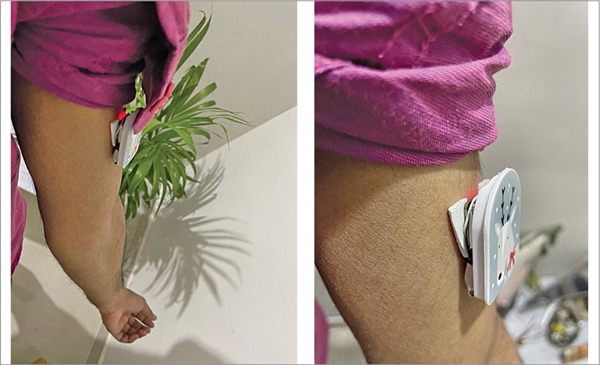
Design and build a small, portable, IoT-enabled health monitor that attaches to the body to capture real-time health data like heartbeat and body temperature over Wi-Fi.
This project is sourced from another site, not written by us — this list is our best match of their components against what we stock, not a verified bill of materials. Always check the original blog (linked above) for the actual parts list before buying.
The A Small Portable IoT Health Sticker functions as a wearable biomedical monitoring device centered around the ESP12F microcontroller module, which features built-in Wi-Fi capabilities. Physiological data is captured via the MAX30100 sensor module, an integrated optical sensor that uses infrared and red LEDs to measure photoplethysmography (PPG) signals for heart rate and blood oxygen saturation. This sensor communicates with the ESP12F processing core, translating raw optical readings into meaningful health metrics. To make the device completely portable and self-contained, power is supplied by a rechargeable Lithium Polymer (LiPo) battery. The MCP73812T battery charger IC manages the safe recharging of the LiPo cell, regulating current and voltage when connected to a power source through the circuit's passive components—such as resistors and capacitors—which ensure stable power delivery and signal conditioning across the custom printed circuit board (PCB). Once the ESP12F processes the health data acquired from the MAX30100, it can connect to a local wireless network, enabling real-time transmission of the patient's vital signs to cloud platforms or remote dashboards for continuous monitoring.
Why Build This
Gain hands-on experience in designing undergraduate-level wearable biomedical telemetry systems for remote patient monitoring.
Learn how to integrate optical vital sign sensors with Wi-Fi microcontrollers to transmit real-time health data securely.
Understand the practical implementation of safe LiPo battery power management and charging circuitry for portable medical devices.
Real-World Application
Remote patient monitoring, personal fitness and continuous health tracking, elderly care, and preliminary outpatient diagnostics.
Skills You'll Learn
I2C communication protocol
Wi-Fi data telemetry
optical sensor interfacing
wearable PCB design
battery management integration
signal conditioning with passive components
Safety Precautions
Ensure proper insulation and safe battery charging circuits when designing wearable devices that make direct contact with the skin.
Technology Tags
IOT
WI-FI
HEALTH MONITORING
WEARABLE ELECTRONICS
MAX30100
ESP8266/ESP12F
Frequently Asked Questions
You can use the Arduino IDE or any equivalent SDK that is compatible with the ESP8266 architecture.
The ESP12F module features integrated Wi-Fi, allowing it to connect to wireless networks and transmit readings from the MAX30100 sensor to cloud platforms.
The circuit utilizes an MCP73812T battery charger IC, which manages charging parameters to safely replenish the LiPo battery.
Gallery
This page is part of Kitkraft's Project Hub — a curated collection of electronics & robotics projects gathered from the maker community to help students and hobbyists discover and learn to build. Kitkraft does not claim authorship of the original project, and makes no representation as to the accuracy, completeness or safety of third-party source material. The summary and "How It Works" explanation above are AI-generated, rewritten with reference to the original tutorial — not a reproduction of it. Full credit and a direct link to the original source are provided above. If you're the original creator and have a concern about how your work is represented here, please contact us and we'll address it promptly.
 MB102 Adjustable Breadboard Power Supply Module (3.3V & 5V) for Arduino & Raspberry Pi
Rs. 139.00
 400 Points Mini Solderless Prototype PCB Breadboard High Quality
Rs. 89.00
 Jumper Wire 10 Pin Male To Male 20cm
Rs. 45.00
 Jumper Wire 10 Pin Male To Female 20cm
Rs. 45.00


