Digital Modulation Techniques Simulation Using MATLAB
Learn how to simulate digital modulation techniques like BPSK, QPSK, and QAM using MATLAB to analyze carrier frequency parameters and real-world signal characteristics.
We stock the boards, sensors and modules this project needs. A full parts list is coming soon — for now, browse our DIY Kits & components or search for Analog / Discrete parts.
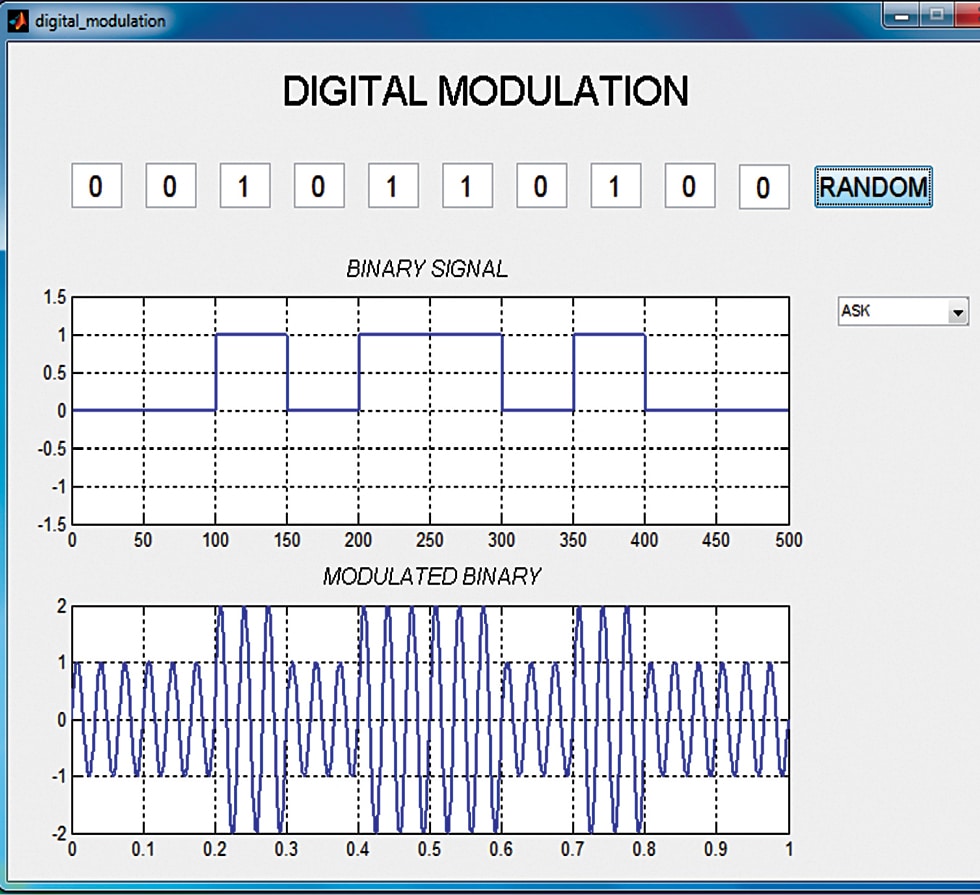
The Digital Modulation Techniques Simulation project operates entirely within a software environment on a PC or laptop equipped with MATLAB. The system functions by taking digital binary data streams and mapping them onto an analog carrier wave for transmission analysis. Using MATLAB scripts, the software generates baseband data bits and applies various digital modulation schemes, specifically Binary Phase Shift Keying (BPSK), Quadrature Phase Shift Keying (QPSK), and Quadrature Amplitude Modulation (QAM). For BPSK, the phase of the carrier wave shifts between two discrete values to represent binary zeros and ones. QPSK expands this by encoding two bits per symbol using four distinct carrier phases, while QAM modulates both the phase and the amplitude of the carrier wave to pack even more data into each symbol period. Once the modulated signals are generated, the MATLAB environment allows you to simulate channel effects such as additive white Gaussian noise (AWGN) to mimic real-world transmission impairments. Finally, the system demodulates the received signal and computes performance metrics like symbol error rate (SER) and bit error rate (BER), which are visualized using MATLAB's plotting tools to display constellation diagrams and signal waveforms.
Why Build This
Bridge theoretical communication engineering concepts with practical software implementation and signal analysis.
Visualize complex mathematical concepts like constellation diagrams, phase shifts, and noise degradation clearly.
Gain foundational programming and simulation experience applicable to modern wireless and RF engineering design.
Real-World Application
Used in telecommunications, satellite communication, video broadcasting, cellular phone systems, cable modems, and aircraft communication for transmitting digital data efficiently over RF carriers.
Skills You'll Learn
MATLAB programming
digital modulation
signal constellation analysis
bit error rate testing
noise simulation
waveform generation
Safety Precautions
No specific precautions noted for this build — always follow general electronics safety practices.
Technology Tags
MATLAB
DIGITAL MODULATION
BPSK
QPSK
8PSK
ASK
OOK
QAM
TELECOMMUNICATION
Frequently Asked Questions
No external hardware is required. The entire simulation runs virtually on your PC or laptop using MATLAB software.
While basic MATLAB handles the matrix math and plotting, having the Communications Toolbox can simplify generating modulations and calculating bit error rates, though core scripts can also be written from scratch.
Yes, once you understand the core mapping principles in the provided simulation scripts, you can adapt the code to experiment with higher-order modulation schemes like 16-QAM or 64-QAM.
Gallery
This page is part of Kitkraft's Project Hub — a curated collection of electronics & robotics projects gathered from the maker community to help students and hobbyists discover and learn to build. Kitkraft does not claim authorship of the original project, and makes no representation as to the accuracy, completeness or safety of third-party source material. The summary and "How It Works" explanation above are AI-generated, rewritten with reference to the original tutorial — not a reproduction of it. Full credit and a direct link to the original source are provided above. If you're the original creator and have a concern about how your work is represented here, please contact us and we'll address it promptly.