Project Hub/Basic Analog & Power Electronics/Power Supplies & Voltage Regulators/IoT based Smart Agriculture Monitoring System

Intermediate
ESP8266
₹1,500 – ₹5,000
3 – 6 Hours
IoT based Smart Agriculture Monitoring System
An IoT-based smart farming system using NodeMCU ESP8266 to monitor environmental parameters like temperature, humidity, soil moisture, and soil temperature while providing automated irrigation.
Originally published by Ashish Choudhary on CircuitDigest
View original tutorial
How It Works
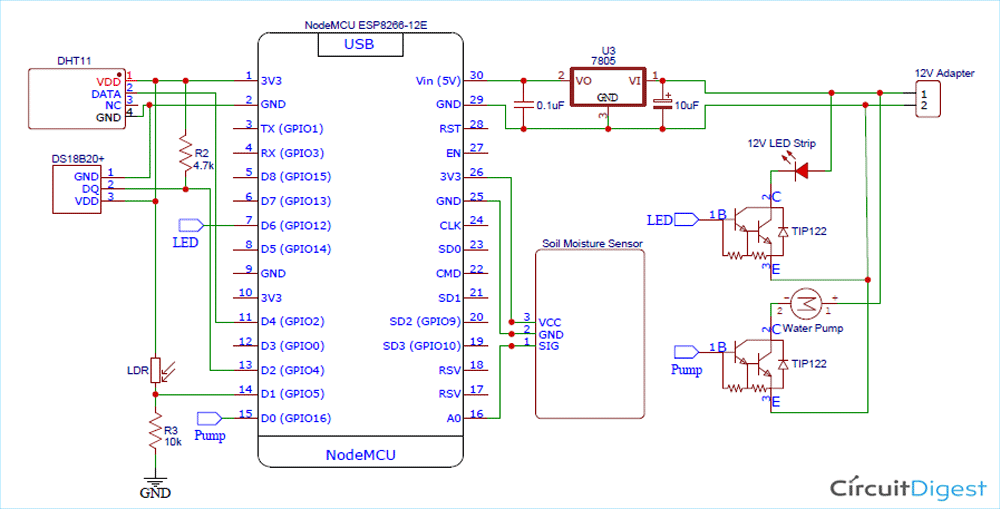
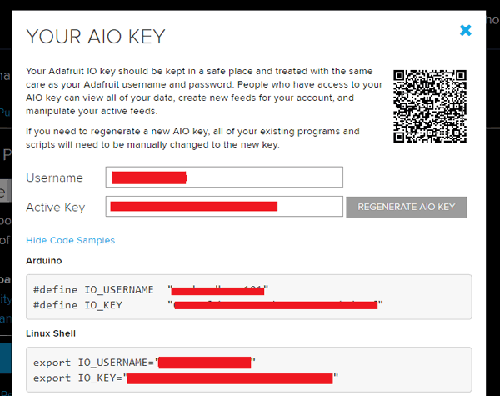
The IoT-based Smart Agriculture Monitoring System operates by integrating a NodeMCU ESP8266 microcontroller with multiple environmental sensors and output actuators to automate farm management. At the heart of the power distribution, a 7805 voltage regulator steps down higher voltages to provide a stable 5V rail, supported by 10uF and 0.1uF capacitors to filter out high-frequency noise and maintain supply stability. The system continuously gathers data using a DHT11 sensor for ambient temperature and humidity, a DS18B20 waterproof probe for precise soil temperature tracking, a soil moisture sensor to evaluate volumetric water content, and an LDR to monitor ambient light levels. These analog and digital signals are processed by the NodeMCU ESP8266, which connects to the cloud via Wi-Fi using the Arduino IDE, Adafruit IO, and the Adafruit MQTT Library, while also fetching external forecasts through the OpenWeatherMap API. Based on sensor feedback and remote commands, the microcontroller triggers higher-power peripherals like a submersible mini water pump and a 12V LED strip. Because these actuators require more current and voltage than the NodeMCU pins can safely source, two TIP122 transistors act as electronic switches, paired with 4.7K and 10K resistors to properly bias the base current and ensure reliable switching control.
Why Build This
Develop practical undergraduate-level engineering experience by integrating cloud telemetry dashboards (Adafruit IO) with physical microcontroller hardware.
Learn how to design mixed-voltage power supply circuits that safely bridge 5V logic components with 12V high-current actuators like water pumps.
Implement automated agricultural monitoring systems that optimize water usage and environmental control for precision farming applications.
Real-World Application
Precision farming, automated greenhouse management, remote crop monitoring, and water conservation in agricultural fields.
Skills You'll Learn
Microcontroller Wi-Fi integration
MQTT protocol communication
analog sensor interfacing
transistor-based load switching
linear voltage regulation
API data parsing
Safety Precautions
Ensure proper insulation and voltage regulation (using 7805 regulator) when working with 12V water pumps and LED strips to prevent damage to low-voltage microcontroller pins.
Technology Tags
NODEMCU
ESP8266
IOT
MQTT
ADAFRUIT IO
OPENWEATHERMAP API
DHT11
DS18B20
SOIL MOISTURE SENSOR
LDR
WATER PUMP
AUTOMATION
Ready to build this?
We stock the boards, sensors and modules this project needs. A full parts list is coming soon — for now, browse our DIY Kits & components or search for ESP8266 parts.
Frequently Asked Questions
Why do I need a 7805 voltage regulator in this circuit?
The 7805 regulator steps down the incoming power supply to a stable 5V, protecting sensitive low-voltage components like the NodeMCU ESP8266 and sensors from voltage spikes.
Can the NodeMCU directly power the 12V water pump and LED strip?
No, NodeMCU digital pins operate at 3.3V and can only supply minimal current. The system uses TIP122 transistors to safely switch the 12V power supply to the pump and LEDs.
How does the system send data to the internet?
The NodeMCU ESP8266 features onboard Wi-Fi, allowing it to connect to your local wireless network and transmit sensor readings to Adafruit IO using the MQTT protocol.
Gallery


Kitkraft Project Hub — curated from the maker community, credited at the source.
PRJ-00435